In the first half of 2024, 127 New Yorkers were killed in traffic. That was the highest six-month total since the Vision Zero program launched in 2014. By the end of September, the count had reached 194.
That spike followed a record set the year before: in 2023, drivers running red lights killed 29 New Yorkers, the highest annual count of red-light fatalities in the city’s recorded history. Every one of those crashes happened at an intersection without a red-light camera.
The 2025 total came down. Through September 2025, traffic deaths had fallen 18 percent compared to the same period the year before. But the structural gap that produced the 2023 record and the 2024 spike has not closed. NYPD moving-violation enforcement is a fraction of what it was before the pandemic.
The red-light camera program covered about one percent of the city’s signalized intersections, and a state-authorized expansion to 600 is only now underway. And the fine for a camera-issued red-light ticket has not changed since the program began.
We mapped red-light running across the city, the gaps in enforcement, and the civil liability that follows when a driver kills or injures someone.
The 2023 Record and the 2024 Spike
Transportation Alternatives, working from NYC DOT and NYPD data, flagged 2024 as the worst Vision Zero year for several categories at once. The headline number: 127 deaths in the first half of 2024, the highest six-month total of the program’s first decade. The full first three quarters reached 194 deaths.
The single most striking factor showed up the year before.
NYC DOT and NYPD records, as compiled by Transportation Alternatives and reported by Patch.com, showed that drivers running red lights killed 29 New Yorkers in 2023, the highest annual count since the program began and more than double the prior decade’s average.
Every one of those 29 deaths happened at an intersection without a red-light camera.
Red-light running incidents jumped 56 percent between 2020 and 2023. The metric tracks fatalities in crashes where running a red light was a contributing factor identified in the police accident report.
Two patterns drove the increase. First, intersection speeds rose during and after the pandemic and never fully returned to pre-2020 levels. Second, the volume of moving-violation enforcement collapsed and stayed collapsed.
The Enforcement Gap
NYPD issued about 283,000 moving violations citywide through May 2024. The same five-month window in 2023 produced about 302,000 violations. The same window in 2019, before the pandemic, produced about 461,000 violations. The 2024 number is roughly 38 percent below the pre-pandemic baseline.
Moving-violation enforcement is the only mechanism that produces points on a driver’s license, reports to insurance carriers, and the broader behavioral signal that running a red light has consequences beyond a $50 mailer. The collapse of that enforcement removes the strongest deterrent in the system.
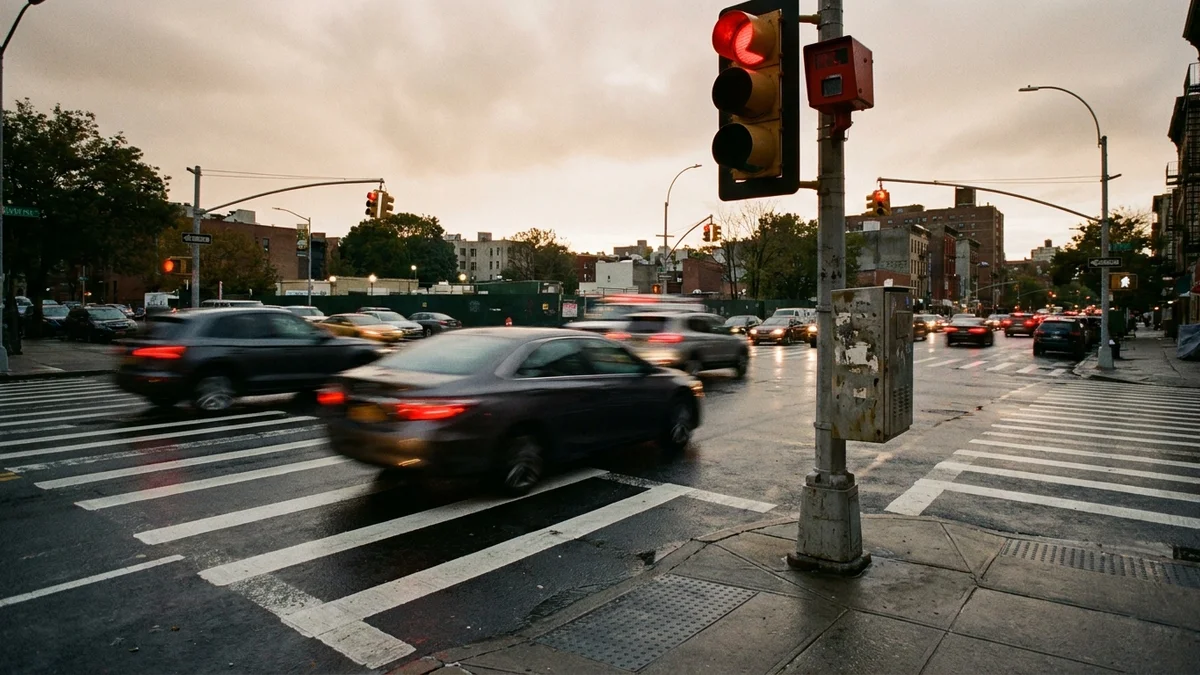
The red-light camera program does not fill the gap. Authorized under VTL § 1111-a, the program covered approximately 150 intersections for most of its history, a hard cap set by the state.
A 2024 law lifted that cap to 600, and NYC DOT began activating the new cameras in early 2026, rolling out 50 per week toward the full 600 by the end of the year.
Even at 600, the cameras would reach under 5 percent of the city’s more than 13,000 signalized intersections. Through the 2023 record and the 2024 spike, they covered roughly 1.1 percent.
A driver running a red light at one of the thousands of uncovered intersections faces no automated consequence at all unless an NYPD officer happens to witness the violation.
The fine structure compounds the gap. A camera-issued ticket carries a $50 civil penalty, no points, no insurance consequence. The driver pays $50 and the file closes. A driver who runs a red light through ten different uncovered intersections in a year faces zero financial consequence.
What 2025 Looked Like
Through September 2025, traffic deaths reached 159, an 18 percent decline from the 194 recorded through the same period in 2024. NYC DOT credited a combination of factors: post-spike rebound effects, expanded protected bike lane mileage, and street redesigns at high-injury corridors.
The decline is welcome. It does not change the structural picture. The NYPD enforcement collapse is still in place. The red-light camera footprint only started expanding in 2026, and the rollout to 600 intersections is still underway.
The 2023 record and the 2024 spike showed how thin the margin is between the city’s current trajectory and a far worse one.
Where Red-Light Running Causes the Most Damage
Red-light running crashes cluster at a specific set of intersection types. NYC DOT’s high-injury network analysis and Transportation Alternatives reporting consistently flag the same categories:
Wide multi-lane corridors with long signal cycles. Queens Boulevard, Atlantic Avenue, Northern Boulevard, Linden Boulevard. Drivers misjudge yellow-to-red timing on these streets because the signal cycles are long and the temptation to “make it” is high.
Off-peak hours on commercial avenues. The most lethal red-light crashes occur during the 7 PM to 4 AM window, when traffic volumes are lower, speeds are higher, and pedestrians crossing on a green walk signal are struck by drivers who are not anticipating their presence.
Left-turn conflicts on permitted left-turn signals. Drivers running a red light on the through-movement leg of an intersection often collide with pedestrians who have entered the crosswalk on a permitted-left phase. NYC DOT has been retrofitting these intersections with split-phase signals, but the work is slow and concentrated in Manhattan.
The geographic distribution follows the high-injury network. NYC DOT’s Vision Zero data shows that a small share of city streets, the priority corridors and intersections, carries a disproportionate share of pedestrian deaths and severe injuries. The same corridors produce a disproportionate share of red-light running deaths.
Civil Liability After a Red-Light Crash
For an injured person or surviving family, a red-light running crash is one of the more straightforward liability cases in personal injury law. The reasons:
The violation is a statutory anchor. VTL § 1111(d) requires drivers to stop at a steady red signal. A driver who proceeded through a red is in violation of the statute.
In New York, an unexcused statutory violation can be used as evidence of negligence, and in some cases can support a finding of negligence per se.
The evidence is often documented. Camera intersections produce time-stamped photographs of the violation. Even at non-camera intersections, signal timing data, witness statements, dashcam footage, and the police accident report typically establish whether the light was red when the at-fault driver entered the intersection.
The NYPD TrafficStat database and NYC Vision Zero View crash map can be used to document prior incidents at the same intersection.
Comparative fault is rarely a major defense. Pedestrians and cyclists with the right of way, and drivers with a green light on the conflicting movement, are usually not at fault for being where the law put them. New York’s comparative negligence rule under CPLR § 1411 reduces recovery by the injured party’s share of fault.
For motor vehicle lawsuits filed on or after May 26, 2026, CPLR § 1411(b), added by Bill A10008 (Chapter 58 of 2026), bars recovery when that share is greater than the combined fault of the defendants. In red-light cases the issue rarely arises.
Damages can be substantial. Red-light crashes at NYC arterial speeds, especially involving pedestrians or cyclists, frequently produce traumatic brain injury, spinal cord injury, multiple fractures, and death.
Verdicts and settlements in NYC for serious red-light crash injuries routinely run into the seven and eight figures. The 2024 NY Top 50 verdict list documents the scale of the largest New York personal injury recoveries.
What to Do After a Red-Light Crash
Three things matter in the first 24 to 48 hours.
Preserve the signal evidence. NYC DOT maintains signal timing logs and, at camera intersections, photographs. The signal logs are public records but require a specific FOIL request. A delay of even a few weeks can mean lost data on smaller systems.
Get the police accident report and any 311 traffic complaints for the location. A history of complaints about driver behavior at the intersection can support a claim that NYC DOT had constructive notice of a known hazard, particularly relevant if the intersection lacks pedestrian timing improvements that have been installed at similar high-risk crossings.
The civil case is not where pedestrian and cyclist deaths get prevented. That work belongs to NYC DOT’s signal timing program, NYPD’s moving-violation desk, and the state legislature’s red-light camera authorization. But when prevention fails, the civil system is what compensates the families who are left behind.
The Math
The 2023 record and the 2024 spike happened because the inputs added up to it. Lower NYPD enforcement plus longer signal cycles plus a camera program that covered about one percent of intersections plus a $50 fine that does not register as a deterrent equals more drivers running more red lights at higher speeds.
The 2025 decline happened because some of those inputs softened. The decline does not mean the structural problem has been solved. It means the city pulled back from the worst version of itself for one year.
Red-light running fatalities are a measurable category. They are concentrated on specific corridors. They respond to specific interventions: split-phase signals, expanded camera coverage, restored moving-violation enforcement, and signal timing changes. The data is clear. What is missing is sustained political will to act on it.