AEE Law · Data Report · Belt Parkway, NYC · 2014-2024
Belt Parkway Is New York City's Most Injurious Road
If you were hurt on Belt Parkway, you already felt how dangerous this road is. Ten years of NYPD crash data confirm it: this highway hurts more New Yorkers than any other road in the city.
New Yorkers injured on Belt Parkway, 2014 through mid-2024, more than on any other road in the city.
46 killed over the same decade · #1 NYC roadway by 2023 crash count, 1,348 crashes
No street in New York City has hurt more people than Belt Parkway. We pulled a decade of NYPD's own crash record for this single highway and checked the math. Belt Parkway topped every ranking there is.
Computed · corridor ranking, 2014 through mid-2024
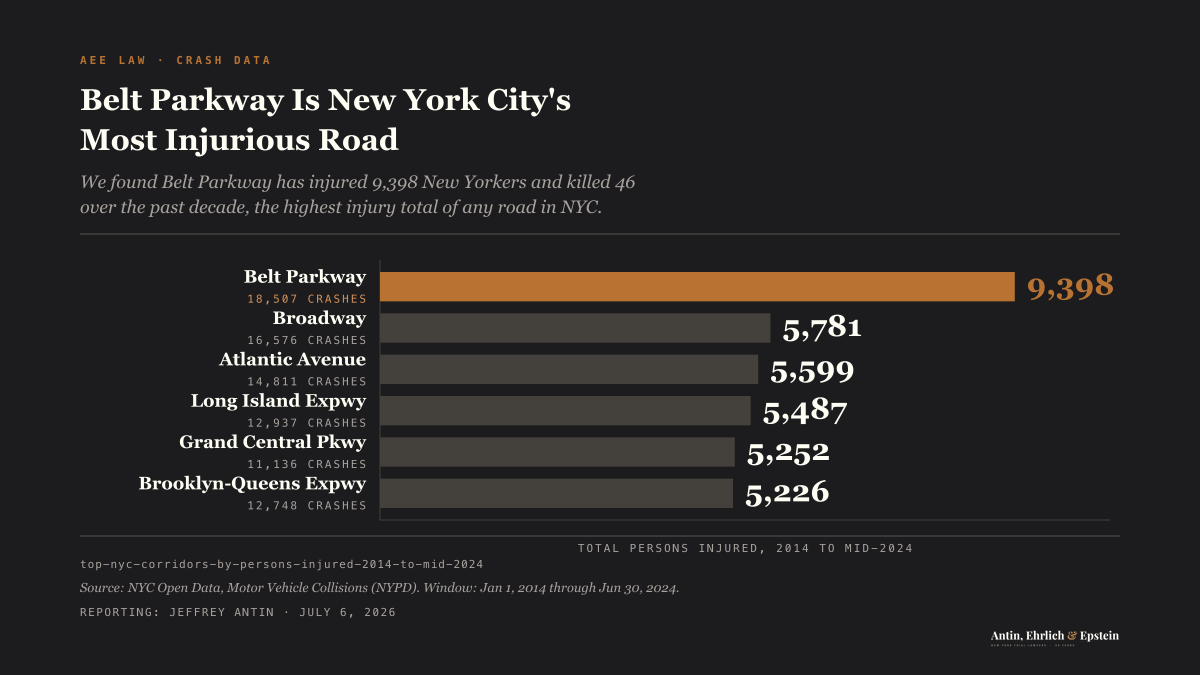
No Road in New York City Hurts More People
9,398 New Yorkers injured on Belt Parkway, 2014 through mid-2024, more than on any other road in the city
We ranked every corridor in New York City by how many people got hurt on it, using NYPD's own crash record. Belt Parkway came out first.
From January 2014 through June 2024, Belt Parkway injured 9,398 people and killed 46, the highest injury total of any road we found. Broadway is second, at 5,781 injured. Atlantic Avenue is third, at 5,599.
The comparison is not highway to highway. Broadway and Atlantic Avenue are surface streets, not limited-access roads, and Belt Parkway still leads both of them. This is the strongest version of the claim. Belt Parkway is #1 among every corridor in the city, highway or surface street, not just among other highways.
The pattern holds in a single year, too. In 2023, Belt Parkway recorded 1,348 crashes, the most of any roadway in New York City. That's 442 more than the Brooklyn-Queens Expressway, the runner-up, a margin of almost 50 percent.
Computed · trend by year, 2016 through 2024
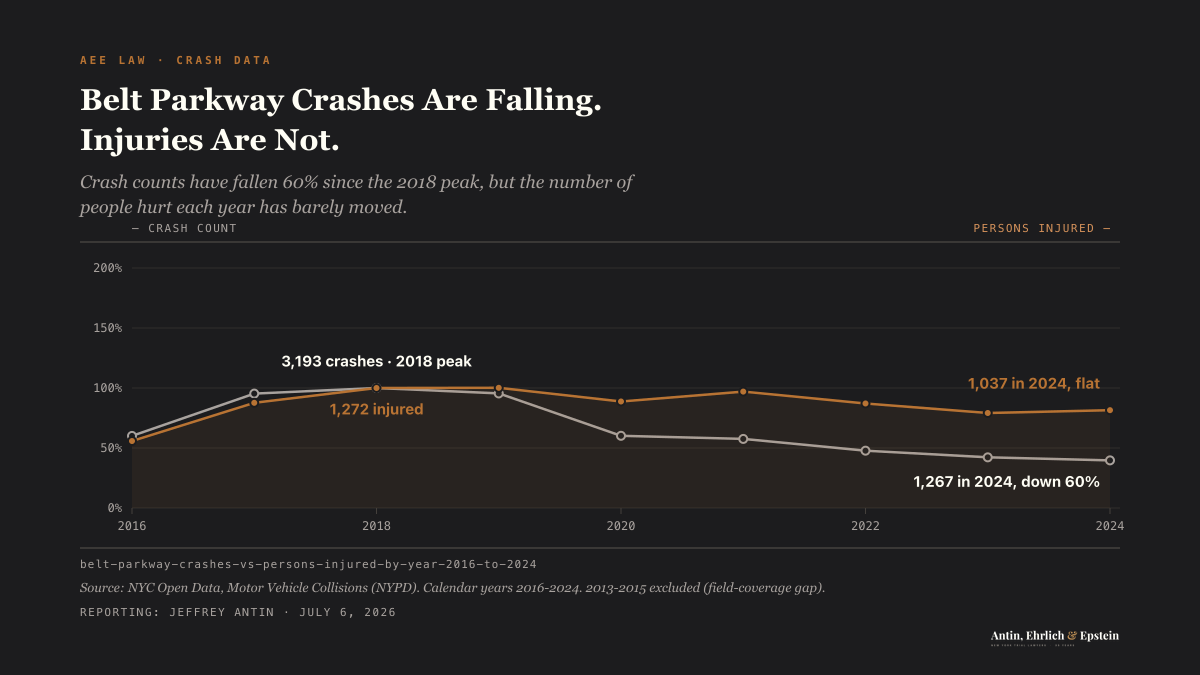
Belt Parkway Crashes Are Falling. Injuries Are Not.
60% drop in Belt Parkway crash counts since the 2018 peak of 3,193, down to 1,267 in 2024
Crash counts on Belt Parkway peaked in 2018 at 3,193 and have fallen every year since. By 2024 the corridor recorded 1,267 crashes, a 60 percent drop from the peak.
The injuries didn't fall anywhere close to that rate. In 2018, 1,272 people were hurt here. In 2024, the number was 1,037, a drop of only 18 percent. Fewer crashes are happening. The people who get hurt aren't disappearing at the same speed.
We start this trend in 2016 on purpose. Belt Parkway's "on street name" field was barely populated before then. Just four crashes total, across 2013, 2014, and 2015 combined, a field-coverage gap in the source data, not a real drop in crashes. That makes 2016 the first year the record is usable.
Computed · contributing factors, all-time pull
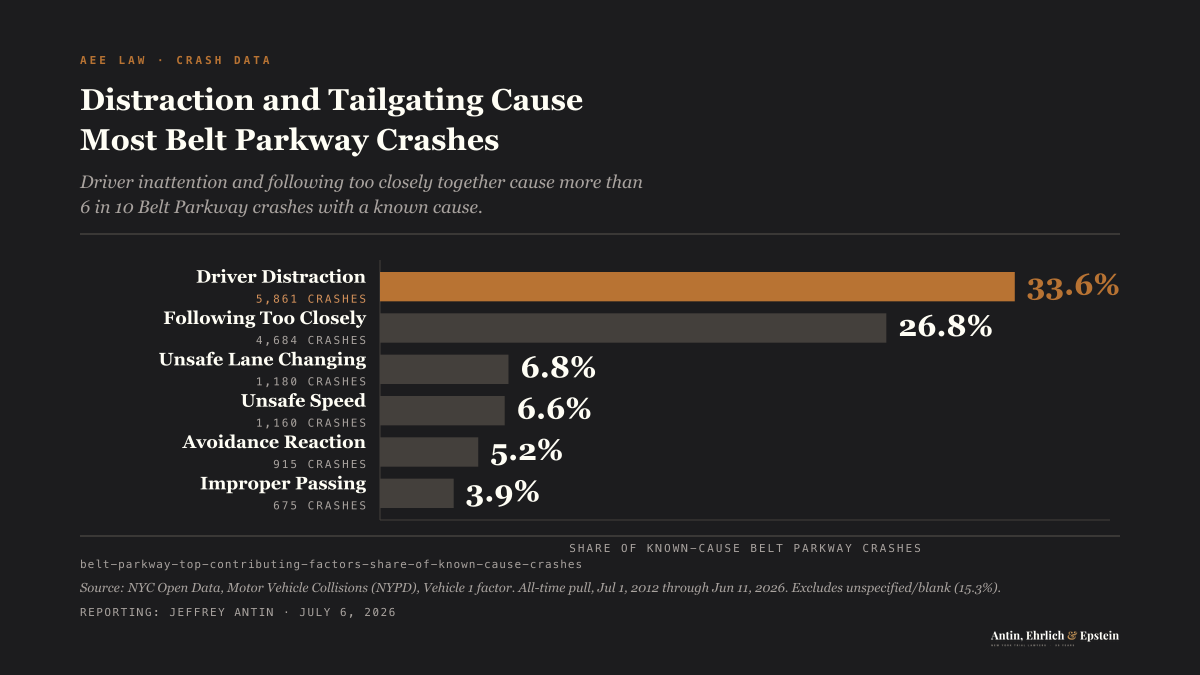
Distraction and Tailgating Cause Most Belt Parkway Crashes
60%+ of Belt Parkway crashes with a known cause come down to driver inattention or following too closely
NYPD's crash reports name a cause for most Belt Parkway crashes. Excluding the 15.3 percent marked unspecified or blank, driver inattention and distraction lead the list at 33.6 percent of known-cause crashes. That's 5,861 crashes in all. Following too closely is second, at 26.8 percent, 4,684 crashes.
Together those two causes account for more than 6 in 10 Belt Parkway crashes with a known cause. Both are the signature pattern of a congested highway: a driver who looks away for a second, or a driver who never left enough room to stop.
Unsafe lane changing (6.8 percent) and unsafe speed (6.6 percent) round out the next tier. No other single factor clears 6 percent.
Computed · hour of day, all-time pull
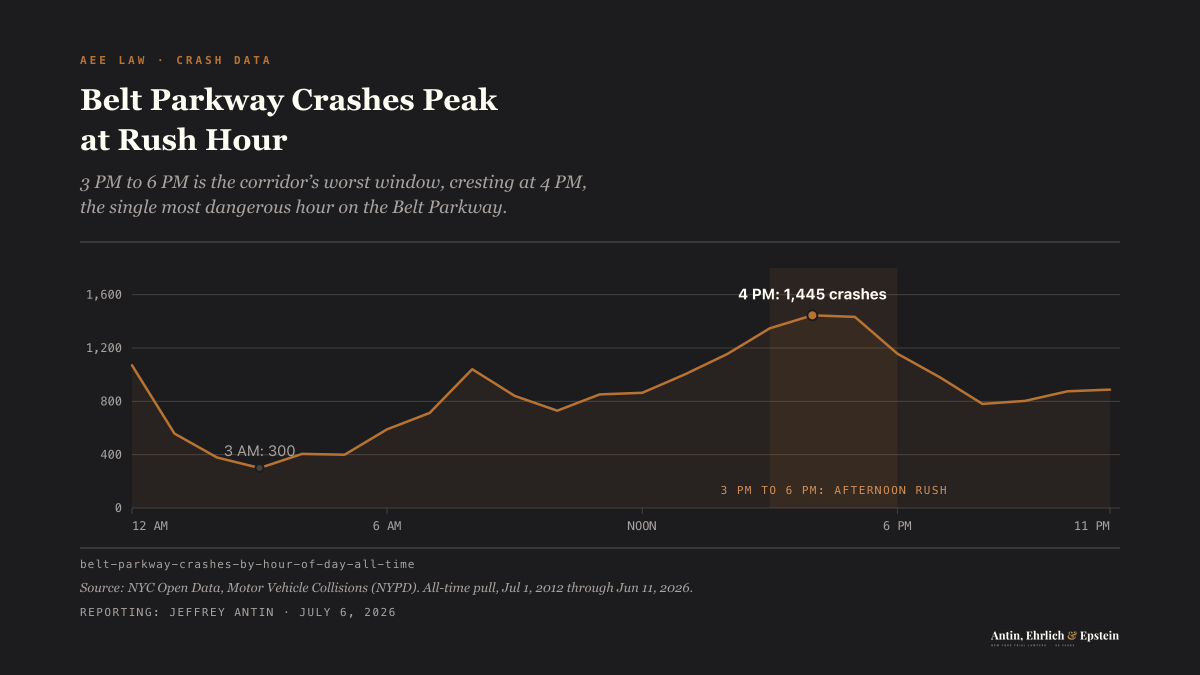
Belt Parkway Crashes Peak at Rush Hour
4pm the single most dangerous hour on Belt Parkway, 1,445 crashes logged in that hour alone
Crashes climb through the afternoon and crest at 4pm, with 1,445 crashes logged in that hour alone. The window from 3pm to 6pm holds the worst of it. All four of the highest-crash hours of the day fall inside it.
Overnight is the quietest stretch. Between 2am and 5am, Belt Parkway sees as few as 300 crashes in a single hour, a small fraction of the afternoon peak.
The day of the week barely matters by comparison. Friday, the worst day, sees only about 10 percent more crashes than Monday, the best. The hour you're on the road matters far more than the day you drive it.
The receipts
Sources and method
AEE Law computed every count, ranking, and trend figure on this page from one named primary source: NYC Open Data's Motor Vehicle Collisions, Crashes dataset. It's NYPD's own record of every reported crash in the city. We ran the analysis over the full file (2,269,187 rows, July 2012 through June 2026), filtered to rows where the street name matches Belt Parkway.
Different findings use different windows, stated on the page. The corridor ranking uses January 2014 through June 2024, the same window the board's original analysis used, so the two can be compared. The year-over-year trend starts in 2016. Belt Parkway's street-name field was barely populated before then, just four crashes total across 2013 through 2015, a field-coverage gap, not a real drop. The contributing-factor and time-of-day findings use the full pull.
Our figures land within one to two percent of the board's original ranking numbers, close but not exact to the digit. NYPD revises crash records after the fact, so a re-pull of the same public dataset months later rarely matches to the decimal. The #1 rank for Belt Parkway holds in every window we tested. This page ships the freshly verified numbers rather than the original figures.
Two cuts of the data aren't reliable enough to headline. The borough field is blank for 98.7 percent of Belt Parkway rows. That's almost certainly a geocoding gap for a limited-access highway, not a real signal, and we don't report a borough comparison from it. The cross-street field is blank for 99.1 percent of rows, only 179 of 20,611 crashes name one. We don't name a "worst intersection" from this cut. Both cuts fail on sample size, not on the underlying crash data.
Our companion legal playbook for a Belt Parkway crash goes deeper on the deadlines, the government-claim rules, and what to do after a crash on this corridor.
- NYC Open Data. (2026). Motor Vehicle Collisions, Crashes [Data set]. New York City Police Department. data.cityofnewyork.us/Public-Safety/Motor-Vehicle-Collisions-Crashes/h9gi-nx95
Questions, answered
Frequently asked
Who is responsible for Belt Parkway maintenance?
Belt Parkway falls under the jurisdiction of the NYC Department of Transportation. The state DOT also has oversight for certain sections. When poor road conditions contribute to a crash, such as potholes, flooding, or inadequate signage, the responsible government entity may share liability.
Can I sue after a Belt Parkway crash if I was partially at fault?
Often, yes. Under New York's comparative negligence rule, your award is reduced by your percentage of fault. If you're 20% at fault and your damages are $500,000, you'd recover $400,000. One limit applies to lawsuits filed on or after May 26, 2026: CPLR 1411(b), added by Bill A10008 (Chapter 58 of 2026), bars recovery when your fault is greater than the combined fault of the drivers you sue.
How much is a Belt Parkway accident case worth?
It depends on the severity of your injuries, the strength of the evidence, and which parties are liable. Highway crashes at speed tend to produce more serious injuries than local street collisions. Cases involving spinal injuries, traumatic brain injuries, or multiple fractures commonly reach six and seven figures.
Where does the Belt Parkway start and end?
Belt Parkway runs roughly 15 miles along the southern shoreline of Brooklyn and Queens. It begins near the Verrazzano-Narrows Bridge approach in Bay Ridge and ends at the Nassau County border, where it connects to the Southern State Parkway. Along the way it interchanges with the BQE, the Cross Island Parkway, and the Cross Bay Bridge. NYPD collision data on the corridor is published through NYC Open Data, and a crash report's exact mile marker matters because it determines which government entity has jurisdiction.
Is the Belt Parkway the same as the BQE?
No. They're two separate roads. The Belt Parkway is a limited-access parkway along Brooklyn and Queens' southern shore, restricted to passenger vehicles. The BQE is Interstate 278, a full freeway that cuts through interior Brooklyn and Queens, and it allows commercial trucks. If you were injured in a crash on either road, the distinction matters because jurisdiction and notice-of-claim rules differ. Government claims require a Notice of Claim within 90 days under General Municipal Law § 50-e.
Are trucks allowed on the Belt Parkway?
Commercial trucks and tractor-trailers are prohibited on the Belt Parkway under New York's Vehicle and Traffic Law. The road is restricted to passenger vehicles, and low parkway bridge clearances, posted as low as 6 feet 11 inches, physically exclude box trucks and trailers. When a banned commercial vehicle causes a crash, the operator and the company that dispatched it can face heightened exposure because the truck had no legal right to be on the parkway. Under VTL § 388, vehicle owners are liable for injuries caused by anyone driving with permission, which gives an injured person another route to recovery when a trucking company puts a prohibited vehicle on a restricted road.
Hurt in a Crash on Belt Parkway?
A road's documented crash history can matter to your case. AEE Law has spent 37 years fighting for New Yorkers hurt on the roads the city built and maintains.
Talk to an AEE Law car accident lawyer