New York City recorded 111 pedestrian deaths in 2025, the lowest number on record. That was down 9% from 122 in 2024 and represents about a 40% drop from the 184 pedestrians killed in 2013, the year before Vision Zero launched in 2014.
The progress is real. But 111 people killed while walking is not zero. Pedestrian fatalities still account for more than half of all NYC traffic deaths. The data shows where the danger persists and which communities bear the greatest risk.
The 2025 Picture
NYC recorded 205 total traffic deaths in 2025, a 19% decline from 253 deaths in 2024. Of those, 111 were pedestrians. The improvements were not spread evenly across the city.
The Bronx saw the largest improvement: a 39% reduction in traffic fatalities from 2024, down from 54 to 33, with 21 fewer deaths.
Queens followed with a 23% reduction from 2024, down from 74 to 57, with 17 fewer deaths.
Brooklyn and Manhattan saw less dramatic reductions.
Staten Island fatalities rose slightly by one.
The overall trend since Vision Zero began in 2014 is clear: a 31% reduction in all traffic deaths. According to Transportation Alternatives’ 2025 year-end analysis, protected bike lanes have reduced deaths and serious injuries for all road users by 18.1% at locations where they’ve been installed.
The Deadliest Roads
Pedestrian fatalities don’t scatter randomly across the city. They concentrate on a specific type of road: wide, multi-lane arterials designed to move cars fast.
Wide Arterial Roads
Roads with four or more travel lanes, speed limits of 30 mph or higher, and long distances between crosswalks produce the most pedestrian deaths. These include:
- Atlantic Avenue (Brooklyn): Six lanes through dense commercial areas
- Northern Boulevard (Queens): Fast-moving traffic through Jackson Heights and Flushing
- Grand Concourse (Bronx): Wide divided boulevard through residential neighborhoods
- Hylan Boulevard (Staten Island): Suburban-speed road with few controlled crossings
Left-Turn Hazards
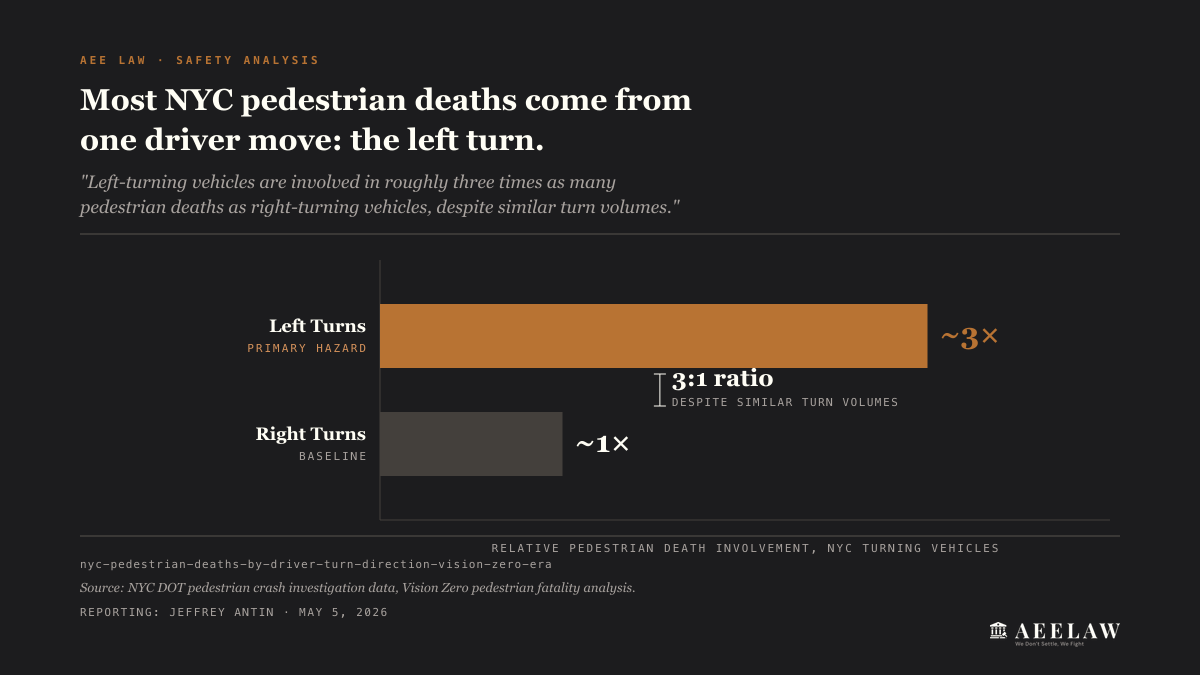
Vehicles making left turns account for a disproportionate share of pedestrian fatalities. A left-turning driver looks for oncoming traffic, finds a gap, accelerates through the turn, and strikes a pedestrian in the crosswalk they did not look at.
Left-turning vehicles are involved in roughly three times as many pedestrian deaths as right-turning vehicles, despite similar turn volumes. The city responded by adding leading pedestrian intervals. These give walkers a head start before cars get the green light.
Mid-Block Crossings
People struck while crossing mid-block, away from a crosswalk, account for a big share of deaths. But blaming walkers misses the point. Many of these crossings happen on long blocks where the nearest crosswalk is hundreds of feet away. The road design forces people to choose between a long detour and a risky crossing.
How Crashes Happen
NYC DOT’s Severe Injury Response Team Analysis breaks down the mechanics of serious pedestrian injuries:
- 67% of serious pedestrian injuries occurred at intersections
- 25% happened at mid-block locations
- 29% of cases involved pedestrians crossing with the signal, meaning they had the right of way
- 14% involved crossing at unmarked locations or without signals
That 29% figure is significant. Nearly a third of seriously injured pedestrians were doing everything right. The intersection itself failed them.
Who Gets Killed
Pedestrian fatalities in NYC are not evenly distributed across the population.
Older adults (65+) are dramatically overrepresented. Slower walking speeds mean they can’t clear wide crosswalks during signal phases designed for younger, faster walkers. They’re also more likely to suffer fatal injuries from the same impact that a younger person would survive.
Low-income neighborhoods have higher pedestrian death rates than affluent areas. The roads are wider, the infrastructure is older, and the investment in safety improvements has historically been lower.
Nighttime crashes produce a disproportionate share of fatalities. Reduced visibility makes it harder for drivers to see pedestrians. Alcohol impairment, by either party, is a factor in many nighttime pedestrian deaths.
Vision Zero: Progress and Gaps
Mayor de Blasio launched Vision Zero in 2014. The program has achieved meaningful results, but the goal of zero traffic deaths remains distant.
What has worked:
- Speed limit reduction to 25 mph citywide
- Speed cameras in school zones, now expanded to 247 locations
- Leading pedestrian intervals at thousands of intersections
- Over 100 miles of protected bike lanes
- Nearly 2 million square feet of new pedestrian space
Where gaps remain:
- Many of the deadliest arterial corridors have not been redesigned
- Enforcement of failure-to-yield violations has been inconsistent
- Large vehicle blind-spot standards remain inadequate
- Pedestrian signals on wide roads still don’t give enough crossing time
The 60% decrease in pedestrian and cyclist deaths and serious injuries at locations with leading pedestrian intervals shows that targeted infrastructure changes work. Scaling those changes to every dangerous intersection is the challenge.
Legal Rights for Pedestrians Who Are Injured
Pedestrians struck by vehicles in New York have strong legal protections.
The “Serious Injury” Threshold
A pedestrian struck by an insured New York vehicle is a covered person under Insurance Law § 5104(a), so recovering for pain and suffering still requires meeting the serious injury threshold under Insurance Law § 5102(d). The good news is that pedestrian crashes routinely clear that bar.
A fracture is its own enumerated category, so a broken wrist qualifies on its own. So do significant disfigurement, permanent loss of use, and a significant limitation of a body function or system, all common in pedestrian cases.
Driver Liability Is Often Clear
Drivers have a duty to yield to pedestrians in crosswalks. Failure to yield is a traffic violation and establishes negligence. Even when a pedestrian crosses outside a crosswalk, the driver still has a duty to exercise due care.
City Liability for Dangerous Roads
If a road’s design contributed to the crash, including a lack of crosswalks, inadequate signal timing, or missing pedestrian islands, the City of New York may share liability. These claims require a Notice of Claim within 90 days under General Municipal Law § 50-e.
Higher Case Values
Pedestrian injuries tend to be more severe than car occupant injuries at comparable speeds. A 30 mph impact that causes whiplash in a car can cause a traumatic brain injury, multiple fractures, or death for a pedestrian.
What to Do After a Pedestrian Crash
Call 911. Even if you feel okay, get checked by paramedics. Adrenaline masks pain. Internal injuries may not produce symptoms for hours.
Stay at the scene until police arrive and complete an accident report.
Document everything. Photograph the intersection, traffic signals, crosswalk markings, your injuries, and the vehicle that struck you. Get witness contact information.
Don’t give statements to the driver’s insurance company before speaking with an attorney. They’ll try to establish that you were at fault.
Act quickly on government claims. If road design contributed to your crash, the 90-day Notice of Claim deadline against the city is unforgiving. The personal injury statute of limitations is three years under CPLR § 214(5). Wrongful death claims must be filed within two years under EPTL § 5-4.1.
Frequently Asked Questions
Can I sue if I was jaywalking when hit by a car?
Often, yes. New York’s comparative negligence rule reduces your recovery by your percentage of fault. For lawsuits filed on or after May 26, 2026, CPLR 1411(b), added by Bill A10008 (Chapter 58 of 2026), bars recovery when your fault is greater than the combined fault of the drivers you sue.
Below that line, partial fault reduces your award without barring the claim.
How much is a pedestrian accident case worth in NYC?
Severity dictates value. A broken leg with surgery is commonly worth $300,000 to $750,000. A traumatic brain injury with permanent effects can reach seven figures. Wrongful death cases for pedestrians killed by vehicles commonly produce verdicts and settlements exceeding $5 million.
Which borough has the most pedestrian deaths?
Brooklyn and Queens consistently account for the most pedestrian fatalities. The Bronx has the highest per-capita rate, reflecting wider roads and less pedestrian infrastructure investment.