
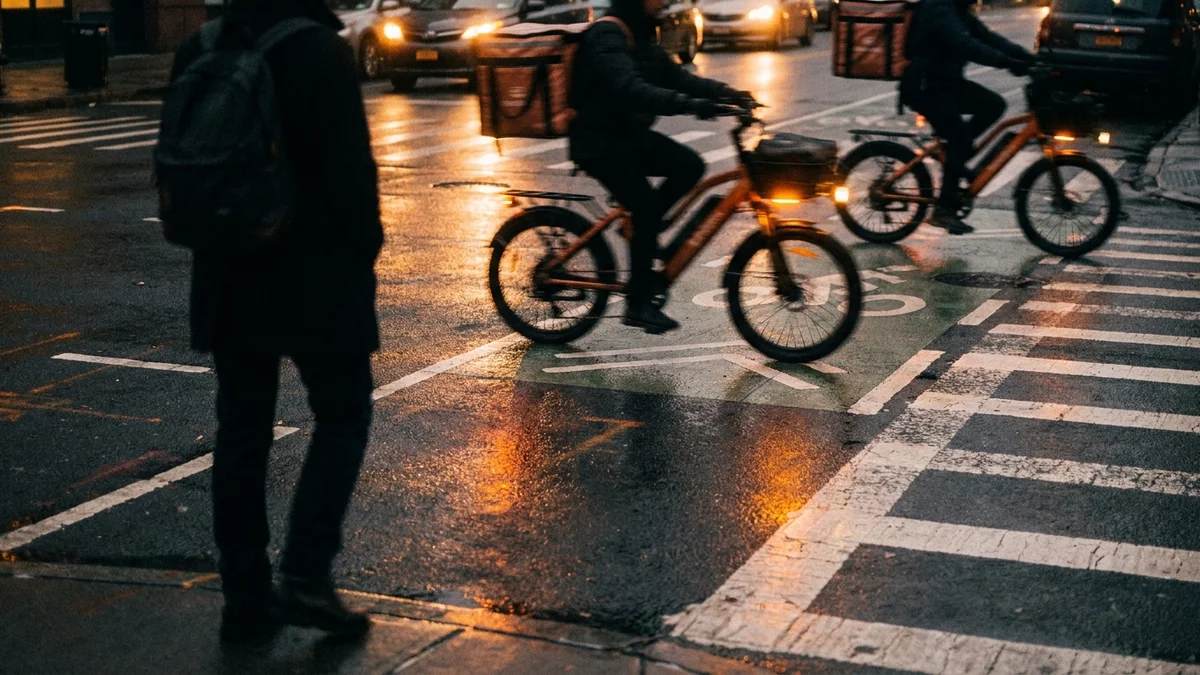
E-bike-involved crashes have injured 17,434 people in New York City since 2019, and 133 people died in them.
Those two numbers come from the city’s own collision records, but nobody had pulled them together in one place: not the injuries alongside the deaths, not the pedestrians alongside the riders, not the borough grain alongside the citywide trend. This ledger does.
The timing matters. The city ended criminal enforcement for minor e-bike offenses on March 27. A lawsuit filed June 24 seeks to void that directive.
And on July 1, the city announced pedestrian deaths at a historic low while its own release showed e-bike, scooter, and moped rider deaths ticking up. Everyone in that fight cites a number. This page shows the whole ledger, with the receipts.
Methodology
We pulled the full NYC Open Data Motor Vehicle Collisions dataset (NYPD MV-104AN reports) on July 2, 2026: 2,269,187 crash records running from July 2012 through June 11, 2026.
A crash counts as e-bike-involved when any of its up to five vehicle-type fields carries an explicit electric-bike or electric-scooter label. That field is officer-entered free text with 98 distinct spellings, so we matched every e-bike and e-scooter variant, excluded ambiguous bare “scooter” entries and gas motorscooters, and tracked mopeds as a separate bucket throughout.
E-bike labels barely exist in the data before 2019, so the ledger starts there. May and June 2026 records are still missing most vehicle-type detail because NYPD’s vehicle forms trail the initial crash report, which makes April 2026 the freshest complete month.
One more thing this data cannot tell you: involvement is not fault. An e-bike-involved crash includes every crash where an e-bike was any party, including the many where a car or truck struck the rider.
Injuries peaked in 2023 and have fallen since
Injuries in e-bike-involved crashes more than doubled from 1,628 in 2020 to 3,498 in 2021, held near that level for three years, and peaked at 3,668 in 2023. They then fell to 2,882 in 2024 and 1,719 in 2025, a 53% drop from the peak.
| Year | E-bike-involved crashes | People injured | People killed |
|---|---|---|---|
| 2019 | 110 | 87 | 0 |
| 2020 | 2,017 | 1,628 | 10 |
| 2021 | 4,037 | 3,498 | 25 |
| 2022 | 4,086 | 3,625 | 31 |
| 2023 | 4,117 | 3,668 | 30 |
| 2024 | 3,181 | 2,882 | 19 |
| 2025 | 1,920 | 1,719 | 12 |
| 2026 through May | 367 | 327 | 6 |
Two honest caveats sit under that table. The near-zero 2019 figure reflects labeling, not safety: officers only began writing “E-Bike” into crash reports in volume after the state legalized the devices in 2020. And the 2026 row is incomplete, because May’s vehicle-type detail has not fully landed yet.
The fatality count deserves its own line. Deaths fell alongside injuries: 30 in 2023, 19 in 2024, and 12 in 2025. Six more are recorded through May 2026, a stretch where NYPD’s vehicle-type reporting has not fully landed, so treat that figure as partial.
The city’s own Vision Zero mid-year release on July 1 announced pedestrian deaths at a historic low, 46 through late June, down 13% from last year and down more than 42% since Vision Zero launched in 2014.
The same release reports deaths of e-bike, stand-up scooter, and moped riders UP this year, 18 against 16 at the same point last year, with e-scooter rider deaths doubling from 3 to 6.
The streets are getting safer for people walking and driving. For people on small electric wheels, the deaths are moving the other way.
Riders absorb most of the harm
The loudest version of the e-bike story is a pedestrian struck on a sidewalk. We found the people most often hurt in these crashes are the riders themselves.
In 2025, 8 of the 23 cyclist deaths citywide happened in e-bike-involved crashes, roughly one in three. In 2023 it was 14 of 31. Year in and year out, cyclist injuries in e-bike-involved crashes run several times the pedestrian count. In 2025 it was 922 cyclists against 169 pedestrians, more than five to one.
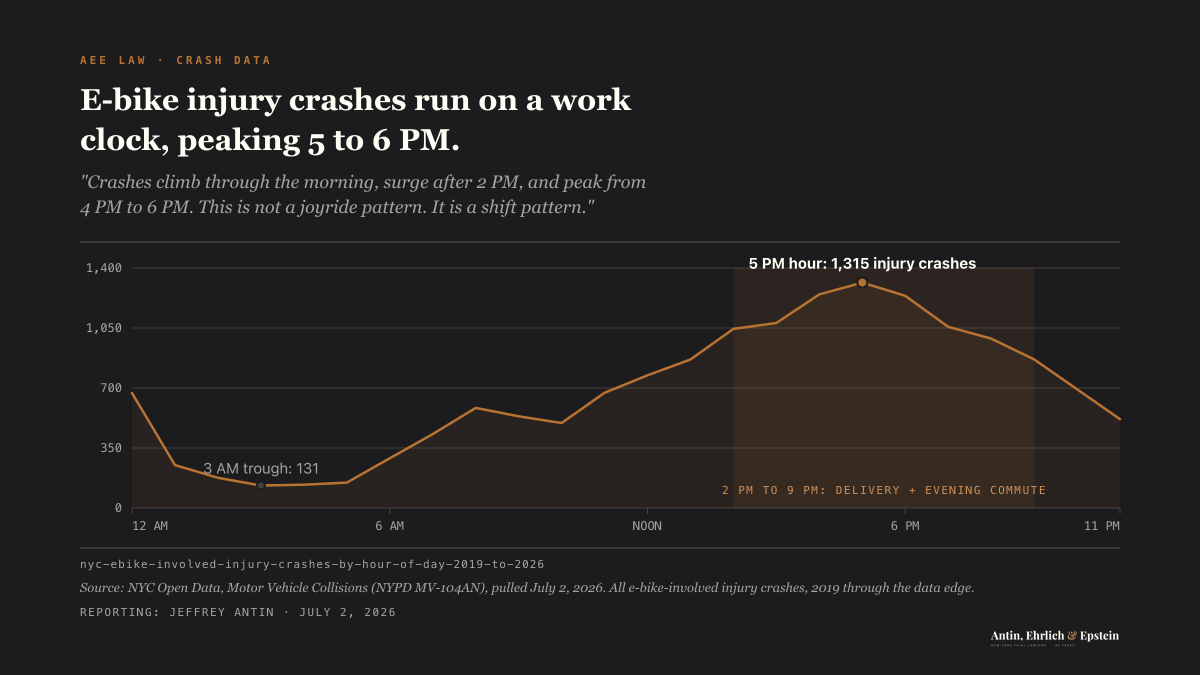
The timing points to work rather than recreation: injuries peak between 4 PM and 6 PM, the heart of the dinner-delivery and evening commute window, and Friday is the single worst day of the week.
The delivery economy runs on e-bikes, and delivery workers take the risk with almost no safety net: no plates, no mandatory insurance, and app schedules that reward speed.
Pedestrians still carry real harm: 1,547 injured and 16 killed in e-bike-involved crashes since 2019. At the 2022 and 2023 peak, that ran 327 pedestrians injured per year. 2025 logged 169. Behind each of those counts is a person who was hit, and who then faced the recovery.
The 0.4% number and the 17,434 number, both true
When you read about this fight, you will see a much smaller pedestrian number quoted: NYPD data cited by Streetsblog says e-bike riders caused just 37 of the 9,610 pedestrian injuries in 2024, or 0.4%. Our ledger counts 267 pedestrians injured in e-bike-involved crashes that year. Both are correct, because they answer different questions.
The NYPD figure counts crashes attributed to the e-bike rider. The ledger counts every pedestrian hurt in any crash where an e-bike was one of the vehicles, including crashes where a car did the striking and an e-bike was simply present. The crash record itself does not say which vehicle hit the pedestrian.
Read the small number as how often riders are blamed, and the big number as how often e-bikes are in the room. Both are true. Quoting one without the other tells half the story.
Where it happens: Brooklyn first, evenings worst
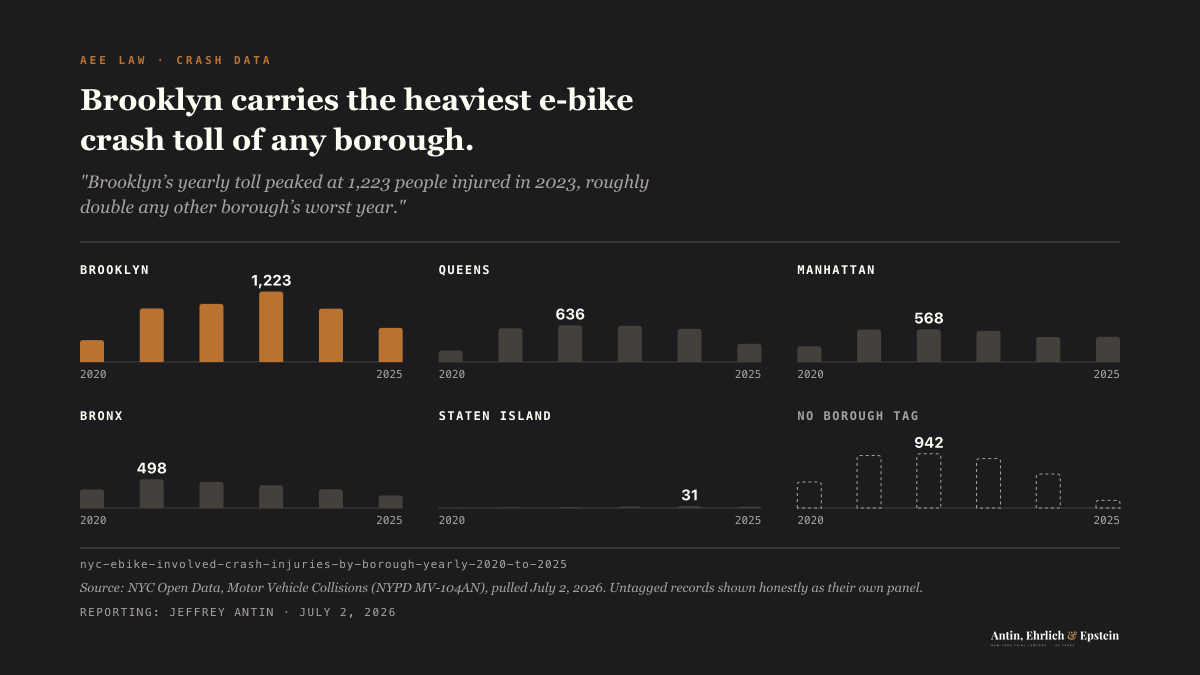
Over the 24 months from June 2024 through May 2026, Brooklyn logged 1,243 people injured in e-bike-involved crashes, narrowly more than Queens and the Bronx combined. Manhattan follows at 836, then Queens at 761, the Bronx at 473, and Staten Island at 44.
The yearly peaks are starker: Brooklyn’s worst year was 1,223 people injured in 2023, roughly double any other borough’s worst year.
One honest asterisk: 13.6% of recent crash records carry no borough tag at all, so every borough’s true count runs somewhat higher. The chart below shows those untagged records as their own panel rather than hiding them.
By street name, the all-time injury-crash count reads like a delivery map: Broadway leads citywide with 293 injury crashes, followed by Brooklyn’s 3rd, 4th, and 5th Avenues, Bedford Avenue, Northern Boulevard, and Fulton Street.
Those are commercial corridors where restaurants, bike lanes, bus routes, and double-parked trucks share the same pavement. A street name like Broadway spans four boroughs, so treat these as corridor families rather than single addresses.
The hour-of-day pattern points the same way. Crashes climb through the morning, surge after 2 PM, and peak from 4 PM to 6 PM. This is not a joyride pattern. It is a shift pattern.
The policy fight, and what we can and cannot prove
On March 18, Mayor Mamdani announced the end of criminal enforcement for minor traffic offenses by cyclists and e-bike riders, effective March 27. Riders who run a stop sign now get the same civil summons a driver would, instead of a criminal court date.
Under the prior policy, NYPD issued 19,039 criminal summonses to riders in less than a year, per Streetsblog’s review of the NYPD summons data. The same announcement promised a delivery-worker safety training program and legislation targeting the app companies whose delivery clocks reward dangerous riding.
On June 24, attorney Jim Walden, who leads the group NYC Common Sense, filed suit in Richmond County Supreme Court against the city and the mayor. Council Member Frank Morano, suing in his personal capacity, leads a plaintiff group of residents that includes people hurt in e-bike crashes.
The suit argues the mayor lacked authority to suspend enforcement of duly enacted laws and asks the court to void the directive. The city defends the policy. That question now belongs to the court, and this page takes no position on it.
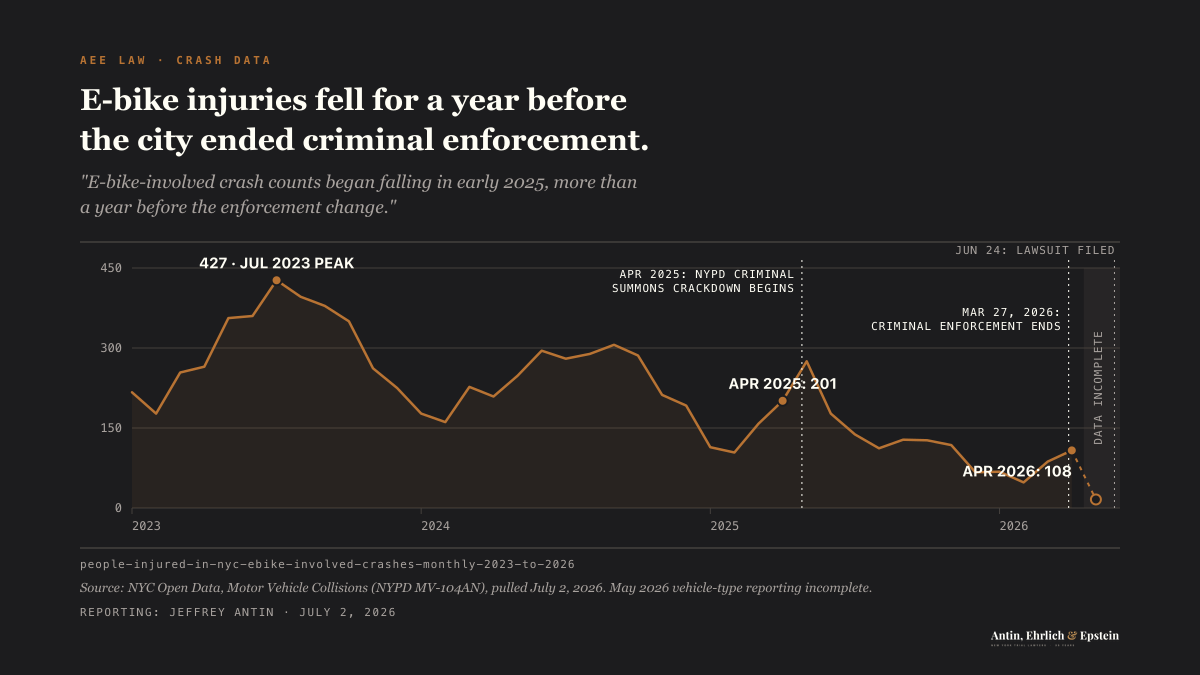
Here is what we can say. April 2026, the first full month under the new policy, recorded 119 e-bike-involved crashes with 108 people injured. April 2025, under the old policy, recorded 230 crashes with 201 injured. Those are observed counts around the policy timeline, nothing more.
Read the monthly numbers honestly. E-bike-involved crash counts began falling in early 2025, more than a year before the enforcement change, and April 2026 sits on that same downhill slope.
One month of post-policy data cannot separate the policy’s effect from a trend that predates it, from weather, or from reporting lag. Anyone claiming these numbers prove the policy made streets safer, or more dangerous, is ahead of the evidence. We will keep counting as the months land.
One adjacent number needs separating, because the official counts now blend the categories. In late June, the city stepped up enforcement against illegal motorized two-wheelers, citing 28 deaths this year through June 28 in crashes involving that group. That count folds motorcycles, mopeds, dirt bikes, and ATVs in with e-bikes and e-scooters.
We keep the classes apart. Mopeds are a separately regulated, faster vehicle class, and their crashes moved differently: 1,868 in 2023, rising to 2,082 in 2024, then easing to 1,859 in 2025, with 11 deaths in 2025 against the e-bike set’s 12.
When officials quote a combined two-wheeler death toll, a large share of it is not the e-bikes the enforcement debate is about.
What this means for New Yorkers
If you’re a pedestrian hurt by an e-bike rider, the hard part is rarely proving the injury. It’s finding the rider. E-bikes carry no plates and no mandatory insurance in New York, which is exactly the gap Priscilla’s Law proposes to close with registration and plates.
If the rider worked for a delivery platform, the platform may share liability depending on the employment relationship, and that changes what a claim is worth.
Document the scene, get witness contacts, and report the crash to the NYPD immediately, because the crash report is the document every later step leans on. A claim with no photos and no police report is the hardest kind to prove.
If you’re a rider hit by a car, you hold the same rights as any cyclist.
A driver who fails to yield under New York’s Vehicle and Traffic Law, VTL § 1146, is liable for the harm, the vehicle’s owner is generally on the hook under VTL § 388, and a serious injury under Insurance Law § 5102(d) opens the door to full pain-and-suffering recovery.
Insurance carriers fight liability harder in these matchups, which is why the police report and any witness names carry outsized weight. Delivery workers hurt on the job may also hold workers’ compensation and third-party claims at the same time.
The enforcement fight will run its course in court and in the Council. We will keep counting either way.
Each of those 17,434 injuries happened to somebody who then had to get their life back.