In 2023, 30 construction workers died on New York City job sites. That was the highest single-year total in a decade. The number followed a steady climb: 13 deaths in 2020, 20 in 2021, and 24 in 2022.
According to the NYCOSH Deadly Skyline Report 2025, on OSHA-inspected fatal job sites across New York State, employers had coinciding safety violations 74% of the time.
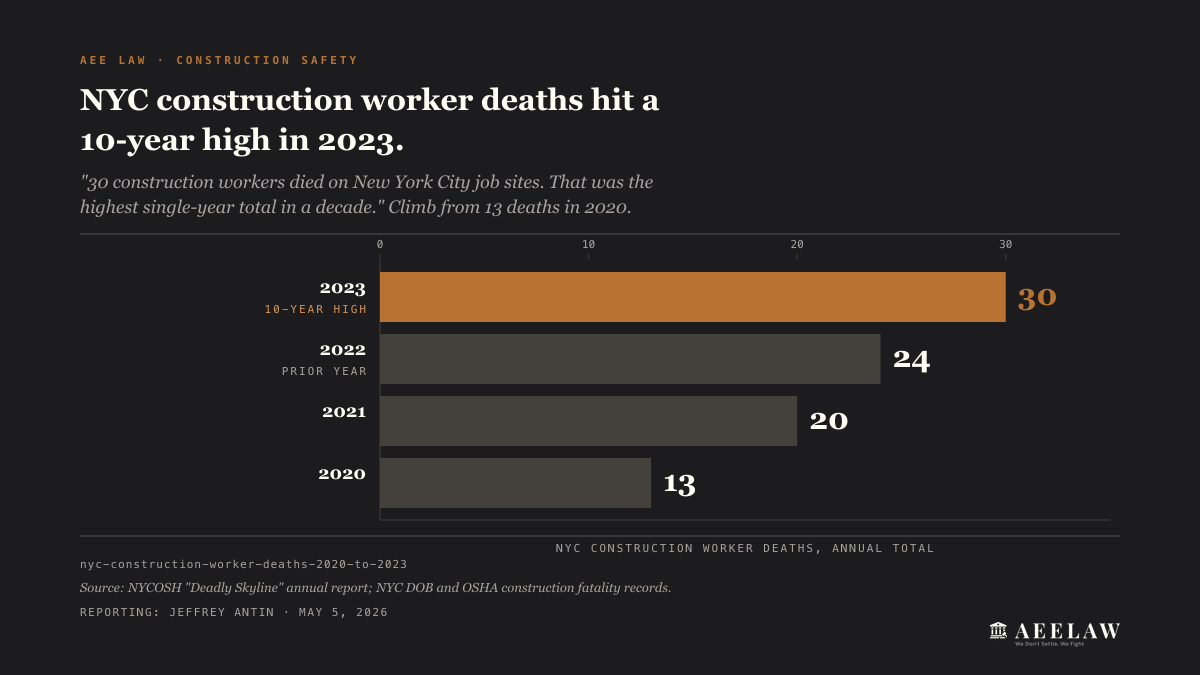
NYC’s construction death rate climbed to 11.6 per 100,000 workers in 2023, higher than the New York State rate of 10.4. Both rose year over year. Building in New York is dangerous. Tight urban sites, old buildings, bad weather, and deadline pressure all create conditions where safety shortcuts turn deadly.
The Numbers in Context
| Year | Deaths | Notes |
|---|---|---|
| 2020 | 13 | Pandemic-era slowdown |
| 2021 | 20 | Construction activity resumes |
| 2022 | 24 | Steady climb continues |
| 2023 | 30 | 10-year high |
A construction boom drove the 2023 spike. Building permits surged after pandemic-era delays cleared, putting more workers on more sites. Enforcement staffing at the Department of Buildings didn’t keep pace.
A note on the numbers: DOB reported only seven deaths in 2023 using a narrower method that covers only building construction sites. NYCOSH’s broader count of 30, drawn from OSHA and Bureau of Labor Statistics data, includes all construction sectors. That broader number is the more complete picture.
How Workers Die on NYC Sites
Falls are the single leading cause of construction fatalities in New York City. This has been true for decades, and it remains true despite regulations specifically targeting fall prevention. The four leading causes:
- Falls from elevation. Scaffold collapses, falls from ladders, falls through floor openings, and falls from roofs. In 2022, falls accounted for nine fatalities and 200 injuries on NYC construction sites. These are the scenarios that New York’s Labor Law 240, the Scaffold Law, was designed to address.
- Struck by falling objects. Tools, materials, and debris fall from upper floors and hit workers below. Hard hats help, but not against heavy objects from high up.
- Caught-in/between hazards. Workers get caught in trench collapses, pinned between machines and walls, or crushed by equipment. Soil weighs about 100 pounds per cubic foot. A partial collapse can bury a worker in seconds.
- Electrocution. Workers touch live power lines, exposed wiring, or badly grounded tools. This happens most on renovation and demolition sites where old wiring is exposed.
Who Is Most at Risk
NYCOSH’s 2025 Deadly Skyline report identified stark patterns in who dies on NYC construction sites.
- Non-union workers account for 77% of deaths. NYCOSH analyzed OSHA’s 44 New York State construction fatality investigations in 2023 and found 77% of the workers who died were non-union. Union programs train workers on safety. Union sites have safety officers. Non-union sites, now the majority in NYC, often lack both.
- Latinx workers face outsized risk. They make up 10% of the workforce but account for 26% of deaths in New York State. Language barriers, fear of reporting unsafe conditions, and placement in higher-risk roles all play a part.
- 74% of fatal sites had coinciding safety violations. On OSHA-inspected construction fatality cases across New York State in 2023, employers had coinciding OSHA violations 74% of the time. These were not freak accidents. They were the result of cutting corners on safety.
Which Sites Are Most Dangerous
Two site types stand out:
- Residential work kills more workers than big commercial projects. Workers on small sites, including home gut-rehabs and low-rise builds, often lack the safety gear that large sites provide. Scaffolding gets improvised. Fall protection may be absent entirely.
- Demolition carries huge risk for the number of workers involved. Unstable structures, hidden asbestos and lead, and the chaos of tearing down buildings make it one of the most deadly types of work.
Consider the economics. A guardrail system costs a few hundred dollars. A full-body harness costs under $100. Yet contractors continue to treat safety equipment as an expense to cut.
New York’s Unique Legal Protections
New York gives construction workers legal protections that most other states don’t.
Labor Law 240: The Scaffold Law
Labor Law § 240(1) is the most powerful construction safety law in the country. It imposes absolute liability on property owners and general contractors when a worker is injured in a gravity-related accident: falls from heights, struck by falling objects, scaffold collapses, ladder failures.
Absolute liability means the owner and contractor cannot defend themselves by arguing the worker was careless. If the safety equipment was missing, defective, or inadequate, and the worker fell or was struck, liability is established.
It applies to falls from scaffolds, ladders, and elevated work surfaces. It covers falls through unguarded floor openings, being struck by falling tools or debris, and scaffold collapses and ladder failures.
Labor Law 241(6): Safety Regulation Violations
Under Labor Law § 241(6), construction sites must comply with specific safety regulations from the NY Industrial Code. When a contractor violates a specific regulation, like failing to provide guardrails at a floor opening, and a worker is injured, the violation itself establishes negligence.
Labor Law 200: General Duty
Labor Law § 200 is a negligence-based claim. It requires showing that the property owner or contractor controlled the work and failed to provide a safe workplace. It’s harder to prove than a 240 or 241(6) claim, but it covers situations those sections don’t reach.
The OSHA Factor
Federal OSHA investigates construction fatalities and can issue citations and fines. But the fines are often modest: tens of thousands of dollars, sometimes less, even for fatalities. The real financial consequence comes from civil lawsuits under New York’s Labor Law.
OSHA violation records are public and can be powerful evidence in a construction accident case. A contractor with a history of citations, particularly for the same type of violation that caused your injury, demonstrates a pattern of disregard for worker safety.
What to Do If You’re Injured on a NYC Construction Site
- Get medical treatment immediately. Even if you think the injury is minor. Construction injuries often worsen. A “tweaked” back can be a herniated disc. A headache after a fall can indicate a brain bleed.
- Report the injury to your supervisor. Document it in writing if possible. Get the names of witnesses.
- Do not sign anything from your employer’s insurance company without legal advice. Workers’ comp adjusters may try to minimize your claim.
- Contact an attorney experienced in NYC construction accidents. Labor Law 240 and 241(6) claims are specialized. Not every personal injury lawyer handles them.
Frequently Asked Questions
Can I sue my employer after a construction accident?
Workers’ compensation generally bars suing your direct employer. But you can sue the property owner, general contractor, and other third parties under Labor Law 240 and 241(6). These third-party claims are where significant compensation comes from.
What is the average construction accident settlement in New York?
It varies based on injury severity. A broken bone with full recovery commonly settles for $200,000 to $500,000. A spinal cord injury with permanent disability can produce verdicts and settlements in the millions. The absolute liability standard under Labor Law 240 strengthens these cases.
How long do I have to file a construction accident lawsuit in New York?
Three years from the date of injury for most construction accident claims under CPLR § 214(5). If the accident involved a city-owned site or public works project, you must file a Notice of Claim within 90 days under General Municipal Law § 50-e.