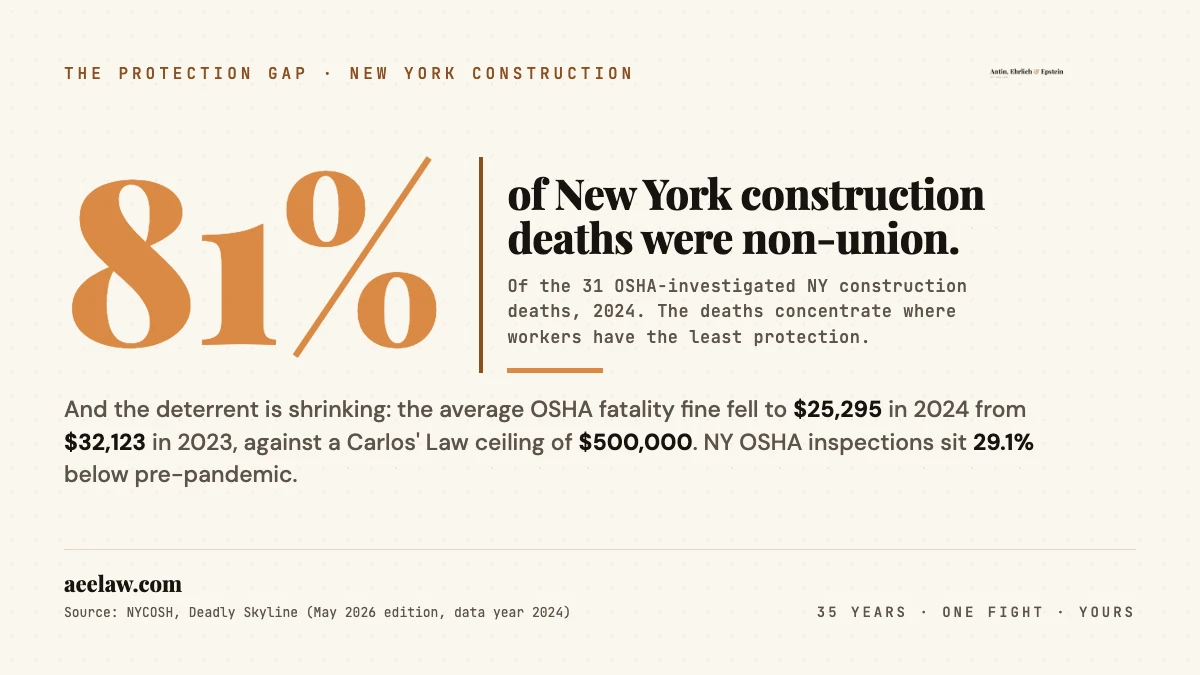
When a New York construction worker was killed in 2024 and OSHA investigated, the dead worker was almost never union. 81% of the 31 New York State construction fatalities OSHA investigated that year were non-union (NYCOSH, Deadly Skyline, May 2026).
That’s the protection gap in one number: New York’s construction deaths concentrate on the sites where workers have the least protection, and they’re doing it while the enforcement that’s supposed to deter them retreats.
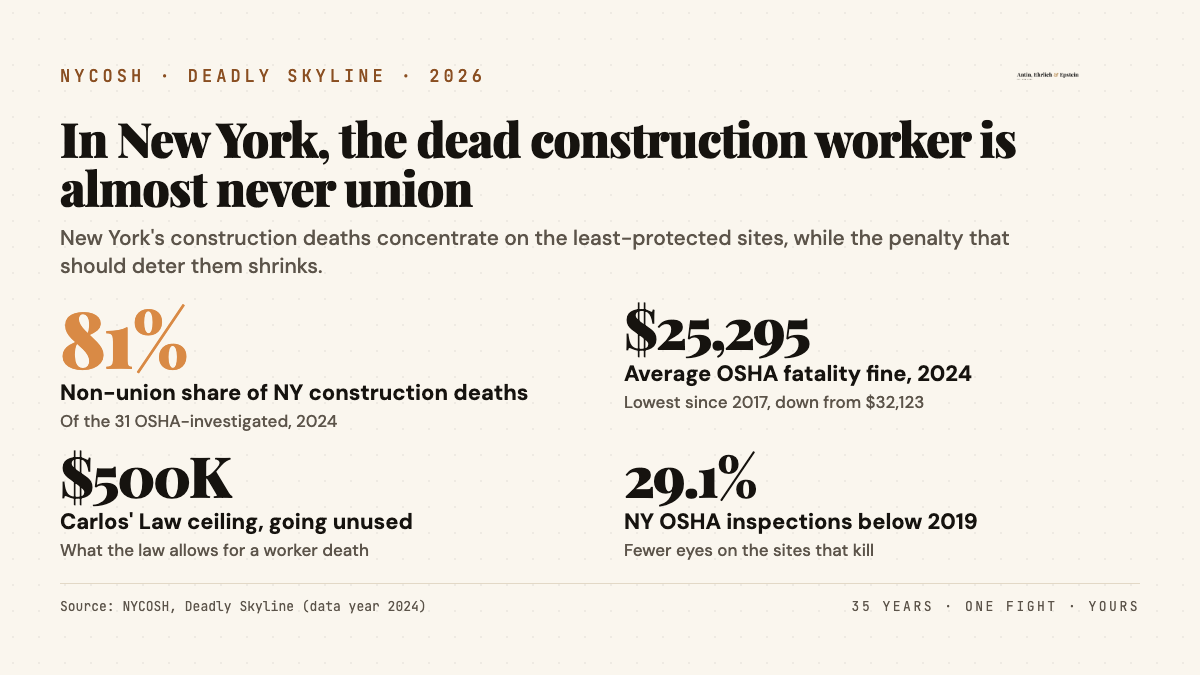
The same report tracks the retreat. The average OSHA fine for a fatal New York construction case fell to $25,295 in 2024, the lowest since 2017 and down from $32,123 the year before (NYCOSH, Deadly Skyline, May 2026).
New York OSHA inspections sit 29.1% below pre-pandemic levels. Carlos’ Law lets the state seek up to $500,000 from a company when a worker dies, and NYCOSH reports that ceiling is going unused. The deaths cluster where protection is weakest, and the penalty that should answer them is shrinking.
Methodology
The figures here come from NYCOSH’s Deadly Skyline report, May 2026 edition, covering data year 2024. NYCOSH is the New York Committee for Occupational Safety and Health, and Deadly Skyline is its annual compilation of New York construction worker deaths, built from OSHA fatality investigations, state records, and public reporting.
The 81% non-union share is calculated against OSHA’s 31 investigated New York State construction fatalities for 2024, so it describes the cases regulators examined, not all 55 statewide construction deaths that year. The n=31 denominator travels with the percentage everywhere it appears.
The average fatality-fine figures ($25,295 in 2024, $32,123 in 2023), the 29.1%-below-2019 inspection decline, the $500,000 Carlos’ Law ceiling, and the statewide and NYC death counts are all read from the same report’s Summary of Findings and Recommendations.
The Deaths Cluster Where Protection Is Thinnest
NYCOSH counted 55 construction worker deaths across New York State in 2024, down from 74 in 2023. New York City carried 19 of them, down from 30 the year before, with the city’s construction fatality rate falling to 9.4 per 100,000 workers from 11.6. The headline counts are down. The structure underneath them is not.
That structure is the 81%. Of the 31 fatalities OSHA investigated in 2024, 81% of the workers who died were non-union (NYCOSH, Deadly Skyline, May 2026). NYCOSH has reported the same concentration before.
In an earlier edition the report found construction deaths happened on non-union job sites roughly 80% of the time, a finding independent trade coverage attributed to NYCOSH.
So the 81% isn’t a one-year artifact. It’s a durable pattern: New York’s construction deaths land, year after year, on the sites where workers have the least bargaining power, the least safety training infrastructure, and the least protection.
NYCOSH sets that gap against a broader vulnerability. Across all New York worker deaths in 2024, the report notes that Latinx workers made up 25.8% of fatalities while making up 18.6% of the workforce.
That over-representation is an all-industry figure, not a construction-only death share, and it belongs here only as context for who carries the most exposure on the lowest-protected sites. The non-union 81% is the construction-specific number.
The Penalty That Should Deter Is Shrinking
If the deaths cluster on the least-protected sites, the answer is supposed to be enforcement. Enforcement is retreating.
The average OSHA fine for a fatal New York construction case fell to $25,295 in 2024 (NYCOSH, Deadly Skyline, May 2026). That’s the lowest average fatality fine since 2017, and it’s down from $32,123 in 2023, a drop of roughly 21% in a single year.
The penalty a company expects to pay when a worker dies on its site got smaller, not bigger, in the same window the protection gap stayed wide.
The inspection record points the same direction. New York OSHA inspections sit 29.1% below pre-pandemic (2019) levels (NYCOSH, Deadly Skyline, May 2026). Fewer inspectors on fewer sites means fewer chances to catch a missing guardrail, an untied harness, or an unshored trench before it kills someone.
Then there’s Carlos’ Law. New York enacted it in 2022, raising the maximum corporate penalty for a worker’s death to up to $500,000.
NYCOSH’s report names enforcing Carlos’ Law as a core recommendation, and the reason is the gap the numbers above describe: a $500,000 ceiling sits over a $25,295 average fine.
The law to hold companies seriously accountable exists. NYCOSH reports it is going unused.
NYCOSH’s own recommendations name the fix in plain terms. Enforce Carlos’ Law against companies whose negligence kills workers. End public funding, permits, and licenses for repeat-offender contractors, so the firms with the worst safety records stop getting subsidized to keep building.
And preserve the Scaffold Safety Law. Those are the issuing body’s asks, drawn from its public record, not anyone’s sales pitch.
The Shield That Still Reaches a Non-Union Worker
Most of the protections a union worker takes for granted, the steward, the training fund, the grievance process, don’t exist on the sites where 81% of these deaths happen. One protection does reach across that line. It’s the one NYCOSH names first among the laws it says must be preserved.
NY Labor Law § 240(1), the Scaffold Safety Law, lets an injured worker or their family hold the property owner and the general contractor liable for a gravity-related construction injury: a fall from height, a falling object, a scaffold or ladder failure.
It reaches the owner and the GC, not just the small subcontractor that often actually employs the worker. That structure matters for a non-union worker, because the sub at the bottom of the chain, the one paying cash or running off the books, is frequently the one with no insurance and no assets.
The law lets the family hold the parties who controlled the site, regardless of who signed the worker’s check or whether a union ever set foot on the job.
That’s why NYCOSH lists preserving the Scaffold Safety Law alongside enforcing Carlos’ Law and cutting off public money to repeat offenders. To a worker on a non-union site, it’s the legal protection that doesn’t depend on having a union behind you.
A few points follow from the data above for someone hurt, or for a family that lost someone, on a New York construction site.
Non-union status doesn’t close the door. A worker on a non-union site, paid in cash, or working for a sub that isn’t on any certified payroll is still covered by Labor Law 240 when the law’s elements are met.
The right defendants are the owner and the general contractor. Whether the law applies turns on the specific facts of how the injury happened, not on whether the worker carried a union card.
The enforcement gap is a reason to preserve the records. With OSHA inspections down 29.1% from pre-pandemic levels and the average fatality fine at its lowest since 2017, the public enforcement file on a given site may be thin.
That makes the worker’s own documentation more important: photos of the site, names of who was present, pay records, and any text messages about the work. Those documents matter to any claim.
Carlos’ Law and the civil claim are different tracks. Carlos’ Law is a criminal penalty the state can pursue against a company. A Labor Law 240 claim is a separate civil matter that an injured worker or family brings to hold the owner and contractor liable.
They don’t cancel each other out, and one isn’t a substitute for the other.
New York’s construction deaths concentrate where protection is thinnest, while the penalty that should answer them shrinks.