
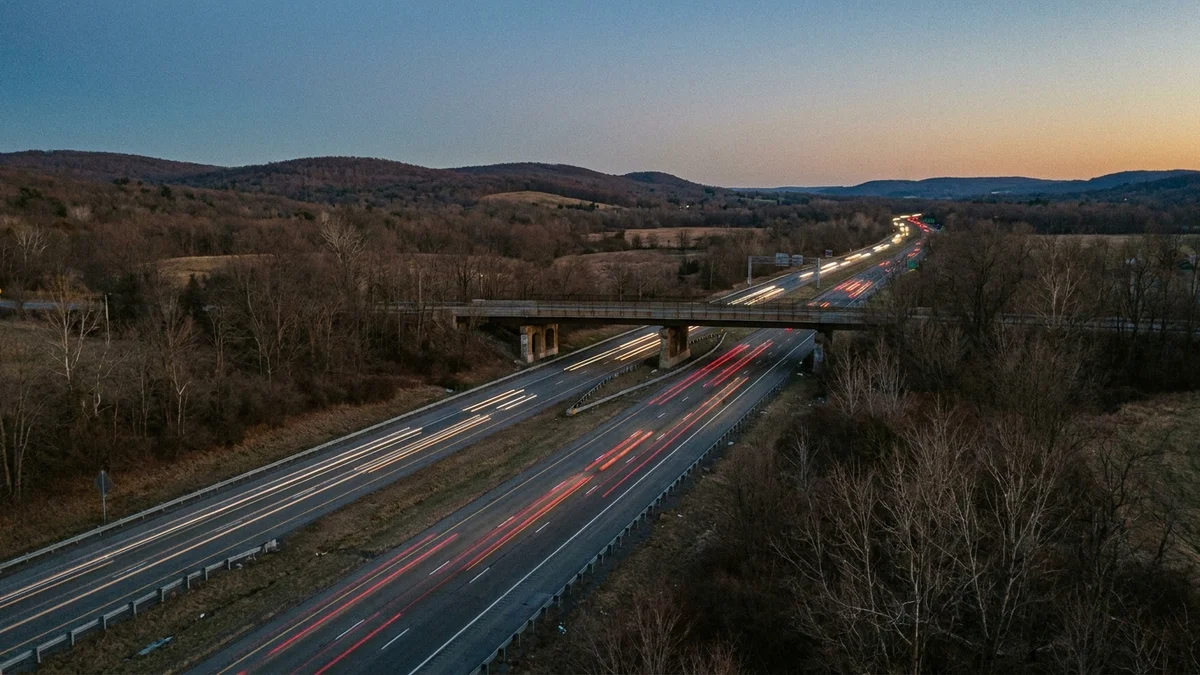
New York recorded 1,101 traffic deaths in 2024, 17.9% more than it recorded in 2019.
Most people assume road deaths spiked during the pandemic and then drifted back to normal. The first half is right. The second half is not.
New York City has made real progress on its own streets. The city closed 2025 with the fewest traffic deaths in its recorded history, and that good news is easy to read as the whole state’s story. It isn’t. Across all of New York, the pandemic-era jump in road deaths is still on the books.
Methodology
We counted every fatal traffic crash and every resulting death in New York State from the federal Fatality Analysis Reporting System, the national census of every crash that kills someone on a public road.
Deaths are the sum of all fatalities in each calendar year, and a fatal crash is any crash that kills at least one person within 30 days.
Figures for 2019 through 2023 come from the final FARS files. The 2024 figure comes from the 2024 Annual Report File, the annual release NHTSA publishes before the final file, and it can revise slightly. Every number below reflects New York State, not New York City alone.
Still Above the Pre-Pandemic Line
Traffic deaths in New York have not been this low since 2019, when 934 people died. That was the bottom of a long decline. In 2024, the count was 1,101.
The gap is 167 deaths, a 17.9% increase over the 2019 baseline. Fatal crashes moved the same way, from 879 in 2019 to 1,036 in 2024, also up about 18%.
| Year | Traffic deaths | Fatal crashes | Change vs 2019 |
|---|---|---|---|
| 2019 | 934 | 879 | baseline |
| 2020 | 1,045 | 958 | +11.9% |
| 2021 | 1,156 | 1,098 | +23.8% |
| 2022 | 1,182 | 1,111 | +26.6% |
| 2023 | 1,117 | 1,035 | +19.6% |
| 2024 | 1,101 | 1,036 | +17.9% |
That 2024 count is the lowest of the post-2019 stretch. It is also still higher than any single year New York recorded from 2016 through 2019.
A Decade of Progress, Undone
The 2019 figure was not a random low point. It was the end of a run. New York cut its traffic deaths every year from 2015 to 2019, from 1,136 down to 934, the fewest in the state’s modern record.
Then the direction reversed. Deaths jumped to 1,045 in 2020 and kept climbing into 2022. By 2024, at 1,101, New York had landed back around where it stood in 2015 and 2016, before that late-decade progress happened at all.
That is the part the headline number hides. This is not only a state that is above its 2019 low. It is a state that erased several years of hard-won safety gains and has not rebuilt them.
The Peak Has Passed. The Floor Has Not.
There is good news in the recent numbers, and it is worth stating plainly. Deaths peaked at 1,182 in 2022. They fell to 1,117 in 2023 and 1,101 in 2024. That is a 6.9% drop off the peak, two years running.
So the state is not surging. Anyone reading these numbers as a runaway crisis is reading them wrong.
But easing is not the same as recovered. Two years of decline have clawed back only a fraction of the pandemic-era rise.
The floor under New York’s road toll reset higher in 2020, and it has stayed higher every year since. A person is still meaningfully more likely to die on a New York road today than in 2019.
What This Means for New Yorkers
Behind the 167-death gap are families. Each of those deaths is a wrongful-death case in waiting, and New York law puts a clock on all of them.
A family can bring a wrongful-death claim under EPTL Section 5-4.1, generally within two years of the death. New York still limits those damages to economic losses, which means lost future earnings and funeral costs rather than the family’s grief. The legislature has tried to change that more than once, and it has not become law.
When a road itself is part of the story, a bad merge, a missing barrier, a flooded low spot, or worn markings, a government entity may share responsibility. Claims against the state, a city, or a county run on a much shorter clock.
A General Municipal Law Section 50-e Notice of Claim is generally due within 90 days of the crash, and missing it can end a claim before anyone looks at the facts.
The statewide numbers also matter as evidence. When a fatal crash happens on a stretch of road that state data already flags as dangerous, that record can help show a government entity knew about the risk. The pattern is public. Whether a specific road was on notice is the question a case turns on.
New York’s roads are safer than they were in 2022. They are not as safe as they were in 2019, and five years is long enough to stop calling that a blip.