NYC’s first round of Local Law 126 parking structure inspections flagged 110 of 550 categorized structures as having unsafe conditions. That’s roughly 1 in 5 under the city’s Periodic Inspection of Parking Structures program. The data sits on the Department of Buildings’ public inspection map, which rates every reporting structure Safe, SREM, or Unsafe at the address level. City Hall hasn’t published it as a borough risk index. We did.
Methodology
Counts come from the NYC Department of Buildings Periodic Inspection of Parking Structures (PIPS) program, which Local Law 126 of 2021 established. The citywide figure is the 550 structures the DOB had categorized by the January 2024 reporting window under Sub-Cycle 1A, of which 110 carried unsafe conditions.
Habitat Magazine reported that January 2024 snapshot, citing the DOB reporting window for the citywide tally of 110 unsafe of 550 categorized, the 62% compliance rate, the roughly 400 fined owners, and the 214 West 80th Street shutdown. Building-level facts on 57 Ann Street come from the DOB’s final investigation report released April 28, 2025, plus ABC7 New York and Tribeca Trib coverage of the official findings.
Classification definitions follow the DOB’s PIPS rules: Safe, SREM (Safe With Repairs and/or Engineering Monitoring), and Unsafe.
What 57 Ann Street Tells Us
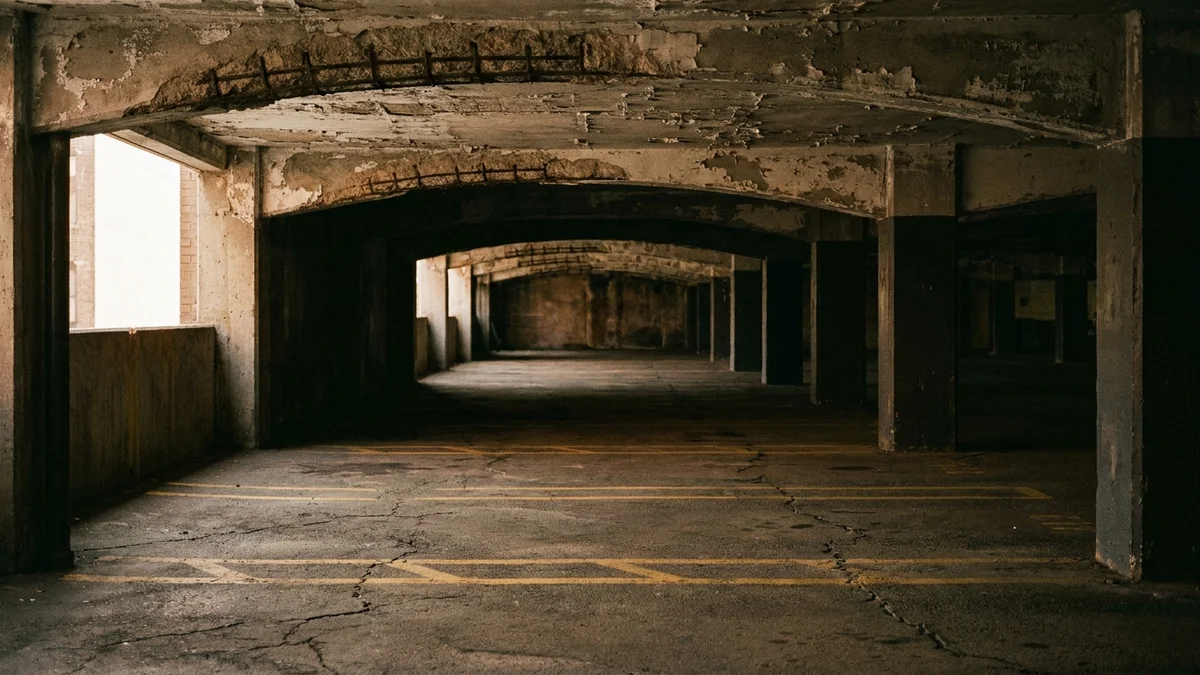
The building at 57 Ann Street went up in 1925. By the time of the April 18, 2023 collapse, the DOB had issued 64 violations on the structure across nearly five decades, including concrete defects and ceiling cracks in 2003, broken stairs and loose concrete in 2009, and exit door issues in 2013. Workers were removing bricks from a load-bearing pier on the day of the collapse. Engineers had assumed a steel column sat encased within the masonry. There was no steel.
When a vehicle drove past the compromised pier on the roof level, the column failed. The second floor came down on the first. Willis Moore, the garage’s longtime manager, died at the scene. Buildings Commissioner Jimmy Oddo called the failures “human errors” that were “preventable.” No criminal charges were filed.
…there was no steel inside the masonry pier. There was very little brick left to support that whole area of the floor.
Within days of the collapse, the DOB flagged 61 garages citywide as immediately hazardous. Several Manhattan and Brooklyn structures closed for emergency assessment. The 161 William Street Pace University building, next door to the collapse site, lost its spring semester to evacuation.
The Inspection Cycle Is Now the Map
Local Law 126 of 2021 created the Periodic Inspection of Parking Structures (PIPS) program. Every parking structure in NYC has to be inspected by a Qualified Parking Structure Inspector at least once every six years. The inspector files an iPIPSR form with the DOB classifying the structure. Three categories apply:
- Safe: no unsafe conditions, no repairs required to maintain integrity through the next six years.
- SREM (Safe With Repairs and/or Engineering Monitoring): presently safe, but requires repair or monitoring inside the next one to six years to prevent deterioration.
- Unsafe: hazardous to persons or property, repair required within 90 days of filing (extendable by the DOB), with a $1,000-per-month penalty for an uncured condition.
The rollout splits the city into three sub-cycles inside the first six-year window:
| Sub-Cycle | Geography | Filing window |
|---|---|---|
| 1A | Manhattan Community Districts 1 through 7 | Jan 1, 2022 to Dec 31, 2023 |
| 1B | Manhattan Community Districts 8 through 12, all Brooklyn | Jan 1, 2024 to Dec 31, 2025 |
| 1C | Bronx, Queens, Staten Island | Jan 1, 2026 to Dec 31, 2027 |
After Cycle 1 closes in 2027, the six-year rhythm restarts citywide.
What the First Cycle Actually Found
By the January 2024 reporting window, the DOB had categorized 550 parking structures citywide. It reported 110 of them, about 1 in 5, with unsafe conditions. Sub-Cycle 1A pulled the oldest, densest, highest-use inventory in the city. Lower Manhattan, Midtown, and the Upper East and West Sides hold parking structures built in the 1920s through the 1960s on tight urban lots with continuous load cycling. Newer suburban-style garages in the outer boroughs may move the rate as Sub-Cycles 1B and 1C close.
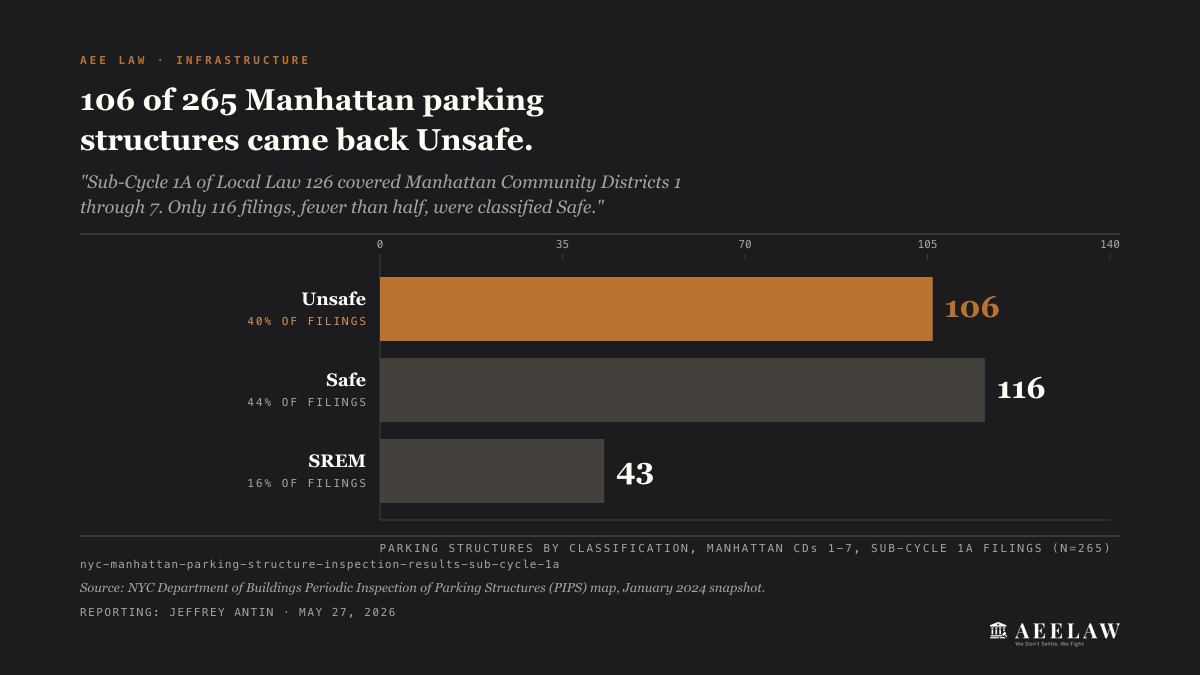
The compliance rate at the December 31, 2023 deadline was 62%. About 400 garage owners were fined for missing it. One garage at 214 West 80th Street in Manhattan was ordered shut down outright after an inspector found significant concrete damage and questioned the structural capacity of the floor slabs.
The Legal Framework When a Garage Fails
Three statutory frameworks attach to a parking structure failure in NYC.
Premises liability under New York common law. Owners and operators owe a duty of reasonable care to anyone lawfully on the property. A 98-year-old structure with 64 open or prior violations is not a reasonable-care record. CPLR § 214 generally gives three years from the date of injury to file. Wrongful death claims under EPTL § 5-4.1 have a two-year limit from the date of death.
Labor Law § 240(1), the Scaffold Law. When the collapse happens while workers are doing demolition, repair, or alteration inside the structure, gravity-related injuries trigger absolute liability on the owner and general contractor. The Ann Street collapse happened during exactly this kind of work, an attempted pier repair. Labor Law § 240(1) removes the comparative-negligence defense once the safety device failed or was absent.
Labor Law § 241(6) and Industrial Code violations. Specific safety regulation violations on a construction or alteration site, including improper shoring, inadequate temporary support, and failure to inspect critical members, support an Industrial Code negligence claim under Labor Law § 241(6). The PIPS inspection record itself becomes evidence of the owner’s notice of structural condition.
Spoliation risk. After a collapse, the physical evidence is the debris field. Owners, insurers, and contractors have an interest in clearing the scene quickly. Photographing the failure plane, securing the load-bearing members for forensic inspection, and getting a court order against premature demolition are early-day moves that decide whether the case can be proven. A garage with 64 prior violations who clears the site before plaintiff’s engineer arrives loses none of those violations to the case. The DOB record stays. But the failure surface is what tells the jury whether the collapse was foreseeable.
What This Means
Three takeaways:
The risk map already exists. The DOB inspection map publishes Safe, SREM, and Unsafe status at the address level. Anyone with a phone can check a garage before parking in it or working in it. The map updates as Sub-Cycles 1B and 1C close. Brooklyn and upper Manhattan close by the end of 2025. The Bronx, Queens, and Staten Island close by the end of 2027.
The first cycle is the worst cycle. Sub-Cycle 1A pulled the oldest inventory in the densest part of the city. The 1-in-5 unsafe rate across the first 550 categorized structures is a directional ceiling on what we should expect from later sub-cycles. The newer borough inventory will likely show fewer Unsafe ratings, but the same kind of long-tail aging hazards.
The Ann Street collapse was not a freak. It was a 1925 structure with 64 violations whose owners hired a handyman to remove bricks from a load-bearing pier. The first round of Local Law 126 inspections found 110 structures already carrying unsafe conditions before repair work even starts.
The map’s published. The repair clock is running.