

NYC paid $266.7 million to settle claims against the NYPD in fiscal year 2023. That was the second-highest single-year total on record, up 12% from $239.1 million in FY22. Citywide tort settlements across every agency totaled $739.6 million, meaning NYPD claims accounted for roughly 36 cents of every dollar the city paid out.
Methodology
The borough and agency totals here come directly from the NYC Comptroller’s Annual Claims Report covering fiscal year 2023 (July 1, 2022 to June 30, 2023), published April 16, 2024. Citywide tort claim totals are reported by the Comptroller across all city agencies. The Legal Aid Society’s Cop Accountability Project 2025 settlement totals are tracked separately and cover police misconduct lawsuits resolved in calendar year 2025. The two datasets measure different windows and slightly different categories: the Comptroller report covers all NYPD tort claims (excessive force, false arrest, motor vehicle, property damage), while the Cop Accountability Project tracks civil rights misconduct cases only. Both are cited for the time periods they cover. Borough-level data reflects total tort payouts across every city agency in FY23, not NYPD alone.
The Bronx Pays Out More Than Every Other Borough
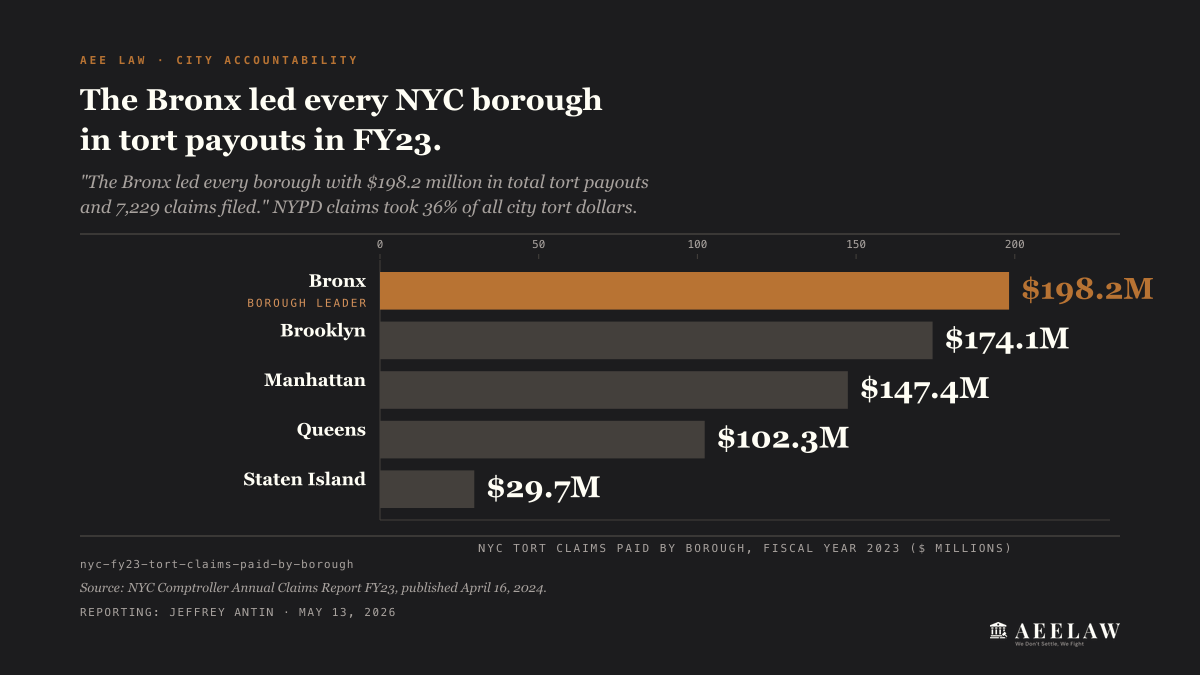
In FY23, the Bronx accounted for $198.2 million in NYC tort payouts across every city agency. That was the highest of any borough. The Bronx also led in total claims filed at 7,229. Brooklyn followed at $174.1 million, Manhattan at $147.4 million, Queens at $102.3 million, and Staten Island, the lowest, at $29.7 million.
The Bronx total reflects both volume and severity. NYC’s poorest borough also carries the highest rates of NYPD stops per capita according to historical NYCLU stop-and-frisk reporting, and it concentrates a disproportionate share of public housing units where premises liability claims arise. Both threads feed the tort line.
The chart above renders five bars, one per borough, sorted by total FY23 tort payouts. Bronx in Burnt Copper as the leader. Brooklyn, Manhattan, Queens, and Staten Island in slate behind it. Source: NYC Comptroller’s published FY23 claims report.
NYPD Claims Took 36 Cents of Every Tort Dollar
Of the $739.6 million NYC paid in tort claims across every agency in FY23, $266.7 million came from claims filed against the NYPD. That is roughly 36%. The Department of Education came in second by share, at $92.8 million according to the same Comptroller report. Every other agency combined made up the balance.
In FY22, NYPD payouts were $239.1 million. The 12% jump to $266.7 million in FY23 outpaced the citywide tort total, which barely moved from $737.8 million to $739.6 million. Claims filed against the NYPD rose too. The Comptroller counted 6,891 NYPD tort claims in FY23, a 50% jump from 4,588 the year before and the first annual increase since FY2014.
What Section 1983 Adds
Most police misconduct lawsuits against the NYPD are filed under 42 U.S.C. § 1983, the federal civil rights statute enacted in 1871 to enforce the Fourteenth Amendment. It allows anyone to sue a government official who, acting under color of law, deprives them of constitutional rights. 42 U.S.C. § 1988 provides for attorney’s fees in successful civil rights actions, which is why firms take these cases when the city’s typical settlement is below typical defense costs.
Common Section 1983 claims against the NYPD include:
- Excessive force, including use of tasers, batons, restraints, and deadly force
- False arrest and false imprisonment, when an officer arrests without probable cause
- Unlawful search and seizure, including warrantless entries and stop-and-frisk encounters
- Malicious prosecution, when officers initiate or continue charges they know lack basis
- Failure to intervene, when one officer fails to stop another from violating rights
- Fabrication of evidence, including coerced confessions and false reports
The Legal Aid Society’s Cop Accountability Project, which has tracked NYPD settlements for years, reported $117,251,230.82 in misconduct payouts across 1,044 settled lawsuits in 2025. That was the fourth consecutive year payouts exceeded $100 million. Since 2019, the project’s running total of NYPD misconduct settlements has reached nearly $800 million. Wrongful conviction cases accounted for $42 million, roughly 36% of the 2025 total.
The Cop Accountability number ($117M) and the Comptroller’s NYPD tort total ($266.7M FY23) measure different things. The Comptroller covers all NYPD-related claims including motor vehicle collisions with police vehicles, property damage, and personal injury beyond civil rights. The Cop Accountability Project covers only the civil rights subset. Both numbers are real, both are public, and the gap between them is the line where misconduct ends and other torts begin.
Where the Precinct Map Goes Next
The Comptroller’s published FY23 report breaks out borough totals but does not publish precinct-level NYPD claims data in its summary. That granular layer exists inside the city’s claims management system. A precinct-level map of where NYPD settlement dollars actually land would require a FOIL request against the claims management database, joined to the NYPD’s published precinct boundaries. The closest publicly available proxy today is the Civilian Complaint Review Board’s substantiated complaint data on NYC Open Data, which is reported by precinct.
Building that join is the next data harvest on this beat. Until then, the borough-level numbers reported here are the most granular public view of where NYC’s NYPD-related tort dollars actually go.
Borough Deep Dives
Each borough’s NYPD claim pattern looks different up close. The Bronx leads in volume. Brooklyn carries the city’s largest single liability cluster. Manhattan’s payouts concentrate in cases, not precincts. Queens owns the largest individual wrongful conviction settlement in city history. Staten Island, the smallest by dollar volume, anchors the policy legacy of Eric Garner.
- The Bronx: $198M in tort payouts and a South Bronx precinct corridor
- Brooklyn: the Scarcella debt and the 77th Precinct ratio
- Manhattan: how a 1986 investigation keeps paying out in 2025
- Queens: $47.7M, three exonerations, one DA’s office
- Staten Island: small numbers, defining moments
What This Means for People Hurt by Police
If you are injured by NYPD officers, a Section 1983 lawsuit is the standard federal vehicle for civil rights claims. The City typically defends and indemnifies officers in these cases, meaning the City, not the officer personally, pays settlements. Three points the data above changes:
The settlement universe is large and growing. $266.7M paid by the city in a single year is not a one-off, it’s a four-year trend. The City has demonstrated capacity to settle high-value civil rights claims when liability is clear.
The borough you were hurt in matters less than the claim type. The Bronx leads borough totals because of volume across all agencies, not because civil rights cases settle for more there. A strong Section 1983 claim from any borough resolves through the same legal framework.
Wrongful conviction cases drive the upper tier. Roughly 36% of 2025 misconduct payouts, about $42 million, came from wrongful conviction matters, where the underlying injury is years of liberty deprivation and the legal framework permits substantial damages.
Section 1983 is the only law that bills the City per officer.


