New York City paid $117,251,230.82 to settle 1,044 police misconduct lawsuits in 2025. That is the fourth consecutive year payouts exceeded $100 million.
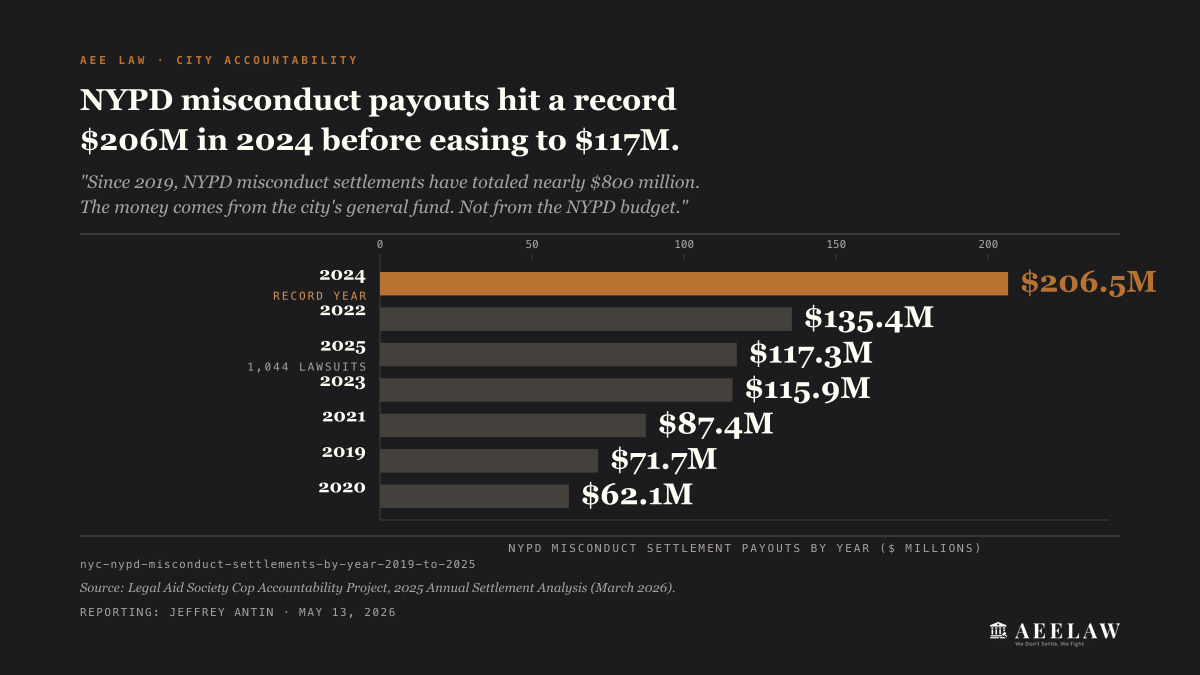
Since 2019, NYPD misconduct settlements have totaled nearly $800 million. The money comes from the city’s general fund. Not from the NYPD budget. Not from the officers involved. From taxpayers.
Seven Years of Payouts
The Legal Aid Society’s Cop Accountability Project tracks NYPD settlement data annually. Their analysis shows a pattern that has not broken.
| Year | Total payouts | Lawsuits settled |
|---|---|---|
| 2019 | $71,723,243 | 1,276 |
| 2020 | $62,103,992 | 929 |
| 2021 | $87,405,727 | 753 |
| 2022 | $135,404,617 | 973 |
| 2023 | $115,852,781 | 811 |
| 2024 | $206,472,257 | 980 |
| 2025 | $117,251,231 | 1,044 |
| Total | $796,213,847 | 6,766 |
The 2024 spike to $206 million included several large wrongful conviction payouts. The 2025 figure is lower but still represents the fourth consecutive year above $100 million.
At 1,044, the number of lawsuits settled in 2025 is the highest since 2019, when 1,276 were resolved.
Where the Money Went
Wrongful conviction cases dominated the 2025 payouts, accounting for about $42 million, roughly 36% of the total. Another $28 million, nearly a quarter of the total, went to incidents that happened more than two decades ago.
Eric Smokes: $13 Million
David Warren: $11.1 Million
Steven Lopez: $3.9 Million
Nine People Framed by Two Officers: $5.2 Million Combined
Two NYPD officers were later convicted of falsifying testimony and paperwork in cases from 2014 to 2016.
Other significant 2025 settlements:
| Case | Amount |
|---|---|
| Man blinded in one eye by police stun gun | $5,750,000 |
| Brigid Pierce: TBI from assault during Brooklyn protest | $2,000,000+ |
| Cheyenne Lee: warrantless entry, false arrest (Bronx) | $125,000 |
The Cheyenne Lee case is worth examining. Nine officers from the 42nd Precinct entered her Bronx home without a warrant, arrested her teenage nephew, then arrested her when she protested. The city paid $125,000 to settle.
The Bigger Picture: City Tort Claims
NYPD settlements are the largest single category in the city’s annual claims liability.
The NYC Comptroller’s Annual Claims Report reported that the city paid $1.94 billion in total injury and tort claims in fiscal year 2024. That is a record, and a 29.3% increase over the prior year.
| Agency | FY 2024 payouts |
|---|---|
| NYPD | $309.56 million |
| Dept. of Correction | $252.87 million |
| Dept. of Education | $128.07 million |
| Dept. of Transportation | $115.27 million |
| Health + Hospitals | $45.77 million |
NYPD claims filed in FY 2024: 9,249. That is a 31.8% increase from 7,017 in FY 2023.
The Legal Framework
Most police misconduct lawsuits in New York are filed under 42 U.S.C. Section 1983, the federal civil rights statute enacted in 1871. It allows people to sue government officials who deprive them of constitutional rights while acting under color of law.
42 U.S.C. § 1988 provides for attorney’s fees in successful civil rights actions, which is why firms take these cases.
Common Section 1983 claims against the NYPD include:
- Excessive force (Fourth Amendment): officers using more force than reasonably necessary, per the standard in Graham v. Connor, 490 U.S. 386 (1989)
- False arrest: seizure without probable cause or a warrant
- Unlawful search: entering a home or searching a person without legal authority
- Malicious prosecution: pursuing criminal charges without probable cause
- Failure to intervene: officers who witness misconduct and do nothing
- Fabrication of evidence: manufacturing or manipulating evidence to secure convictions
- Monell claims: municipal liability under Monell v. Department of Social Services, 436 U.S. 658 (1978) when the city’s own policy or custom caused the violation
The Eric Smokes and David Warren cases illustrate the fabrication category. Officers manufactured evidence that sent two men to prison for murder, a combined 44 years behind bars for a killing they did not commit. The city paid $24.1 million.
Qualified Immunity: The Barrier
Qualified immunity is the primary legal obstacle in police misconduct cases. The doctrine shields government officials from civil lawsuits unless they violated a “clearly established” constitutional right.
In practice, this means an officer can use excessive force and avoid liability if no prior court decision addressed the specific circumstances of their conduct. The standard does not ask whether the officer’s actions were constitutional. It asks whether existing case law put the officer on notice.
Body Camera Accountability
Body cameras were supposed to increase accountability. The data on that is mixed.
A NYC Comptroller audit in October 2025 found that the NYPD is non-compliant with Freedom of Information Law obligations for body camera footage. Of 355 appeals of denied footage requests between 2020 and 2024, 344 were granted, a 97% reversal rate. The NYPD systematically denies initial requests.
A CUNY ISLG study in December 2025 examined 2022 footage and found that 19% of reported stops were unconstitutional. The court-appointed federal monitor overseeing NYPD stop-and-frisk practices found “significant discrepancies” between the department’s self-reported compliance rates and actual findings.
Stops are rising again: from 8,947 in 2021 to 25,386 in 2024, the highest count since 2014. NYPD supervisors rate the overwhelming majority of those stops as compliant. Independent review contradicts that self-assessment.
Repeat Offenders on the Force
The Legal Aid Society maintains the Law Enforcement Lookup database, containing more than 450,000 records of alleged officer misconduct.
Their analysis found officers with multiple lawsuits who remain on active duty. Pedro Rodriguez of Brooklyn’s 72nd Precinct has been named in four lawsuits resulting in $12,050,000 in total payouts and has 19 allegations with 10 substantiated for abuse of authority. He is still on the force.
As the Legal Aid Society’s Jennvine Wong stated: “New Yorkers are once again paying the price for alleged police misconduct, and the numbers from the full 2025 calendar year make clear that this pattern continues.”
How NYC Compares
A FiveThirtyEight analysis of 31 major U.S. cities found NYC’s police misconduct payouts far exceed any other city.
| City | 10-year total | Annual average |
|---|---|---|
| New York City | $1.7 billion | $170.4 million |
| Chicago | $467.6 million | $46.8 million |
| Los Angeles | $329.9 million | $33.0 million |
Chicago’s payouts surged in 2025, exceeding $204 million for wrongful convictions alone. A single September 2025 settlement reached $90 million. But even at those elevated levels, NYC’s payouts dwarf every other city.
Per capita, NYC taxpayers paid approximately $14.12 per resident for NYPD misconduct settlements in 2025. Over seven years, the cumulative cost: $95.93 per resident.
What This Means
The $117 million represents cases that settled. It does not capture open cases, cases dismissed on qualified immunity grounds, or the legal defense costs the city incurs fighting these claims through its Law Department.
NYPD’s FY 2026 budget is $6.15 billion. Misconduct settlements represent roughly 2% of that. But the settlements come from the city’s general fund, not the police budget, which means the department bears no direct financial consequence for officer behavior.