

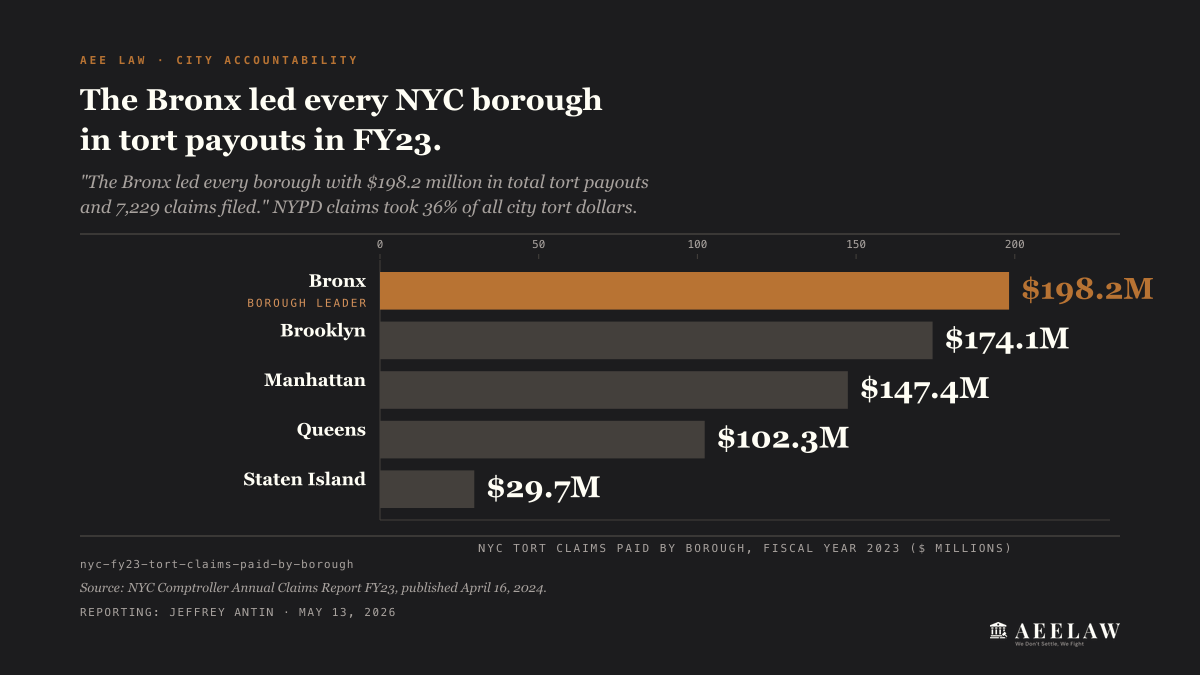
In FY23, Manhattan absorbed $147.4 million in all-agency tort payouts from the city. That ranked third among the five boroughs, behind the Bronx at $198.2 million and Brooklyn at $174.1 million. But the headline number obscures something more specific: two of the five largest individual NYPD misconduct settlements in 2025 trace to a single midtown Manhattan street corner from 38 years earlier. One case. One night. One corrupt detective. Twenty-four million dollars paid out decades later.
Methodology
Borough totals here come directly from the NYC Comptroller’s Annual Claims Report covering fiscal year 2023 (July 1, 2022 to June 30, 2023), published April 16, 2024. The borough figures represent all-agency tort payouts geolocated to each borough, not NYPD-specific figures. The Comptroller does not publish NYPD-specific settlement dollars broken out by borough. The $266.7 million citywide NYPD total for FY23 exists only as one citywide figure. Named settlement amounts come from the Legal Aid Society’s Cop Accountability Project 2025 Annual Analysis, which tracks civil rights misconduct cases under NYC Admin Code § 7-114. Precinct-level settlement pattern data comes from the Comptroller’s Blueprint to Address Police Misconduct (October 2024).
Manhattan’s Liability Lives in Cases, Not Precincts
The NYC Comptroller’s Blueprint to Address Police Misconduct, published October 2024, identifies the 14 precincts that generated the most NYPD settlement costs across the city from 2019 to 2024. None of them are in Manhattan.
This is not an oversight. It reflects a structural difference in how police misconduct liability concentrates in Manhattan compared to the outer boroughs. In Brooklyn and the Bronx, settlement dollars cluster visibly in a handful of high-complaint, high-volume precincts. In Manhattan, the pattern is more dispersed: claims spread across a larger number of precincts at lower per-precinct settlement totals. The borough has 23 precincts covering roughly 1.60 million residents. No single precinct runs far enough ahead of the others to reach the Blueprint’s threshold.
The data file available to this analysis confirmed complaint volume at the 25th Precinct (East Harlem) and the 34th Precinct (Washington Heights/Inwood) as historically elevated among Manhattan precincts, consistent with CCRB data tracked at ProPublica’s NYPD misconduct database. But neither generated a blockbuster settlement in the 2022 to 2025 window that would pull either precinct into the Blueprint’s top tier.
| Precinct | Neighborhood | Pattern Note |
|---|---|---|
| 25th Precinct | East Harlem | Historically among Manhattan's highest CCRB complaint precincts. No Manhattan precinct in Comptroller Blueprint top-14 (2019 to 2024). |
| 34th Precinct | Washington Heights / Inwood | Elevated complaint volume in upper Manhattan. Settlement dollars dispersed, not concentrated, compared to Bronx and Brooklyn patterns. |
The absence of Manhattan precincts from the Blueprint’s top tier is itself a data point. The borough carries $147.4 million in FY23 all-agency tort costs. The NYPD settlement component is real but distributed. What’s not distributed is the wrongful-conviction layer, where geography matters only because it anchors to where an incident happened decades ago.
The 1987 Investigation That Keeps Paying Out
Shortly after midnight on New Year’s Day 1987, a 71-year-old French tourist named Jean Casse was murdered during a street robbery on West 52nd Street in midtown Manhattan. Two men were convicted for it. Both convictions were wrong.
Eric Smokes was 19 years old at the time of arrest. He spent 24 years in prison before his release. David Warren was 16. He served 20 years. Both were convicted based on witness identifications that Manhattan DA Alvin Bragg’s office later determined were coerced and fabricated. Bragg moved to vacate both convictions in 2024, citing fraudulent police practices tied to a corrupt detective.
NYC settled both federal civil rights claims in 2025, in the Southern District of New York.
The compounding-interest frame is not rhetorical. A 19-year-old arrested in 1987 and a 16-year-old arrested the same night: their claims didn’t resolve until 2025. Thirty-eight years of compounding. The investigation took maybe 48 hours. The liability ran almost four decades. The city paid $24.1 million in 2025 for a case it could have prevented in 1987 by not fabricating evidence.
The Smokes and Warren settlements are the Manhattan anchor in a national wrongful-conviction pattern. They are also a reminder of what the Comptroller’s top-14 precinct list does not show: concentrated settlement costs in outer boroughs obscure the single large-dollar cases that can originate anywhere and pay out anytime across a 38-year window.
Section 1983 in Manhattan
Section 1983 claims against the NYPD in Manhattan are filed in the Southern District of New York. The SDNY covers Manhattan and the Bronx. The federal courthouse is the Daniel Patrick Moynihan U.S. Courthouse at 500 Pearl Street in lower Manhattan, three blocks from City Hall.
42 U.S.C. § 1983 is the federal civil rights statute enacted in 1871 to enforce the Fourteenth Amendment. It lets anyone sue a government official who, while acting under color of law, deprives them of constitutional rights. 42 U.S.C. § 1988 provides for attorney’s fees in successful civil rights actions, which is why firms take cases where the city’s expected settlement exceeds the cost of federal litigation.
Two U.S. Supreme Court cases define the substantive standards that govern every Section 1983 claim filed in Manhattan. Graham v. Connor, 490 U.S. 386 (1989) set the objective-reasonableness test for excessive force claims: courts evaluate force from the perspective of a reasonable officer on the scene, not with 20/20 hindsight. Monell v. Department of Social Services, 436 U.S. 658 (1978) established municipal liability: a city is liable under Section 1983 when its own policy or custom caused the constitutional violation. Both cases are active doctrine in every Manhattan NYPD lawsuit.
Manhattan also generated one of the most consequential structural settlements in recent NYPD history. In February 2024, the SDNY approved a settlement agreement resolving a class-action lawsuit over the NYPD Strategic Response Group’s conduct at Manhattan protests, including the 2020 Black Lives Matter demonstrations and the 2023 Jordan Neely protests in SoHo. The settlement restructures how and when the SRG can be deployed citywide, requires additional NYPD oversight mechanisms, and is the most direct court-imposed constraint on crowd-control policing since the Floyd v. City of New York stop-and-frisk consent decree. Because most major Manhattan protests occur in Manhattan, the settlement has its most direct daily operational effect there.
The Smokes and Warren settlements illustrate the fabrication-of-evidence category. Fabrication is the highest-severity Section 1983 claim type: it doesn’t require the plaintiff to show an unreasonable risk of harm in the moment. It requires showing that an officer manufactured evidence that sent a person to prison for a crime they didn’t commit. When that happens, the damages are calculated in decades of liberty lost.
What This Means for People Hurt by Police in Manhattan
If you were injured, wrongfully arrested, or had your rights violated by NYPD officers in Manhattan, a 42 U.S.C. § 1983 lawsuit is the standard federal vehicle. The city defends and indemnifies officers in these cases. The money comes from the general fund, not the NYPD budget, and not from the officer’s personal finances.
Three points the data above changes for anyone considering a Manhattan claim:
The borough’s overall tort total is the third-highest in NYC. Manhattan carries real municipal liability, even if it doesn’t produce the same precinct-level concentration visible in the Bronx and Brooklyn. The underlying claim volume is there.
SDNY is one of the most demanding federal venues in the country for civil rights litigation, but it is also the venue where the city has settled wrongful conviction cases at eight-figure values. The Smokes and Warren settlements did not require a trial. Both cases settled in SDNY after DA Bragg’s conviction integrity work created an unambiguous factual record.
Deadlines are fixed and they don’t move. Claims against the city require a Notice of Claim filed within 90 days of the incident under NY GML § 50-e. The three-year statute of limitations under CPLR § 214 runs from the date of the constitutional violation. For wrongful conviction cases specifically, the clock can start from the date a conviction is vacated, but that question is actively litigated and the answer isn’t typically in the plaintiff’s favor.
The city pays what it’s forced to pay.


