

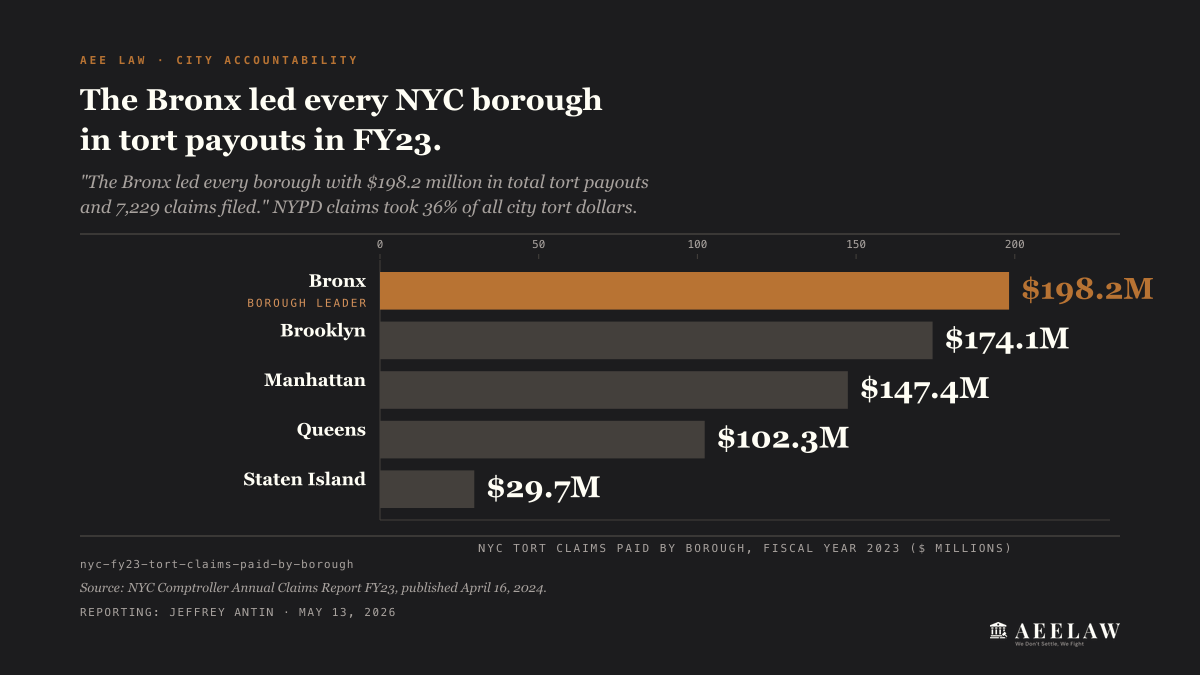
The Bronx filed 7,229 tort claims against New York City in fiscal year 2023 and collected $198.2 million in total payouts. That is more claims than any other borough filed, and more dollars than any other borough collected.
At 533 total tort claims per 100,000 residents and 464 personal injury claims per 100,000 residents, the Bronx runs at more than three times the Queens rate and nearly double the Manhattan rate. Two precincts in the South Bronx account for the densest concentration of NYPD misconduct settlements in the borough.
Methodology
Borough payout and claim-count figures come from the NYC Comptroller’s Annual Claims Report for FY23, published April 2024 and covering July 1, 2022 through June 30, 2023.
Precinct-level settlement data comes from the Comptroller’s Blueprint to Address Police Misconduct (September 2025), which tracks NYPD misconduct settlements from 2019 to 2024. Named case facts are drawn from Innocence Project records, SDNY docket filings on CourtListener, and verified news coverage.
The South Bronx Corridor
The Bronx’s tort liability concentrates in a defined arc stretching from Port Morris north through University Heights. Five precincts in this southern and central corridor account for the bulk of NYPD misconduct settlement dollars, with the 40th and 44th precincts at the top.
| Precinct | Neighborhood | Settled Cases | Total Paid (2019-2024) |
|---|---|---|---|
| 40th | Mott Haven / Melrose / Port Morris | 149 cases | $3.17M |
| 44th | Grand Concourse / Highbridge | 132 cases | $3.37M |
| 46th | University Heights / Morris Heights | 97 cases | $2.77M |
| 52nd | Inwood / Kingsbridge / Fordham | 93 cases | $3.04M |
| 42nd | Melrose / Morrisania | 88 cases | $2.67M |
Both the 40th and 44th precincts logged more than 100 excessive-force CCRB complaints in the 2022 to 2024 window, a threshold that only four NYC precincts cleared citywide during that period.
The 40th Precinct also recorded an 88% increase in complaint volume comparing the 2019 to 2021 average against the 2022 to 2024 average, according to the Comptroller’s Blueprint report.
Together, the 40th and 44th accounted for 281 settled misconduct cases and more than $6.5 million in payouts in the six-year window.
The 45th Precinct in Throgs Neck and Co-op City is the fastest-rising precinct in the borough. It recorded a 323% increase in CCRB excessive-force complaints between the 2019 to 2021 period and the 2022 to 2024 period, the steepest percentage rise of any NYC precinct.
The 46th Precinct in University Heights and Morris Heights carries additional significance beyond its 97 settled cases: the lead NYPD officer in the Norberto Peets wrongful conviction case, Detective Claude Staten, was assigned to the 46th and remained active in the precinct after the conviction was vacated.
That detail comes from Innocence Project case documentation and the civil complaint filed in federal court.
The geographic pattern is consistent with demographic concentration. Each of these five precincts covers neighborhoods where more than 85% of residents are Black or Hispanic, and all sit within or adjacent to the Rikers Island catchment area.
Rikers Island itself, though physically in the East River, is classified under the Bronx for claims purposes. The Department of Correction tort claims routed to the Bronx are a separate but meaningful driver of the borough’s elevated all-agency total, distinct from NYPD misconduct cases.
The NYC Open Data CCRB complaints dataset provides updated complaint counts at the precinct level and is the primary public tool for tracking ongoing CCRB activity in these commands.
Named Cases
$14.75 Million: Norberto Peets Wrongful Conviction
The Peets case illustrates how wrongful-conviction payouts have become a distinct and growing cost center in Bronx civil rights litigation. The lead NYPD officer in the case was assigned to the 46th Precinct, the same command that appears in the Comptroller’s high-cost watchlist with 97 settled misconduct cases and $2.77 million in payouts since 2019.
The wrongful conviction track adds to the misconduct settlement total; it doesn’t replace it.
Nearly $7 Million: Mott Haven Protest Class Action
The Mott Haven class action was concentrated in the 40th Precinct’s coverage area, the same command that leads the Bronx in raw settled-case volume. The settlement was confirmed and covered by Epicenter NYC and is documented in SDNY docket records.
Section 1983 in the Bronx
Most NYPD civil rights cases in the Bronx are filed in the Southern District of New York, which covers Manhattan, the Bronx, and several surrounding counties. The courthouse is the Daniel Patrick Moynihan United States Courthouse at 500 Pearl Street in Lower Manhattan.
The SDNY is one of the busiest federal districts in the country and has developed substantial case law on 42 U.S.C. § 1983 claims against municipal defendants.
42 U.S.C. § 1983, enacted in 1871 under the Civil Rights Act of that year, allows any person to sue a government official who, acting under color of state law, deprives them of rights secured by the Constitution or federal law.
For NYPD cases, the constitutional provision that most commonly drives the claim is the Fourth Amendment prohibition on unreasonable searches and seizures, which covers excessive force, false arrest, and unlawful entry. Wrongful conviction cases also invoke the Fourteenth Amendment due process clause when they allege fabrication of evidence or suppression of exculpatory material.
The threshold standard for excessive-force claims was set by the Supreme Court in Graham v. Connor, 490 U.S. 386 (1989), which requires courts to evaluate the objective reasonableness of an officer’s force based on the circumstances facing the officer at the time.
The Mott Haven class action sits squarely in this analysis: plaintiffs alleged officers used force against a crowd that had not been given a lawful dispersal order.
When the claim rests on a pattern of behavior rather than a single officer’s decision, plaintiffs argue municipal liability under Monell v. Department of Social Services, 436 U.S. 658 (1978). A Monell claim requires showing that the constitutional violation resulted from an official policy, a widespread practice, or a deliberate choice by a policymaker.
The concentration of settled misconduct cases in the 40th, 44th, and 46th precincts gives plaintiffs in Bronx-based cases a foundation to argue persistent pattern rather than isolated incident. The Comptroller’s Blueprint report documents that pattern in the Comptroller’s own data, which makes it a powerful exhibit in any Monell argument.
42 U.S.C. § 1988 provides for attorney’s fees in successful civil rights actions, which is why experienced civil rights firms take these cases even when individual settlement amounts appear modest relative to the cost of litigation.
What This Means for People Hurt by Police in the Bronx
Three procedural deadlines govern every civil rights claim arising from a Bronx encounter with the NYPD.
The first and most unforgiving is the Notice of Claim. Under NY GML § 50-e, anyone bringing a lawsuit against the city or its employees must file a Notice of Claim within 90 days of the incident. This is a precondition to suit, not a litigation deadline.
Missing the 90-day window ordinarily bars the claim entirely, though courts can grant leave to file a late notice in limited circumstances.
The second deadline is the three-year statute of limitations for the federal Section 1983 claim itself. New York courts borrow the state’s three-year personal injury limitations period for Section 1983 actions.
Filing in SDNY means the complaint goes to the Daniel Patrick Moynihan Courthouse at 500 Pearl Street, Manhattan, even though the incident occurred in the Bronx.
The third consideration is the nature of the claim. Wrongful conviction cases, like the Peets case, move on a different timeline than excessive-force or false-arrest claims.
The clock on a malicious prosecution claim typically starts running when the criminal charges are finally dismissed, not at the date of arrest or conviction. That extension is what made the Peets case cognizable in 2024 for a 1996 incident.
The Legal Aid Society’s Cop Accountability Project tracks settled NYPD misconduct lawsuits citywide and publishes annual totals. Their database doesn’t disaggregate by borough, but the precinct-level data in the Comptroller’s Blueprint identifies where the density lies. The Bronx precinct corridor is that density.
Closing
The Bronx doesn’t lead NYC in tort claims because its residents are more litigious. It leads because the data shows the highest policing intensity per capita of any borough.


