

George Bell spent 24 years in prison for murders he didn’t commit. When the city settled his civil rights lawsuit in 2023, the payment was $17.5 million. Bell’s attorney Richard Emery described it at the time as the highest sum New York City had ever paid to resolve a single wrongful conviction.
Methodology
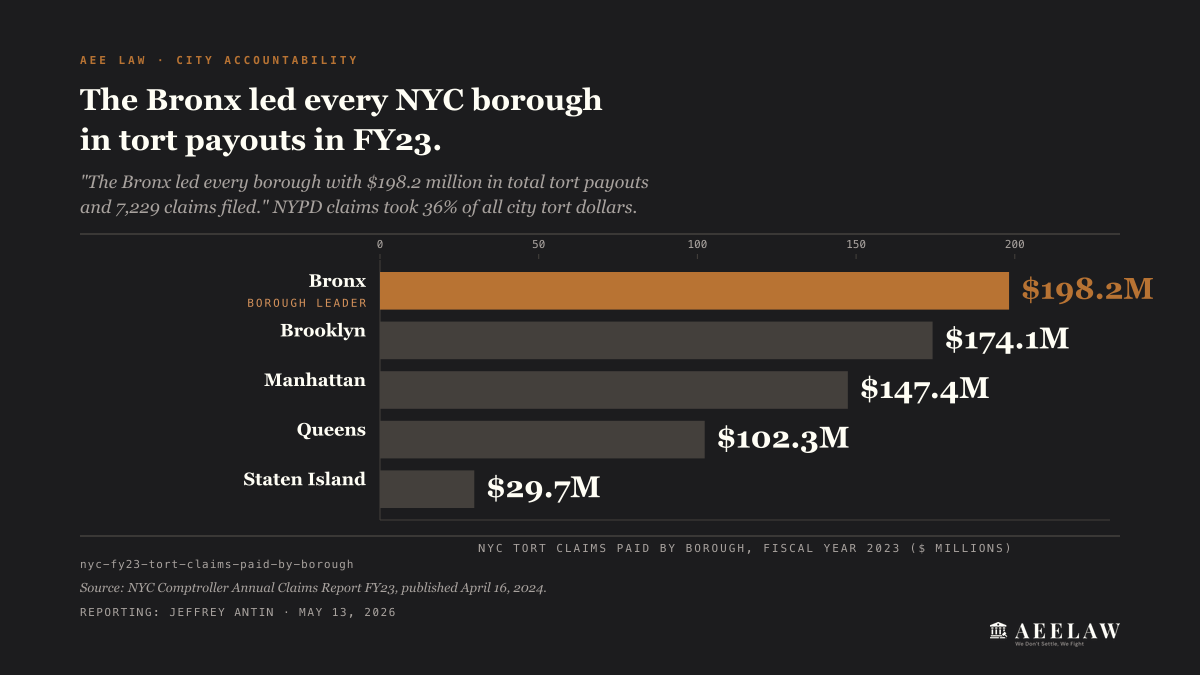
The borough payout totals come from the NYC Comptroller’s Annual Claims Report covering fiscal year 2023 (July 1, 2022 to June 30, 2023), published April 16, 2024. Borough figures reflect all-agency tort payouts geolocated to each borough, not NYPD-specific payouts: the Comptroller does not publish NYPD-only settlement totals broken out by borough.
Named wrongful conviction settlements (Bell, Bolt, Johnson) are drawn from the Queens Daily Eagle’s reporting on the Bell settlement, confirmed against the Queens Eagle’s 2025 misconduct settlements recap and the NYC Comptroller’s separate Blueprint report on police misconduct (September 22, 2025).
Precinct-level settlement data comes from the Comptroller’s Blueprint report. The since-2000 precinct CCRB complaint totals come from the public CCRB complaint database aggregated by the 50-a.org project. The 108th Precinct force-complaint trend and the southeastern-Queens complaint share come from the Queens Daily Eagle’s September 2025 misconduct reporting.
Where Queens Liability Concentrates
Queens recorded $102.3 million in total all-agency tort payouts in FY23, fourth among the five boroughs. The borough filed 3,758 total claims, including 2,489 personal injury claims and 1,269 property damage claims.
Its per-capita tort rate of 167 claims per 100,000 residents was the lowest of any major borough, well below the Bronx at 533 per 100,000 and Manhattan at 276 per 100,000.
| Precinct | Neighborhood | Complaints / Allegations | Notable Trend |
|---|---|---|---|
| 103rd | Jamaica / Hollis / St. Albans | 2,709 / 3,841 (since 2000) | Leads all Queens precincts |
| 113th | South Jamaica / Laurelton | 2,209 (since 2000) | 22.2% of all Queens complaints alongside 103rd |
| 114th | Astoria / Long Island City | 2,013 (since 2000) | 20 officers with substantiated CCRB findings |
| 108th | Long Island City / Sunnyside | 175% increase 2022-2024 vs. 2019-2021 | Second-steepest rise of any NYC precinct |
The 103rd Precinct in Jamaica has logged the highest complaint totals in Queens by volume. The 113th Precinct in South Jamaica sits alongside it. Together the two cover southeastern Queens neighborhoods, where complaint concentration runs deepest.
On settlement dollars, the picture shifts.
The 103rd is the only Queens precinct on the Comptroller’s Blueprint report list of city precincts by total settlement dollars for incidents since 2019, and it sits near the bottom at $1,690,250 across 38 cases. That ranks far below Brooklyn’s 77th Precinct at $11 million and 75th at $9.9 million.
Queens’ overall precinct-level settlement picture stays dispersed across many commands at lower per-precinct amounts rather than concentrated the way those two Brooklyn precincts are. The borough’s outsized dollar liability comes from the wrongful conviction cases, not from patrol-level excess-force claims.
The Bell / Bolt / Johnson Pattern
In 1996, two people were shot and killed at a check-cashing business in East Elmhurst, Queens. George Bell, then 19, was convicted in 1999 for the double homicide, including the killing of an off-duty police officer.
Rohan Bolt and Gary Johnson were convicted as co-defendants in the same investigation. Bell received a life sentence without parole.
In 2021, the Queens DA’s Conviction Integrity Unit, under District Attorney Melinda Katz, reviewed the case and found withheld exculpatory evidence and coerced confessions. All three convictions were overturned.
Together they had been in prison for 72 combined years.
Each man filed a federal civil rights lawsuit under 42 U.S.C. § 1983. All three settled.
Three defendants. One investigation. One Queens DA’s office. Overlapping detectives and prosecution team. Seventy-two combined years. $47.7 million in public money.
The pattern is systemic, not individual. A single botched investigation from a single prosecutorial office produced three of the city’s largest individual wrongful-conviction settlements in a two-year window. The Queens CIU review that vacated all three convictions found the same evidentiary failures in each file. That’s Monell territory, not an isolated officer’s bad day.
Section 1983 in Queens
Federal civil rights lawsuits from Queens are filed in the Eastern District of New York. The EDNY courthouse sits at 225 Cadman Plaza East in Brooklyn. The EDNY covers Queens, Brooklyn, Staten Island, Long Island, and the eastern counties of New York.
Civil rights cases from Manhattan and the Bronx go to the Southern District at 500 Pearl Street.
Claims under 42 U.S.C. § 1983 allow any person to sue a government official who, acting under color of law, deprives them of constitutional rights guaranteed by the Fourteenth Amendment. For wrongful conviction cases, the standard claim theories are malicious prosecution, fabrication of evidence, and denial of due process.
42 U.S.C. § 1988 provides for attorney’s fees in successful civil rights actions.
When city policy or custom caused the violation, plaintiffs can add a Monell claim under Monell v. Department of Social Services, 436 U.S. 658 (1978). The Bell/Bolt/Johnson cluster fits that pattern: same office, same era, same evidentiary failures across all three files.
The Queens DA’s Conviction Integrity Unit is now one of the most active CIUs in the state. Its track record of vacating convictions means more Section 1983 lawsuits are likely to follow as older cases get reviewed. Each vacatur triggers the same legal machinery: lawsuit, discovery, and in most cases, settlement.
What This Means for People Hurt by Police in Queens
If you’re injured by NYPD officers or by prosecutorial misconduct in Queens, the legal framework that governs your claim is federal.
The primary vehicle is a lawsuit under 42 U.S.C. § 1983 filed in the EDNY. The statute of limitations is three years from the date of the incident.
A Notice of Claim under NY GML § 50-e isn’t a prerequisite for the federal claim: the Supreme Court held in Felder v. Casey, 487 U.S. 131 (1988) that state notice-of-claim rules don’t apply to Section 1983 actions.
It does govern the state-law claims most people bring alongside, so file it within 90 days to keep those claims alive.
For wrongful conviction claims specifically, the three-year Section 1983 limitations period typically runs from the date the conviction is vacated or the false charges are dismissed, not from the date of the original arrest. This is the accrual rule established in Heck v. Humphrey and its progeny.
George Bell’s conviction was vacated in 2021. His lawsuit followed and settled in 2023. That timeline is typical.
Wrongful conviction cases differ structurally from excessive force claims. The damages analysis covers lost liberty, the years of wages not earned, the psychological toll of wrongful imprisonment, the reputational harm, and in some cases the physical injuries sustained while incarcerated.
In the Bell/Bolt/Johnson cluster, the city paid an average of roughly $662,000 per year of wrongful imprisonment across the three settlements. That figure reflects the severity of the underlying liberty deprivation, not just economic loss.
If you or someone you know is currently incarcerated on a Queens conviction and evidence of wrongful prosecution has emerged, the Queens DA’s CIU reviews applications from people who believe their convictions resulted from constitutional violations. That review process is the gateway. A vacatur is what opens the door to a Section 1983 lawsuit.
Section 1983 doesn’t recover the years. It recovers what the law can measure.


