

One retired Brooklyn detective’s caseload has cost New York City roughly $150 million and counting. The Scarcella wrongful-conviction cluster, 17 defendants framed across 21 overturned homicide convictions, represents the largest single running NYPD liability in the city’s history.
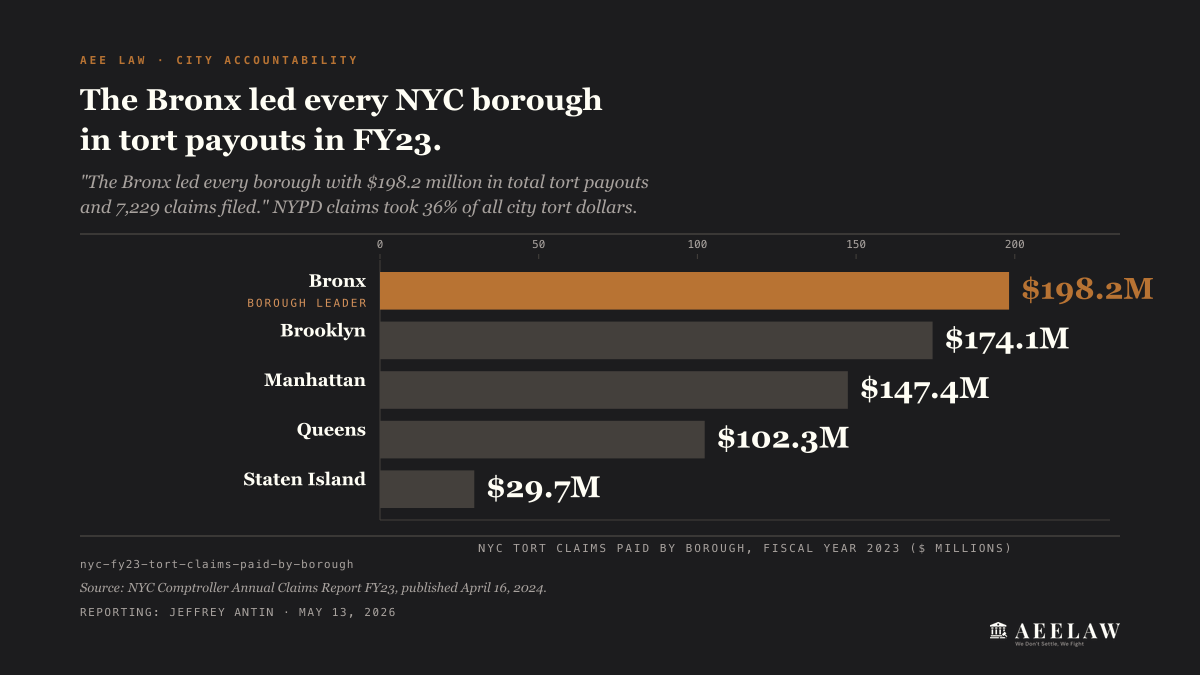
Add in the 77th Precinct’s $11 million paid in just 59 misconduct cases and the 75th Precinct’s 104-case settlement tab, and Brooklyn’s NYPD exposure dwarfs any other borough’s on a per-case and per-precinct basis. By comparison, the Bronx, which leads all boroughs in total dollar payouts, spreads its liability across hundreds of lower-value cases.
Brooklyn concentrates its liability in blockbusters.
Methodology
Borough and precinct data come from two NYC Comptroller publications: the Annual Claims Report for Fiscal Year 2023 (April 16, 2024), which covers all-agency tort payouts from July 1, 2022 to June 30, 2023, and the Blueprint to Address Police Misconduct (September 2025), which reports precinct-level settlement totals for 2019 to 2024.
Borough payout totals represent all city agencies, not NYPD alone. The Comptroller does not publish NYPD-specific payouts by borough.
Named settlement figures for Scarcella cases and the Sunset Park paralysis case come from contemporaneous court reporting; the $150 million Scarcella aggregate is the publicly reported estimate through mid-2025. The Legal Aid Society’s Cop Accountability Project tracks calendar-year misconduct payouts separately from the Comptroller’s fiscal-year tally; both are cited for the periods they cover.
Where Brooklyn’s Liability Concentrates
The NYC Comptroller’s Blueprint report ranks precincts by total misconduct settlement payout from 2019 to 2024. Brooklyn owns the top two spots citywide.
| Precinct | Neighborhood | Total Paid (2019-2024) | Settled Cases | Notable Trend |
|---|---|---|---|---|
| 77th | Crown Heights / Prospect Heights | $11.02M | 59 | Highest payout of any NYC precinct; 671 CCRB allegations across 242 complaints on record (ProPublica, through 2020) |
| 75th | East New York / Cypress Hills | $9.88M | 104 | 104 CCRB force complaints across 2022-2024, among the highest counts citywide |
| 73rd | Brownsville | $1.52M | 78 | 100+ excessive force complaints to CCRB in 2022-2024 window |
| 67th | Crown Heights South / Flatbush | $1.14M | 88 | Overlaps geographically with Scarcella-era homicide cases |
The 77th Precinct’s cost-per-case ratio stands out: $11.02 million across 59 cases works out to roughly $187,000 per settled matter. The 75th Precinct’s 104 cases average $95,000 each. The disparity reflects claim type. The 77th’s concentrated payout suggests a larger share of high-value deprivation-of-liberty and serious-injury cases compared to the higher-volume, lower-average 75th.
The 88th Precinct in Fort Greene, Clinton Hill, and Brooklyn Heights recorded a 100% increase in force complaints between the 2019-2021 and 2022-2024 periods, ranking it among the 16 precincts citywide with the sharpest proportional rise.
Its absolute complaint count is lower, but the rate of increase flags it as a precinct to watch in the next settlement cycle.
The Scarcella Cluster
Louis Scarcella spent roughly two decades as a Brooklyn homicide detective. He was known for closing cases quickly. He was also known, his critics argued long before the courts agreed, for deciding who was guilty first and building the evidence afterward.
By mid-2025, 21 people had homicide convictions vacated in cases he worked. Seventeen reached settlements. The aggregate: approximately $150 million, for 420+ combined years of wrongful imprisonment across those 17 defendants. Individual payouts documented in court reporting include approximately $16.3 million each for two claimants, $9.25 million for another, and $6.73 million for Roger Logan.
The Shawn Williams case illustrates the pattern. Williams spent 24 years in prison after his 1994 conviction for a 1993 Brooklyn murder. A witness later stated that Scarcella had coerced her identification.
The Brooklyn DA’s office and court proceedings ultimately vacated the conviction. Williams’s case was the 14th overturned Scarcella conviction at the time of settlement.
The Scarcella file is not closed. The Brooklyn DA’s Conviction Integrity Unit is still auditing his estimated 200 homicide investigations. Every additional vacatur triggers a new federal lawsuit. The $150 million figure is a running total, not a final one.
The 72nd Precinct in Sunset Park adds a separate chapter to Brooklyn’s liability record. In 2022, the city paid $12 million to settle a lawsuit brought on behalf of a 17-year-old who was tackled by officers Pedro Rodriguez and Pavel Kuznetsov and suffered neck fractures and a spinal cord injury that left him paralyzed.
Rodriguez had 11 prior CCRB complaints and a prior settled lawsuit at the time of the incident.
The Sunset Park case sits inside a broader pattern. Excessive-force allegations to the CCRB jumped 49% citywide between 2022 and 2023, with individual force allegations up 57% over the same span.
The 75th Precinct logged 104 force complaints across the 2022 to 2024 window, among the highest counts of any precinct citywide. The 88th Precinct’s force complaints doubled between the 2019-2021 and 2022-2024 windows, a 100% rise.
The precinct-level data from the ProPublica NYPD Files shows the 77th Precinct alone had 671 total CCRB allegations across 242 complaints against 85 officers, in cumulative data through 2020.
Section 1983 in Brooklyn
Most Brooklyn police misconduct lawsuits are filed in federal court under 42 U.S.C. § 1983, the civil rights statute enacted in 1871 to enforce the Fourteenth Amendment. It permits anyone to sue a government official who, acting under color of state law, deprives them of a constitutional right.
42 U.S.C. § 1988 provides for attorney’s fees in successful civil rights actions, which is the economic engine that keeps plaintiff’s firms in the space.
Brooklyn’s cases land in the Eastern District of New York (EDNY), the federal district court at 225 Cadman Plaza East in Brooklyn Heights. EDNY has jurisdiction over Brooklyn, Queens, Staten Island, Nassau County, and Suffolk County.
It handles a disproportionate share of New York City’s wrongful-conviction litigation because Brooklyn alone has generated more vacated convictions than any other borough in the city’s history.
Common Fourth Amendment theories in Brooklyn’s NYPD dockets include:
- Excessive force: officers using force beyond what the circumstances reasonably required, under the standard in Graham v. Connor, 490 U.S. 386 (1989)
- Malicious prosecution and fabrication of evidence: manufacturing witness identifications, coercing confessions, or withholding exculpatory material to secure convictions
- Unlawful search and seizure: entries without warrants, stops without reasonable suspicion
- Failure to intervene: officers present during misconduct who took no action to stop it
Wrongful-conviction cases rely heavily on Monell v. Department of Social Services, 436 U.S. 658 (1978), which established municipal liability under Section 1983 when the constitutional violation results from an official policy, practice, or custom. The Scarcella cluster, with its decades-long pattern of fabricated evidence across a single detective’s caseload, fits the Monell framework directly.
What This Means for People Hurt by Police in Brooklyn
Two procedural deadlines control whether a Brooklyn civil rights claim survives to discovery.
The first is the Notice of Claim under NY GML § 50-e. For state-law tort claims against the city, a written Notice of Claim must be filed with the NYC Comptroller within 90 days of the incident.
This applies to false arrest, excessive force, and related torts brought under state law. Missing the 90-day window can bar state-law claims entirely, though courts can grant permission to file late in limited circumstances.
The second is the 42 U.S.C. § 1983 statute of limitations. Federal civil rights claims in New York borrow the state’s three-year personal-injury limitations period. For most incidents, the three years runs from the date of the constitutional violation.
For wrongful conviction cases, courts have held the clock starts when the conviction is vacated, which is why Scarcella defendants were able to sue decades after the original cases. That rule matters to anyone whose conviction is still under review by the Brooklyn DA’s Conviction Integrity Unit.
The City of New York indemnifies NYPD officers in civil rights cases. The officer doesn’t pay. The city does, from the general fund, not from the NYPD budget. That structure is why the 77th Precinct can carry $11 million in settlement costs and the officers named in those cases remain employed without direct financial consequence.
A strong Section 1983 case from Brooklyn resolves through the same legal framework as one from any other borough. The Scarcella cluster proves that the Eastern District will adjudicate even the oldest, largest, and most politically sensitive cases when the underlying record supports it.
Brooklyn’s debt to its own wrongly convicted residents isn’t settled yet.


