

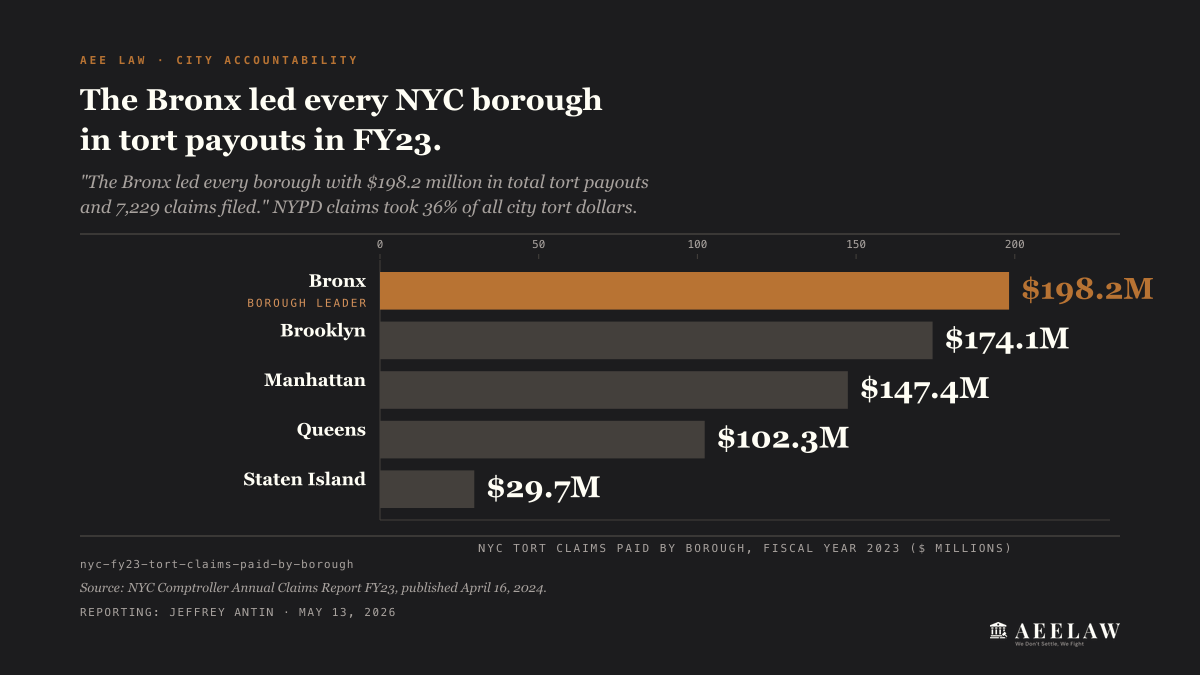
Staten Island paid $29.7 million in municipal tort claims in fiscal year 2023. That’s the smallest dollar total of any borough. Per capita the picture changes: 168 tort claims per 100,000 residents, nearly identical to Queens at 167. The island isn’t as quiet as it looks.
Methodology
This analysis draws from the NYC Comptroller’s Annual Claims Report for Fiscal Year 2023, published April 16, 2024, which covers the period July 1, 2022 through June 30, 2023. The $29.7 million Staten Island figure is the all-agency tort burden for claims geolocated to Staten Island.
Named settlements (Garner, Kuyateh, Serrano) are sourced from contemporaneous press reporting and the federal EDNY docket. The Garner settlement is from 2015 and is included as the historical anchor the data requires.
The North Shore Concentration
The 120th Precinct covers the North Shore of Staten Island, from St. George through New Brighton and Stapleton. It’s the island’s most densely populated and racially diverse command, and it’s the source of the borough’s most consequential recent misconduct cases.
| Precinct | Neighborhoods | Complaint Volume |
|---|---|---|
| 120th | St. George, New Brighton, Stapleton | Highest on the island; 4 to 12 CCRB complaints per month (2024) |
| 122nd | Dongan Hills, Midland Beach, New Dorp | Mid-island; 2015 leaked photos exposed an arrest-points scoreboard |
| 121st | Richmond, Eltingville, Tottenville | South Shore; typically 4 to 5 complaints per month (2024) |
| 123rd | Huguenot, Pleasant Plains, Prince’s Bay | South Shore; lowest volume; 1 to 4 complaints per month (2024) |
The Eric Garner killing on July 17, 2014 occurred in Tompkinsville, a 120th Precinct neighborhood. Eight years later, the same precinct generated a federal investigation.
In 2022, the FBI and EDNY opened an investigation into drug-planting and misconduct allegations tied to officers from the 120th, following bodycam footage showing Officer Kyle Erickson planting a partially burning marijuana cigarette in a stopped vehicle on October 3, 2018.
Two federal settlements followed. In Lasou Kuyateh v. City of New York (EDNY 21CV00652), the city paid $326,000 in 2022 after Kuyateh was falsely charged with felony firearm possession by Officers Erickson, Elmer Pastran, and Frank Desiderato. The bodycam footage, which showed Erickson planting the contraband, surfaced after charges were filed and led to dismissal.
In Jason Serrano v. City of New York (EDNY 22CV01989), the city paid $200,000 in 2022 to a second person victimized by the same Erickson and Pastran scheme.
The 122nd Precinct generated a separate accountability thread. In 2015, leaked photos exposed an arrest-points scoreboard in the precinct: officers scored a point for every misdemeanor arrest and 1.5 points for every felony, creating a perverse incentive structure that increases false-arrest risk across all encounters.
The Garner Legacy
Eric Garner died on July 17, 2014 in Tompkinsville, Staten Island, after NYPD Officer Daniel Pantaleo applied a prohibited chokehold during an arrest for selling loose cigarettes. Garner repeated “I can’t breathe” 11 times before losing consciousness. He was 43 years old.
The policy trail from that settlement is measurable. NYC Admin Code § 10-181 codified the chokehold ban into city law in 2020, building on a departmental prohibition that Pantaleo violated.
The Right to Know Act, which took effect in 2018 as NYC Admin Code §§ 14-173 and 14-174, requires officers to identify themselves and explain the basis for investigative encounters.
Body camera deployment, now mandatory across the entire NYPD, accelerated directly from the Garner accountability gap: there was no bodycam footage from Garner’s death. The CCRB’s authority was expanded in 2021 to include prosecutorial power over certain officer misconduct cases, a structural change the Garner case helped drive.
None of those reforms stopped the 120th Precinct drug-planting operation. But they did produce the bodycam footage that exposed it.
The two drug-planting cases from the same precinct ten years later illustrate the contemporary pattern.
The three cases spanning 2014 to 2022 trace a single command geography: the North Shore’s 120th Precinct. They are not three isolated incidents. They are a pattern.
Section 1983 in Staten Island
Federal civil rights claims from Staten Island route through the Eastern District of New York. The EDNY courthouse sits at 225 Cadman Plaza East in Brooklyn.
Staten Island cases are filed there, briefed there, and tried there. The distance matters practically for discovery and depositions, but the legal framework is identical to any other EDNY district.
Most claims against the NYPD are filed under 42 U.S.C. § 1983, the federal civil rights statute enacted in 1871 to enforce the Fourteenth Amendment. It lets anyone sue a government official who, acting under color of law, deprives them of constitutional rights.
The standard for excessive force is objective reasonableness under Graham v. Connor, 490 U.S. 386 (1989). When the violation stems from a departmental custom or practice rather than one officer’s conduct, Monell v. Department of Social Services, 436 U.S. 658 (1978) allows the city itself to be named as a defendant.
42 U.S.C. § 1988 provides for attorney’s fees in successful civil rights actions, which makes it economically viable for firms to take Section 1983 cases even when the settlement is below typical defense costs. The Kuyateh and Serrano settlements, each under $350,000, were reachable partly because of the fee-shifting structure.
Common Section 1983 claims against the NYPD include false arrest, unlawful search, excessive force, malicious prosecution, failure to intervene, and fabrication of evidence. All of the above appeared in the 120th Precinct drug-planting cases.
What This Means for People Hurt by Police on Staten Island
If you’re hurt by NYPD officers on Staten Island, the legal path runs through EDNY at 225 Cadman Plaza East in Brooklyn.
The framework is federal: 42 U.S.C. § 1983, constitutional claims, and the city as the named defendant under Monell. The 90-day notice requirement is state law but it governs federal cases against the city.
Three steps matter immediately after a police misconduct incident on Staten Island. Get bodycam footage preserved: NYPD retains it for a limited period, and litigation holds can be triggered early.
Request the officer’s identity and shield number in writing. And file the Notice of Claim within 90 days: even if you’re still deciding whether to sue, the notice preserves your right to do so.
The per-capita claims data shows Staten Island residents file at the same rate as Queens residents. The difference is that their cases don’t generate the same headlines. That doesn’t change what the borough owes them under the law.
Small borough, defining moments. The law counts them the same.


