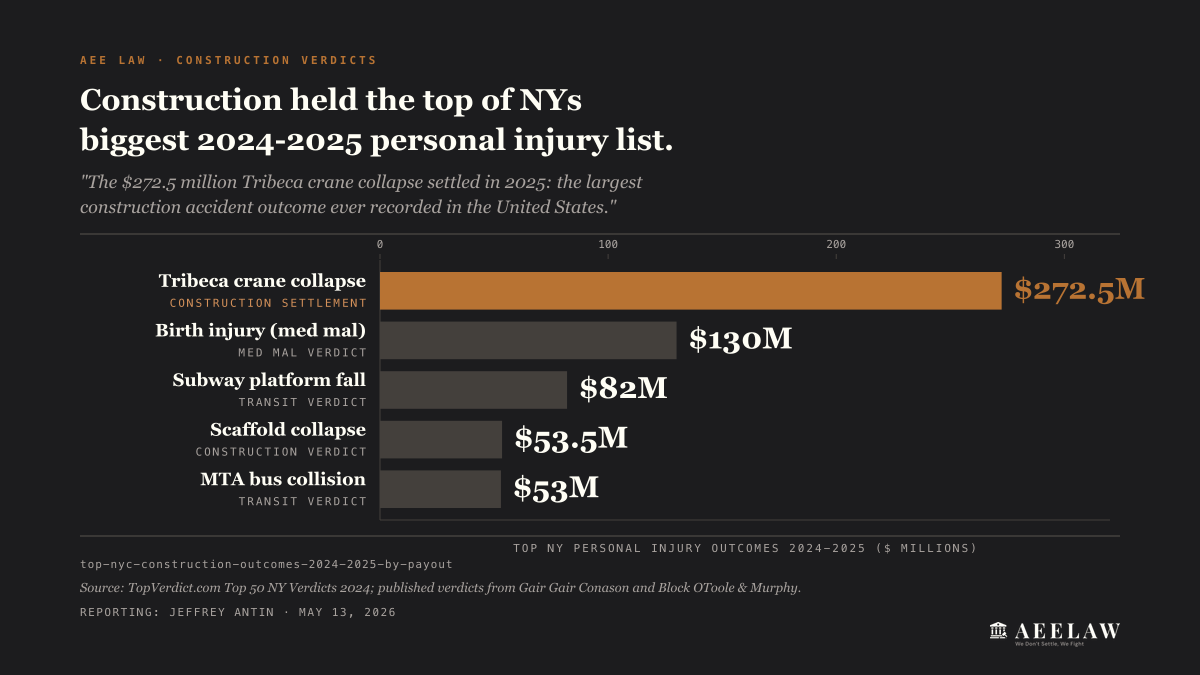
The top 15 New York personal injury outcomes across 2024 and 2025 totaled more than $1.1 billion. Construction cases held the top of that list. A $272.5 million settlement closed the 2016 Tribeca crane collapse in 2025, the largest known crane-collapse recovery in New York history. A separate $53.5 million Brooklyn construction-fall verdict, returned in 2023, shows the same Labor Law 240 pattern at trial.
Methodology
The outcomes here come from published verdict and settlement reports from Gair Gair Conason Rubinowitz Bloom Hershenhorn Steigman Mackauf, Block O’Toole & Murphy, TopVerdict.com, and Expert Institute. The sample frame is publicly reported NY personal injury verdicts and settlements resolved in calendar years 2024 and 2025 with a disclosed dollar amount. The $272.5 million Tribeca crane settlement, which resolved in 2025, traces to Gair Gair. The $53.5 million Brooklyn construction-fall verdict sits outside that 2024-2025 window: a Kings County jury returned it in 2023, and it appears here as a representative Labor Law 240 trial outcome, not as a member of the 2024-2025 sample. It traces to Block O’Toole.
The median NY jury award figure of $287,628, the national median of $34,550, and the 8.3x ratio come from Jury Verdict Research compensatory-damages data as compiled in industry verdict reporting. Construction outcomes are flagged where the case was filed under Labor Law § 240(1), Labor Law § 241(6), or Labor Law § 200.
Construction Owned the Top of the List
Of the top 15 NY personal injury outcomes in 2024 and 2025, multiple were construction cases. The Tribeca crane settlement led that group. The 2023 Brooklyn construction-fall verdict below sits outside the 2024-2025 window but shows the same Labor Law 240 pattern at trial:
Other top 2024-2025 outcomes were transit (an $81.7 million subway platform verdict in 2025, a $53 million MTA bus collision verdict in 2025) and medical malpractice (a $60 million epidural verdict in 2025).
Across the construction subset, the through-line is Labor Law § 240. The statute imposes absolute liability when a worker is injured in a gravity-related accident: falls from heights, falling objects, scaffold collapses, ladder failures. The owner and general contractor cannot defend by arguing the worker was careless. Comparative negligence does not apply. Once the safety device failed, liability is established. The jury’s only question is damages.
The Median Is 8.3 Times the National
The median NY personal injury jury award is $287,628. The national median sits at $34,550. NY’s median runs 8.3 times higher.
Three structural reasons drive that gap:
No comparative-negligence defense on the gravity cases. Labor Law 240 takes the worker’s conduct off the table on the threshold liability question. The Iowa or Texas equivalent of a Tribeca crane collapse would let the defense argue the worker should have worn a harness, should have inspected the rigging, should have refused the assignment. New York closes those arguments before they reach the jury.
No statutory cap on non-economic damages. Most states cap pain and suffering at a fixed dollar amount or a multiple of economic damages. New York does not. When a construction worker loses both legs in a scaffold fall, the jury can value future pain and suffering at whatever the evidence supports.
NYC juries draw from the highest cost basis in the country. Lost wages, medical care, future life-care plans all calculate against numbers that are higher in New York than anywhere else. Even before the multiplier from non-economic damages, the economic damages baseline is larger.
Trial Versus Settlement
Most NY Labor Law 240 cases never reach a jury. The cases that do, settle differently. Defendants who go to trial in NYC Supreme Court on a 240 case face strict-liability instructions and a jury pool drawn from the five boroughs. The cases that resolve before trial typically settle at a discount to the expected trial outcome. The $272.5 million Tribeca crane number is a settlement, but it resolved on the eve of trial after years of litigation.
The trial-versus-settlement data we have today is publicly available only for cases that proceed to verdict, where the OCA reports the result, or where settlement amounts are filed on the docket. Confidential settlements, which represent the majority of resolved 240 cases, do not surface in public verdict reporting. A complete trial-versus-settlement median for NYC Labor Law 240 cases would require docket-by-docket pulls from the New York State Unified Court System OCA verdict and settlement reports, joined to disposition codes. That harvest is the next data move on this beat.
What’s clear from the published verdict data alone: the cases that reach trial on a strong Labor Law 240 record produce outcomes in the eight-figure range routinely. The $53.5 million construction-fall verdict is one. The $272.5 million Tribeca crane settlement, while resolved before final verdict, was negotiated against years of litigation exposure.
What This Means for NYC Construction Workers
If you were hurt in a gravity-related construction accident in NYC, three points the data above changes:
The legal framework is unique to New York. Labor Law § 240(1) exists nowhere else. A scaffold collapse in NYC and a scaffold collapse in any other state produce different cases. The NY case has absolute liability on the owner and general contractor. The other state’s case requires proving negligence.
The damages ceiling is the injury, not a statute. Because New York does not cap non-economic damages, the value of a Labor Law 240 case scales with the severity of harm. Permanent paralysis, amputations, severe traumatic brain injury, and wrongful death all support seven-, eight-, and nine-figure outcomes when the liability framework holds.
Settlement does not mean low value. The $272.5 million Tribeca crane outcome is a settlement, not a verdict. Owners and insurers settle Labor Law 240 cases at trial-equivalent values when the liability picture is clear and trial would expose them further.
Scaffold Law works when a case is built for trial.