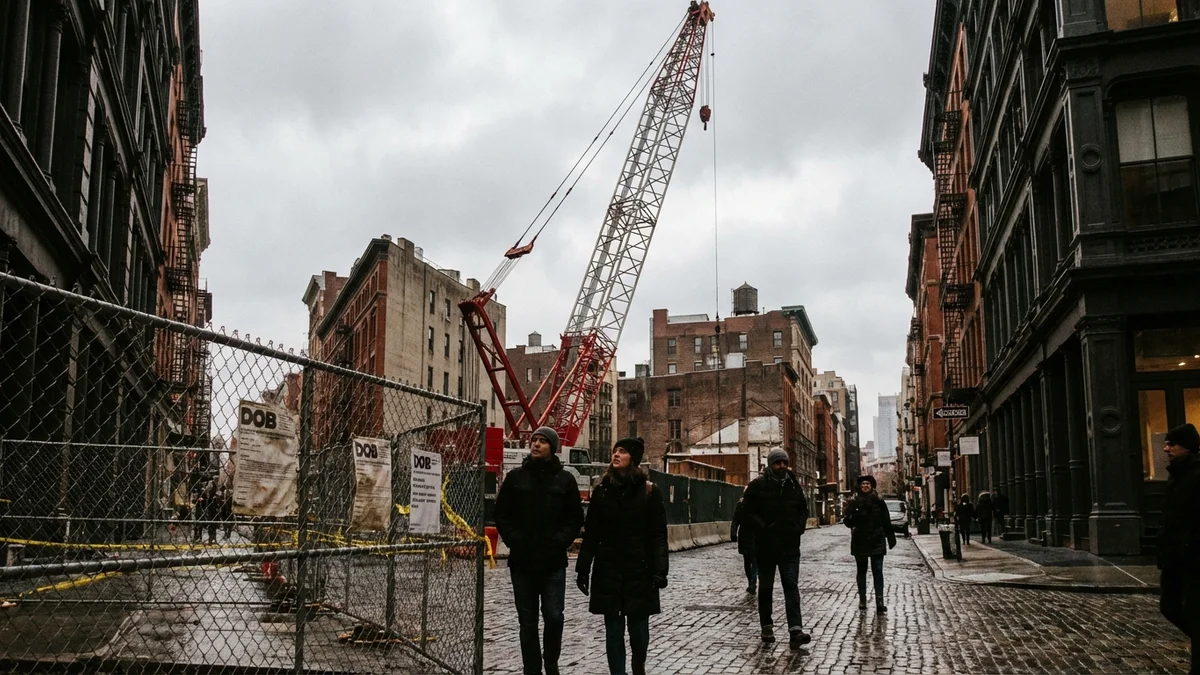
On February 5, 2016, a 565-foot crawler crane toppled on Worth Street in Tribeca. It crushed a parked car and killed 38-year-old pedestrian David Wichs. Three others were injured. The operator had failed to secure the crane the night before while lowering it in 37 mph winds.
That single collapse reportedly produced a $272.5 million settlement, the largest crane accident payout in New York City history, according to the plaintiffs’ firm on the case. The operator’s license was permanently revoked.
It wasn’t an isolated event. Two crane collapses in 2008 killed a combined nine people. A 2023 fire on a crane 45 stories above Hell’s Kitchen injured 12. Each disaster triggered regulatory reforms. Each time, the pattern held: warnings ignored, enforcement gaps exploited, workers and pedestrians paying the price.
We traced every major New York City crane collapse, what the city changed after each one, and where the liability landed.
The Three Deadliest Crane Collapses in NYC History
March 15, 2008: East 51st Street
A tower crane collapsed on Manhattan’s East Side. Seven people killed, 24 injured. The OSHA investigation found the polyester slings supporting the crane’s suspended collar failed during a jumping operation, when the collar was supposed to tie the mast laterally to the building.
Manhattan prosecutors charged master rigger William Rapetti with manslaughter, alleging he secured the crane with too few worn slings. A judge acquitted Rapetti in 2010. Roughly 60 civil lawsuits followed and resolved through confidential settlements, with no single public verdict figure. The crane on this site was not owned by New York Crane and Equipment.
May 30, 2008: East 91st Street
Eleven weeks later, a crane owned by New York Crane and Equipment Corporation collapsed on the Upper East Side. Two workers killed: operator Donald Leo and ground worker Ramadan Kurtaj. The cause: a faulty turntable bearing manufactured in China. A supplier had warned owner James Lomma about quality concerns before the bearing went into service.
A jury awarded the two families $96 million, including $48 million in punitive damages. The First Department reduced the total to roughly $35 million on appeal. Lomma was acquitted of manslaughter in 2012. The NYC Department of Buildings Commissioner resigned in the wake of the 2008 collapses.
February 5, 2016: Worth Street, Tribeca
A 565-foot crawler crane being lowered ahead of high winds tipped over. It stretched an entire city block. One pedestrian killed, three injured. The operator was lowering the boom but failed to properly secure it overnight.
At the time, 429 cranes were operating across the five boroughs: 376 crawler cranes and 53 tower cranes.
The resulting litigation reportedly produced the largest crane accident settlement in New York history, according to the plaintiffs’ firm on the case.
The 2023 Hell’s Kitchen Incident
On July 26, 2023, a hydraulic hose failure caused a fire on a Favelle Favco crane 45 stories above Hell’s Kitchen. Twelve workers were injured. The crane was owned by New York Crane and Equipment, the same company behind the May 2008 East 91st Street collapse.
The DOB investigation found the company had ignored a 2016 manufacturer safety bulletin. It specifically addressed the hydraulic system at the point of failure.
The incident led to the most sweeping crane regulation in the city’s history. In December 2025, the city mandated fire suppression systems on all diesel tower cranes operating in New York.
National Crane Fatality Data
The Bureau of Labor Statistics recorded 297 crane-related fatalities nationwide between 2011 and 2017. An average of 42 deaths per year. New York City accounts for about 6% of national crane fatalities despite operating a disproportionately small share of the country’s crane fleet.
The same BLS data shows just over half of all fatal crane injuries are struck-by incidents: workers or bystanders hit by the crane structure, loads, or falling objects.
How NYC Changed Its Crane Laws
Every major collapse has triggered legislative action. The regulatory timeline:
After the 2008 collapses:
- 12 new crane safety laws enacted
- NCCCO (National Commission for the Certification of Crane Operators) certification required for all crane operators in the city
- $4 million crane oversight study commissioned
- DOB Commissioner Robert LiMandri resigned
- Master rigger and signal person licensing requirements tightened
After the 2016 Worth Street collapse:
- Wind threshold for crane operations lowered to 20 mph
- Fines for crane safety violations doubled to $10,000
- Local Law 3 of 2018: 25-year age limit imposed on cranes operating in NYC (Building Code § 3319.13)
- Crane operators required to submit weather monitoring plans before operations
After the 2023 Hell’s Kitchen fire:
- Fire suppression systems mandated on all diesel tower cranes (December 2025)
- Hoisting Machine Operator (HMO) license expanded to cover mini cranes and articulating booms, making NYC the first city in the nation to regulate these smaller machines
DOB enforcement in 2024:
- 416,290 field inspections conducted (a record)
- Construction injuries dropped 30% compared to the prior year
- Worker fatalities at a 10-year low
Where Crane Activity Stands Now
Crane activity in NYC has contracted. The RLB Crane Index for Q3 2025 put New York City among the cities where tower crane counts fell more than 20% that quarter. That reflects both the regulatory tightening and the broader slowdown in new construction starts.
For context, 429 cranes were operating across the city at the time of the 2016 Worth Street collapse. The current count is a fraction of that peak.
Liability in NYC Crane Collapse Cases
Crane collapse cases are complex. Multiple parties, multiple insurance policies, federal and state regulations. But New York’s legal framework heavily favors injured workers and bystanders.
Labor Law § 240(1): The Scaffold Law. This statute imposes absolute liability on property owners and general contractors for gravity-related injuries on construction sites. A crane collapse is a textbook 240(1) case.
It doesn’t matter if the owner hired a subcontractor. It doesn’t matter if the injured worker made a mistake. The property owner and general contractor are liable.
The Scaffold Law protects construction workers, not pedestrians or bystanders. A pedestrian hurt by a collapsing crane, like David Wichs on Worth Street, recovers under common-law negligence against the owner, contractor, and crane operator, not under 240(1).
Multiple responsible parties. A single crane collapse can produce claims against:
- The crane owner/operator company
- The general contractor
- The property owner
- The crane manufacturer (products liability)
- The rigger or signal person
- Engineering firms that approved crane plans
Verdicts and settlements. NYC crane collapse cases consistently produce eight- and nine-figure outcomes:
- $272.5 million settlement, reported (2016 Worth Street)
- $96 million jury award, reduced to roughly $35 million on appeal (2008 East 91st Street)
- Roughly 60 lawsuits resolved through confidential settlements (2008 East 51st Street)
These figures reflect the severity of crane collapse injuries: crush injuries, traumatic brain injuries, spinal cord damage, amputations, and death. Prior results do not guarantee a similar outcome.
The Pattern
Every major NYC crane collapse follows the same pattern: known risks that went unaddressed, safety bulletins ignored, cost-cutting that overrode caution.
One company connects the dots. New York Crane and Equipment owned the crane in the 2008 East 91st Street collapse (faulty turntable bearing) and the crane in the 2023 Hell’s Kitchen fire (ignored safety bulletin).
Between those incidents, the city passed dozens of new laws, doubled fines, and created new licensing requirements. Fatalities have declined. But the underlying dynamic persists.
Construction in New York City requires cranes. Cranes require operators, riggers, engineers, and inspectors to do their jobs correctly every time. When they don’t, the consequences land on workers and pedestrians.