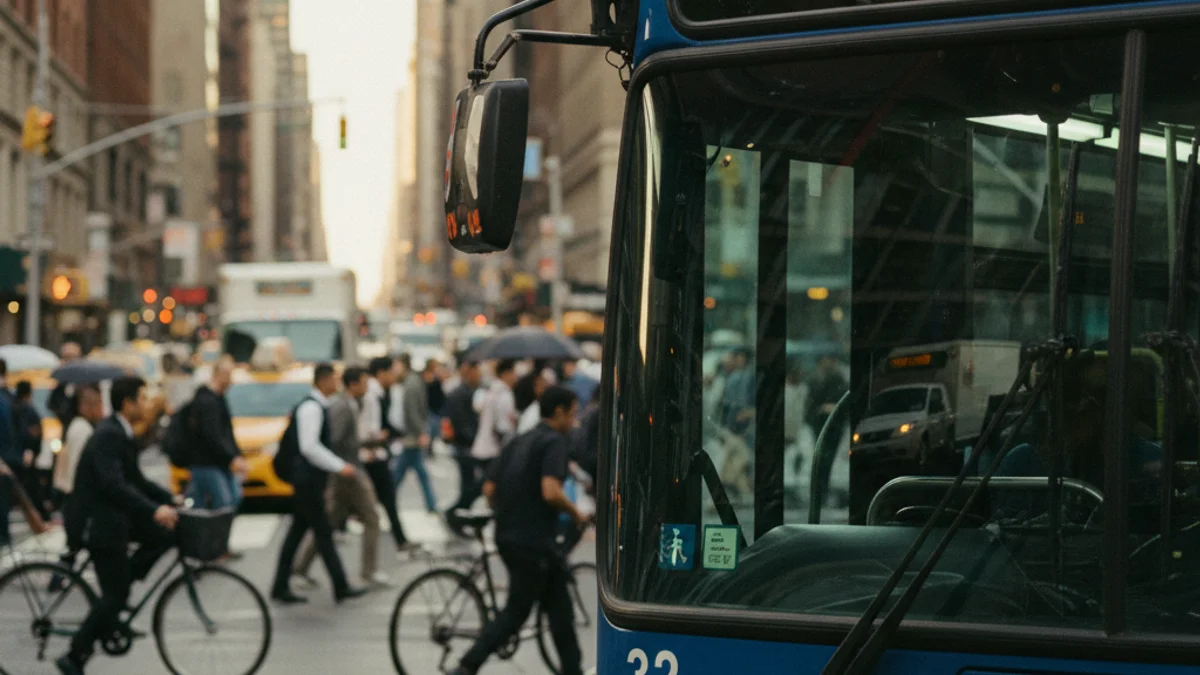
MTA buses were involved in 1,872 collisions in 2023. That is roughly 5 per day, every day, across the five boroughs.
New York City Transit operates the largest bus fleet in the United States: more than 5,700 buses on 322 routes, carrying approximately 1.3 million riders on an average weekday. In 2024, the system logged 409 million total rides. With that scale comes a collision rate that produces thousands of injuries every year.
The Collision Numbers
MTA’s NYCT Safety Data, published through New York State’s open data portal, tracks collisions, injuries, and safety metrics for the bus system. The key figures paint a clear picture.
In 2023, MTA buses recorded 1,872 collisions. Approximately 10% of those collisions resulted in injuries, producing roughly 187 incidents where passengers, pedestrians, cyclists, or other motorists were hurt.
The collision-with-injury rate tells a more granular story:
| Year | Collisions with Injury Rate (per million vehicle miles) | Notes |
|---|---|---|
| 2019 | 6.50 | Pre-pandemic baseline |
| 2020 | 4.47 | COVID traffic reduction |
| 2023 | 7.91 | Recent peak |
| 2024 | 7.78 | Slight dip from the 2023 peak |
The 2024 rate of 7.78 collisions with injuries per million vehicle miles sits well above the pre-pandemic baseline of 6.50. Even accounting for the artificial COVID-era dip, the trajectory has moved in the wrong direction since 2020.
The customer injury rate (measuring injuries to passengers already on the bus) is also climbing: from 2.05 per million customers in 2022 to 2.27 in 2023. On a system carrying hundreds of millions of riders a year, that rate translates into thousands of passenger injuries annually.
The crash type breakdown from 2023 MTA data:
- Rear-end collisions: 35% of all incidents
- Sideswipes: 25%
- Single-vehicle crashes (curb strikes, fixed objects): 20%
- Other (pedestrian strikes, cyclist collisions, turning movements): 20%
Notable Incidents: 2021 to 2025
The statistics represent real crashes with real consequences. Several recent incidents illustrate the pattern.
2021 to 2023
| Date | Location | What Happened | Injuries/Deaths |
|---|---|---|---|
| Jan 14, 2021 | University Ave, Bronx | Bx35 articulated bus drove off Cross Bronx Expressway overpass. Driver traveling 17-26 mph in a turn requiring 3-4 mph. Driver refused MTA-mandated drug test. | 8 injured |
| June 7, 2023 | Broadway & E 13th St, Manhattan | Staten Island express bus struck Roberta Lerman, 70, as she crossed Broadway near Union Square. | 1 killed |
2024
| Date | Location | What Happened | Injuries/Deaths |
|---|---|---|---|
| March 1, 2024 | Avenue D & E 10th St, Manhattan | MTA bus struck pedestrian Shawn Gooding, 45, who fell into the path of a turning bus. Driver reportedly did not know he hit a pedestrian. | 1 killed |
| Aug 6, 2024 | Baisley Blvd, Queens | Q85 bus struck Amesha Keys, 31, making a left turn at 10:36 p.m. Driver fled the scene. Later terminated by MTA and charged by NYPD. | 1 killed |
Early 2025
| Date | Location | What Happened | Injuries/Deaths |
|---|---|---|---|
| Jan 26, 2025 | Fifth Ave & 51st St, Midtown | M1 bus struck boom lift where Vladimir Cruz, 39, was changing a billboard. Cruz was thrown 20 feet to the ground. | 1 killed |
| June 16, 2025 | E 28th St & 3rd Ave, Manhattan | MTA bus struck pedestrian crossing at 5:33 a.m. Pedestrian pronounced dead at Bellevue Hospital. | 1 killed |
| July 11, 2025 | Flushing, Queens | Q20A bus jumped curb and hit traffic light pole at 6 a.m. Camera review found the 25-year-old probationary driver likely fell asleep at the wheel. | 8 injured |
Late 2025
| Date | Location | What Happened | Injuries/Deaths |
|---|---|---|---|
| Oct 13, 2025 | Flushing, Queens | Two Q27 buses collided after one experienced brake failure. | 19 injured, 14 hospitalized |
| Dec 15, 2025 | Morrisania, Bronx | BX6 bus lost control, struck 4 vehicles over five blocks. Investigation pointed to possible mechanical failure. | 7 injured |
Several patterns emerge from these incidents.
The Bronx overpass crash in January 2021 remains the most striking example. An articulated Bx35 bus attempted to turn left from University Avenue onto a ramp to the Washington Bridge just after 11 p.m.
The MTA’s investigation found the driver was traveling between 17 and 26 mph through a turn that required 3 to 4 mph for an articulated bus.
The bus crashed through a guardrail and the front section fell about 50 feet to the Cross Bronx Expressway ramp below, while the articulation cables connecting the two halves kept the bus from separating and dropping completely.
Eight people were injured. The driver refused a mandated drug and alcohol test required by both the MTA and the Federal Transit Administration.
In July 2025, a Q20A driver in Flushing jumped the curb and struck a traffic light pole at 6 a.m. Onboard camera review showed no signs of mechanical issues or distraction. Investigators concluded the 25-year-old probationary driver, hired just nine months earlier, had fallen asleep at the wheel.
In August 2024, a Q85 bus driver in Queens struck and killed a 31-year-old pedestrian, then fled the scene. The driver was later terminated by the MTA and charged by the NYPD. A hit-and-run by a city bus driver.
What the MTA Pays
Bus injury claims are part of a much larger liability picture. As we documented in our analysis of NYC injury claims data, the city paid a record $1.94 billion in total tort and law claims in fiscal year 2024, the most ever for a single fiscal year.
The NYC Comptroller’s Claims Dashboard shows the NYC Department of Transportation alone accounted for $115.27 million, and transit-related claims represent a significant share of the city’s overall liability exposure.
Individual bus accident outcomes vary widely. Published case results from New York personal injury firms show the range:
The amounts depend on injury severity, liability clarity, and the quality of evidence preservation.
Fleet Size and Ridership Context
Understanding the scale of MTA bus operations puts the collision data in perspective.
| Metric | Number | Source |
|---|---|---|
| Total bus fleet | 5,700+ | MTA |
| Bus routes | 322 | MTA |
| Annual rides (2024) | 409 million | MTA ridership data |
| Average weekday ridership | 1.29 million | MTA 2024 report |
| Average weekend ridership | 1.46 million | MTA 2024 report |
| NYCT Bus annual rides (2023) | 340.8 million | MTA ridership data |
| MTA Bus Company annual rides (2023) | 86.2 million | MTA ridership data |
Bus ridership declined 4.2% in 2024, falling to 409 million annual rides from 427 million in 2023. The MTA attributed this to increased fare evasion and reduced ridership on five routes participating in an eight-month free bus pilot program.
Even with declining ridership, the bus system carries more people daily than the entire population of many American cities. The collision rate, multiplied across that volume, produces a steady stream of injuries.
School Buses: A Parallel Problem
NYC’s school bus system is the largest in the country. The Department of Education’s Office of Pupil Transportation oversees approximately 11,000 vehicles operated by private bus companies, transporting roughly 150,000 students daily. A school bus fleet oversight review found rising complaint volumes across NYC’s private bus vendors.
School bus accidents follow different legal rules than MTA bus claims. Most NYC school buses are operated by private contractors, not city employees. This means the 90-day Notice of Claim requirement does not apply. Instead, the standard three-year statute of limitations for personal injury claims governs these cases.
The Legal Reality: 90 Days
If you are injured on an MTA bus or struck by one as a pedestrian, the most important number is 90. You have exactly 90 calendar days from the date of your injury to file a Notice of Claim with the New York City Transit Authority.
This is not a suggestion. It is a statutory requirement under General Municipal Law § 50-e. Miss the deadline and your case is almost certainly over.
The Notice must identify the specific bus route, the date and time, the location, what happened, and your injuries. Vague descriptions are grounds for dismissal.
After filing, the NYCTA has the right to conduct a sworn examination (called a 50-h hearing under General Municipal Law § 50-h) where their attorneys will question you about the incident.
Evidence preservation matters. MTA buses carry 8 or more cameras recording continuously, plus GPS data, driver logs, and maintenance records. Filing your Notice of Claim early creates a legal obligation for the MTA to preserve this evidence. Delay, and footage gets overwritten within 30 to 90 days.
Common Carrier Duty of Care
MTA buses are “common carriers” under New York law. This legal designation means the MTA owes passengers the highest degree of care consistent with practical operation of the vehicle. This is a higher standard than ordinary negligence.
The MTA must protect passengers from foreseeable risks, maintain vehicles in safe condition, and ensure drivers operate within safe parameters.
When an articulated bus takes a turn at 17 mph instead of 3 mph and crashes through a guardrail, that is a clear breach of the common carrier duty.
When a bus strikes a pedestrian crossing with the signal, the standard applies to the driver’s obligation to yield. The heightened duty of care strengthens injury claims against the MTA.
What This Means for Injured Bus Passengers and Pedestrians
MTA bus accidents produce a combination that makes cases both valuable and complex: a government defendant with significant resources, strict procedural requirements, extensive electronic evidence, and a heightened duty of care that favors injured passengers and pedestrians.
Our firm has handled bus accident claims against the MTA and private operators for over 37 years. We file the Notice of Claim immediately, preserve video and electronic evidence before it disappears, prepare clients for the 50-h hearing, and build cases that account for the full scope of injuries.
If you were hurt on an MTA bus, struck by one as a pedestrian, or injured in any bus-related collision, the clock is running. Contact us before the 90-day deadline passes.
Call 212-221-5999 or request a free case review.