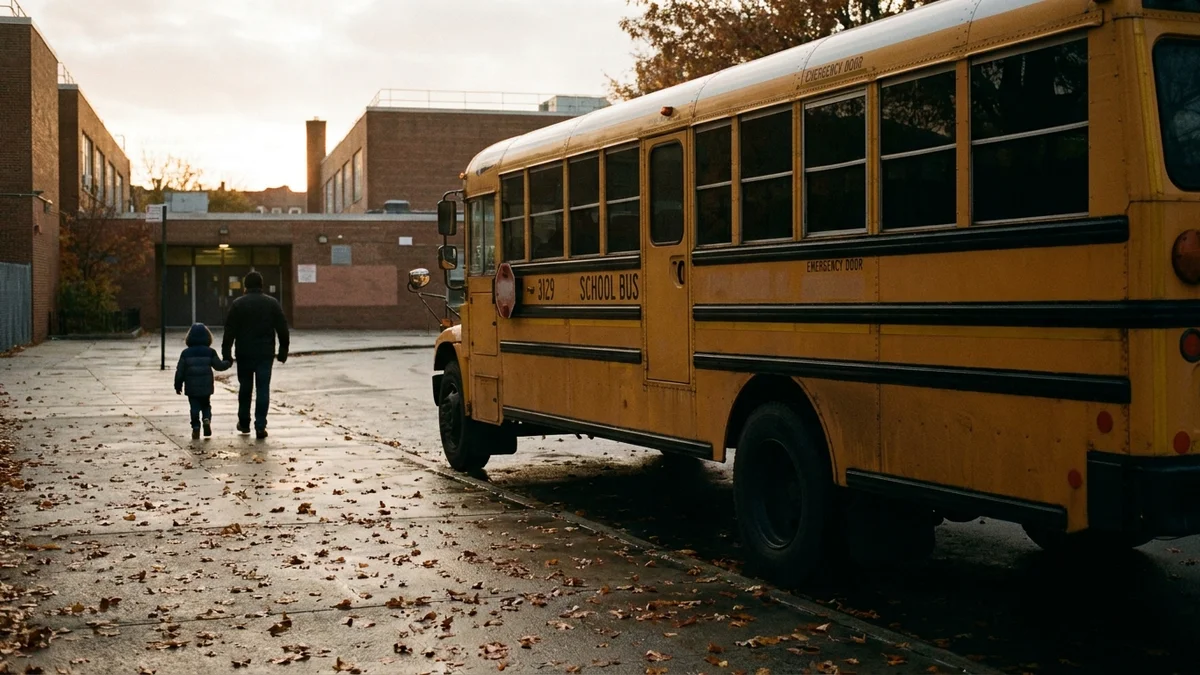
NYC’s Office of Pupil Transportation received 154,376 complaints about school bus service in the 2023-24 school year. That’s an 82% jump from 84,849 in SY2021-22.
The Comptroller’s December 17, 2025 audit named the five vendors carrying the worst complaint-per-route ratios and surfaced an enforcement gap worth $42.6 million in uncollected penalties. The system is documented, the bad actors are named, and the safety risk lives inside the same dataset.
Methodology
The vendor and complaint figures come directly from the NYC Comptroller’s audit of DOE bus oversight (FM25PAR20002), published December 17, 2025 and covering school year 2023-24.
The audit reviewed OPT records for 51 contracted bus vendors operating roughly 7,458 routes across CTS (Curb-to-School) and STS (Stop-to-School) service, plus complaint logs, GPS compliance records, dry-run attestations, and liquidated-damages assessments.
The collision-claim totals come from the NYC DCAS Safe Fleet Transition Plan final report, which compiled City-paid bus-claim data from 2017 through 2022 (the City covers the first $1.5 million of each claim before contractor insurance attaches).
Complaint counts include CTS and STS routes combined. “Problem runs” are a separate sub-category for routes flagged repeatedly by the same school. Vendor complaint-per-route ratios were calculated by the Comptroller’s auditors directly from OPT logs and are reproduced here in the rankings.
Five Vendors Account for the Worst Service Failures
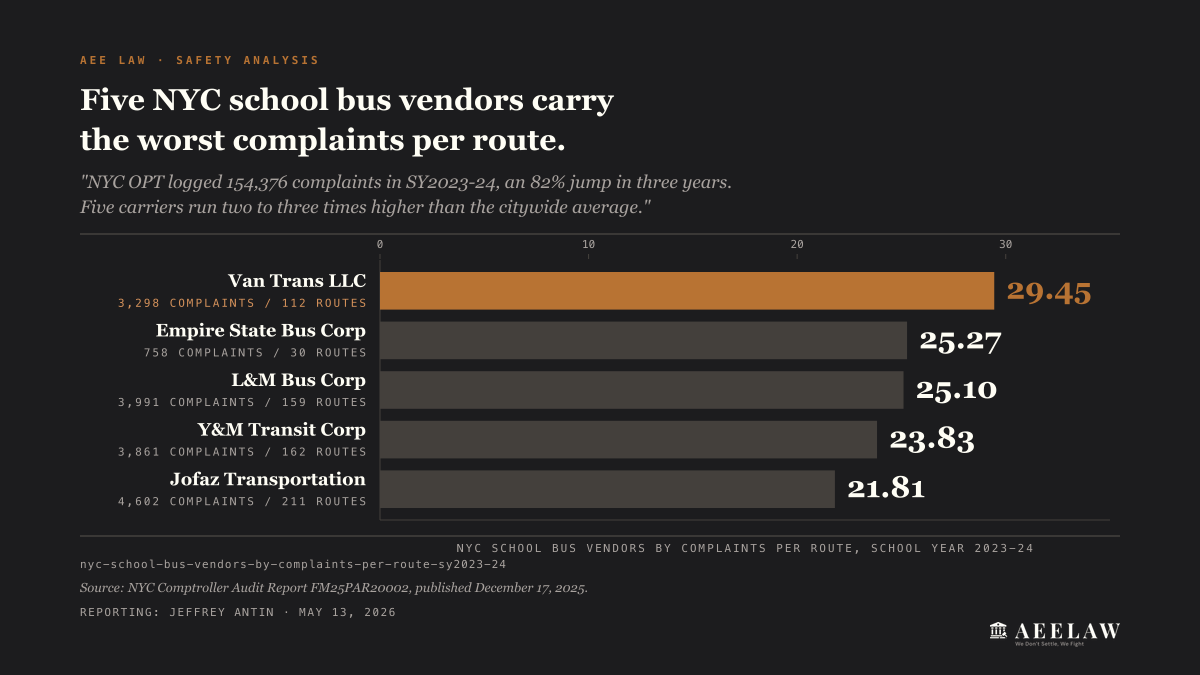
Across NYC’s 51 contracted bus vendors, five carriers carry the highest complaint-per-route ratios in the SY2023-24 file. Van Trans LLC led with 3,298 complaints across 112 routes (29.45 per route).
Empire State Bus Corp followed at 25.27 on 30 routes. L&M Bus Corp at 25.10 across 159 routes. Y&M Transit Corp at 23.83 across 162 routes. Jofaz Transportation at 21.81 across 211 routes.
The five-vendor list captures concentrated risk: bus contractors carrying complaint rates two to three times higher than the citywide average across the routes they run.
Two findings inside the same audit deepen the picture. Empire State Bus Corp also led the delay-per-route table at 49.47 delays per route across 30 routes.
Jofaz Transportation failed to complete dry runs on 55% of its 423 routes before the school year started. Third Avenue Transit, Inc. completed 0% of dry runs on its 24 routes.
Dry runs are the pre-school-year route rehearsal that lets drivers learn pickup locations and timing in advance. Skipping them produces the no-show pattern that drove the complaint volume.
The audit identifies 19 vendors with incomplete dry-run compliance before SY2023-24 even began. The Comptroller estimated $268,691 in liquidated damages went uncollected on dry-run violations alone.
Children with Disabilities Carry the Worst Routes
The single most striking finding inside the audit isn’t a dollar figure, it’s a population number. 99% of “problem runs” in NYC’s school bus system serve students with disabilities.
CTS (Curb-to-School) routes, which transport children who need door-to-door service for medical, mobility, or special-education reasons, account for the overwhelming share of late, missed, and reassigned trips.
Route K099 received 129 no-show or late-service complaints in SY2023-24 across 20 to 31 assigned students. Route K521 received another 129 complaints across 18 to 29 students. Route M107, serving the Manhattan iHOPE special-education program, received 87 no-show complaints serving only one to three students.
iHOPE reported that during the following school year (SY2024-25), 68 students collectively accumulated more than 400 absences attributable to transportation failures.
Federal IDEA law guarantees a free appropriate public education to every student with a documented disability. NYS Education Law § 3623 sets New York’s school bus approval and safety standards and the aidable transportation expense framework.
Both are bypassed when the bus doesn’t show, the child doesn’t get to school, and the lost school days compound into lost services.
The Penalty System Stopped Working
DOE’s contracts with bus vendors include liquidated damages: per-violation fines that the City is contractually entitled to deduct from contractor payments when service standards aren’t met.
In SY2024-25, OPT recorded 200,556 instances of GPS log-in non-compliance, meaning bus drivers didn’t sign into the location-tracking system at route start. That’s the foundational accountability mechanism. Without GPS log-in, OPT can’t verify whether the route ran.
The Comptroller calculated $44.3 million in liquidated damages that could have been assessed for those GPS violations. DOE assessed damages in only 7,556 of the 200,556 violations, just 5.5%, totaling $1.7 million.
The gap: $42.6 million in penalties DOE was entitled to assess but didn’t. Across the broader audit, the Comptroller documented additional uncollected damages on dry runs ($268,691), missed routes, and other contract-compliance failures.
Separately, the audit reviewed the $51.7 million Via Transportation contract for technology modernization (routing software and student ridership tracking). The contract was awarded in 2019 with a December 2021 implementation target.
As of November 2025, ridership tracking was still in pilot phase with a December 2025 launch and a March 2026 expansion. DOE is roughly four years late on the technology that would let it verify whether routes are actually being run.
What This Means for Parents and People Hurt by School Buses
If your child rides an NYC contracted school bus, three points the audit changes:
The vendor matters more than the route. Van Trans, Empire State, L&M, Y&M, and Jofaz have demonstrated patterns of complaint concentration that DOE has been on notice about for at least three years.
Parents can look up which company runs their child’s route by calling the OPT hotline (718-392-8855) and checking the assigned vendor against the Comptroller’s complaint-per-route table. The contractor is the entity that owes a duty of care to the child on the bus.
If your child is hurt in a school bus collision, two clocks start. The bus contractor is a private company, so a direct claim follows ordinary negligence procedure with a three-year statute of limitations under CPLR § 214.
If the City or DOE is named (oversight failures, route assignment, special-education accommodation failures), a Notice of Claim must be filed within 90 days under General Municipal Law § 50-e, then suit filed within one year and 90 days.
Wrongful death claims have additional limits under EPTL § 5-4.1. Missing the 90-day GML deadline usually bars municipal claims regardless of injury severity.
If you witness a driver passing a stopped school bus with extended stop arm and flashing red lights, that’s a violation of NY VTL § 1174.
VTL § 1174-a, enacted in 2019, authorizes stop-arm cameras that mail civil-liability tickets to the registered vehicle owner. The penalty is $250 for the first offense, $300 by the third within 18 months.
The DCAS Safe Fleet Transition Plan notes that in 12 of 39 school-bus pedestrian fatalities nationally from 2011 to 2020 (about 30%), the bus was turning.
That pattern is why DCAS plans an audible turn alert pilot starting with fifty systems focused on electric buses. A separate intelligent speed assistance pilot covers 50 buses running on diesel and electric.
Where the Data Doesn’t Reach Yet
The Comptroller’s audit catalogs complaints, delays, dry-run failures, and uncollected penalties. It does not publish per-vendor collision counts. NYC’s Open Data Motor Vehicle Collisions file tags vehicle type “bus” but doesn’t reliably separate school bus from MTA, charter, or private coach.
The DCAS SFTP claim file aggregates all City-paid bus claims for 2017 through 2022 but doesn’t break them out by contractor. The federal FMCSA Safety Measurement System tracks DOT-registered carriers but pulls many NYC school bus operators into the same intrastate-carrier bucket without exposing per-route exposure.
Building a contractor-level collision and injury file would require joining the OPT vendor roster against NYPD MV-104 collision reports tagged to school bus operators by name, geocoded to route shapefiles. That’s the next data harvest on this beat.
Until then, the complaint-per-route concentration table published December 2025 is the most granular public view of which contractors carry the worst safety-adjacent risk.
Every NYC parent should know which company runs their child’s route.