On the morning of February 26, 2026, a 47-year-old worker was killed at a Bushwick excavation site. A 40-year-old coworker was pulled out alive but in critical condition.
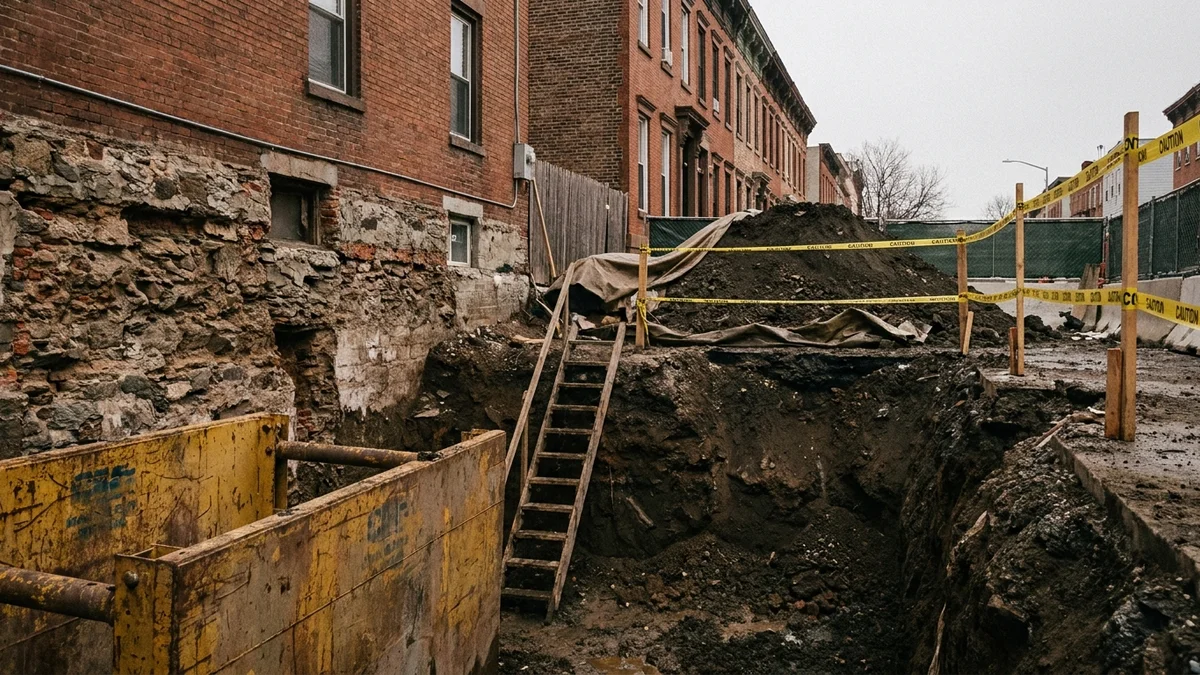
The address: 174 Jefferson Street, an existing two-story building being enlarged to four stories, operating under an active NYC Department of Buildings permit for foundation work. A portion of rubble foundation gave way and buried both men.
The collapse drew local news cameras and OSHA inspectors. It also drew a familiar question. The federal trench safety standard has been on the books since 1989. So why does this keep happening?
We went through New York City’s trench-collapse deaths, the OSHA standard written to prevent them, and the liability that follows when a contractor skips it.
What Happened in Bushwick
The site at 174 Jefferson Street had an active permit for foundation work on an existing two-story building being enlarged to four stories. The collapse occurred during work on the existing rubble foundation, a common condition in older Brooklyn structures where the original below-grade walls are field stone or unreinforced concrete bound with weak mortar.
Two workers were inside the excavation when the foundation material gave way. The 47-year-old died at the scene. The second worker was extracted by FDNY rescue and transported to a nearby hospital in critical condition. CBS News New York and News 12 Brooklyn covered the response. OSHA opened an investigation.
The cause is still under review. What is known: rubble foundation removal and underpinning are among the most dangerous trench operations in NYC because the existing material can fail without warning, and the work often occurs in narrow lots where shoring and shielding are awkward to deploy.
The OSHA Standard
OSHA’s excavation standard sits at 29 CFR 1926 Subpart P. It has been federal law since 1989. The core requirements:
Five feet or deeper requires a protective system. That means one of three approaches: sloping or benching the walls back to a stable angle, shoring the walls with hydraulic or timber supports, or shielding the workers with a trench box. The choice depends on soil type, depth, and adjacent loads.
Daily inspection by a competent person. Before any worker enters the trench, after every rainstorm, after any vibration event such as nearby pile driving or heavy traffic, and after any change in soil conditions. The competent person must have authority to stop work immediately.
Twenty feet or deeper requires a registered professional engineer. The protective system at that depth must be designed and stamped by a PE. Off-the-shelf trench boxes rated for shallower work cannot be used.
Spoil pile setbacks. Excavated soil must be kept at least two feet from the edge of the trench. Tools, equipment, and material loads need the same setback or further.
Means of egress. A ladder, ramp, or steps within 25 feet of any worker for trenches four feet or deeper.
The standard exists because soil is heavy and unforgiving. One cubic yard weighs roughly 3,000 pounds, about the weight of a small sedan.
A worker buried to the waist cannot draw breath against the pressure. A worker buried to the chest is dead in two minutes if not extracted faster than rescue crews can typically reach the site.
The Numbers
The Bureau of Labor Statistics tracks trench and excavation deaths through its Census of Fatal Occupational Injuries, and CPWR analyzes that microdata year to year.
The annual count swings hard: 15 deaths in 2021, then 39 in 2022, the deadliest year in nearly two decades, then back to roughly 15 in 2023. The count tends to spike after a long industry boom, when smaller contractors with less safety infrastructure take on work they are not equipped to manage.
OSHA classifies trench collapse as a “serious recognized hazard” and treats most fatal trench cases as willful or repeat violations. Civil penalties for willful violations under the OSH Act run up to $165,514 per violation as of 2026.
NYC Department of Buildings construction-related accident data captures incidents within the city’s permitting system. Foundation and underpinning work account for a small share of total incidents but a larger share of fatal incidents.
The pattern is the same one OSHA has documented nationally: trench work is a high-consequence, low-volume hazard, and the cases that go wrong tend to go wrong catastrophically.
Why It Keeps Happening
Investigators who handle trench collapse cases see the same recurring conditions:
No protective system installed. The contractor relied on the assumption that the soil would hold for the duration of the task. Soil does not behave that way. Vibration, moisture, prior disturbance, and undocumented utilities can all destabilize a trench wall in seconds.
No competent person on site. OSHA requires a designated competent person. On many sites the role is checked off paperwork but never actually filled, or it is assigned to a foreman who has never been trained on soil classification or atmospheric testing.
Spoil piles too close. The excavated dirt sitting at the edge of the trench adds load to the wall. When the wall fails, the spoil pile dumps in on top of the workers.
Trench boxes mis-sized. A trench box is rated for a specific depth and soil type. Crews routinely use boxes rated for Type B soil in Type C conditions, or stack boxes vertically without engineering review.
Production pressure. Most trench fatalities involve contractors working on a tight schedule with thin margins. Putting in a proper shoring system can take a half day. Skipping it saves money on a job priced without shoring in the bid.
Labor Law 241(6) and the Industrial Code
For trench collapse cases in New York, the most powerful legal tool is Labor Law § 241(6). It imposes non-delegable liability on property owners and general contractors for violations of specific Industrial Code provisions. The relevant provision for excavation work is 12 NYCRR 23-4.
This matters because trench work is almost always subcontracted. The injured worker’s direct employer is typically a small excavation outfit. Workers’ compensation bars a suit against the direct employer, but it does not bar suits against the general contractor or the property owner. Labor Law § 241(6) is the statute that makes those defendants reachable.
Labor Law § 240(1), the Scaffold Law, can also apply when the collapse involves a worker falling into the trench or being struck by collapsing material from above. Both statutes can run together in the same case.
Verdicts and Settlements
Trench collapse cases in New York consistently produce seven- and eight-figure outcomes. The driver is the severity of the injury. Workers who survive trench collapses typically present with crush injuries, traumatic brain injury from oxygen deprivation, fractured vertebrae, and long-term pulmonary damage from inhaled soil and dust.
Wrongful death claims include lost lifetime earnings for workers often in their 30s, 40s, or 50s, plus pain and suffering for the period before rescue or death.
The mathematics of these cases is straightforward. A 47-year-old worker with 20 years of expected earnings remaining, even at modest construction wages, represents seven figures in lost income alone.
Add pain and suffering, loss of consortium for a spouse, loss of parental guidance for any minor children, and the cases climb quickly into the eight-figure range when liability is clear. Liability under 241(6) usually is clear.
What Families Should Do
Two things matter immediately after a trench collapse fatality.
Preserve the scene. OSHA will investigate. So will the NYC Department of Buildings. The scene, the equipment, the spoil pile, the trench box if any, the shoring lumber, the soil samples: all of it can become evidence in a civil case.
Photographs, videos, and witness statements taken in the first 48 hours are the most reliable record.
Get the OSHA file. OSHA inspection reports become available through FOIA after the investigation closes, but the underlying field notes, photographs, and citations are critical to a civil case. Citations alone, when issued, are admissible as evidence of code violations under Labor Law § 241(6).
The Bushwick collapse is the kind of case where the OSHA report will likely document a Subpart P violation, the DOB inspection history of the site will tell its own story, and the civil case will turn on which of those violations a competent person should have identified before the second worker entered the trench.
The Pattern
Every fatal trench collapse looks different on the surface. The address changes. The contractor changes. The soil type changes. What does not change is the standard. Subpart P has been the law since 1989. Industrial Code 23-4 has been on the books even longer in substance.
The standard exists because trench collapses are predictable. Soil weighs what it weighs. Walls fail when they are not supported. Workers cannot breathe under three feet of dirt. None of this is new information.
A trench collapse is rarely an accident in the colloquial sense. It is the predictable result of a known set of decisions: skip the shoring, skip the inspection, push the schedule, hope the wall holds. When the wall does not hold, the consequences land on the workers and their families.