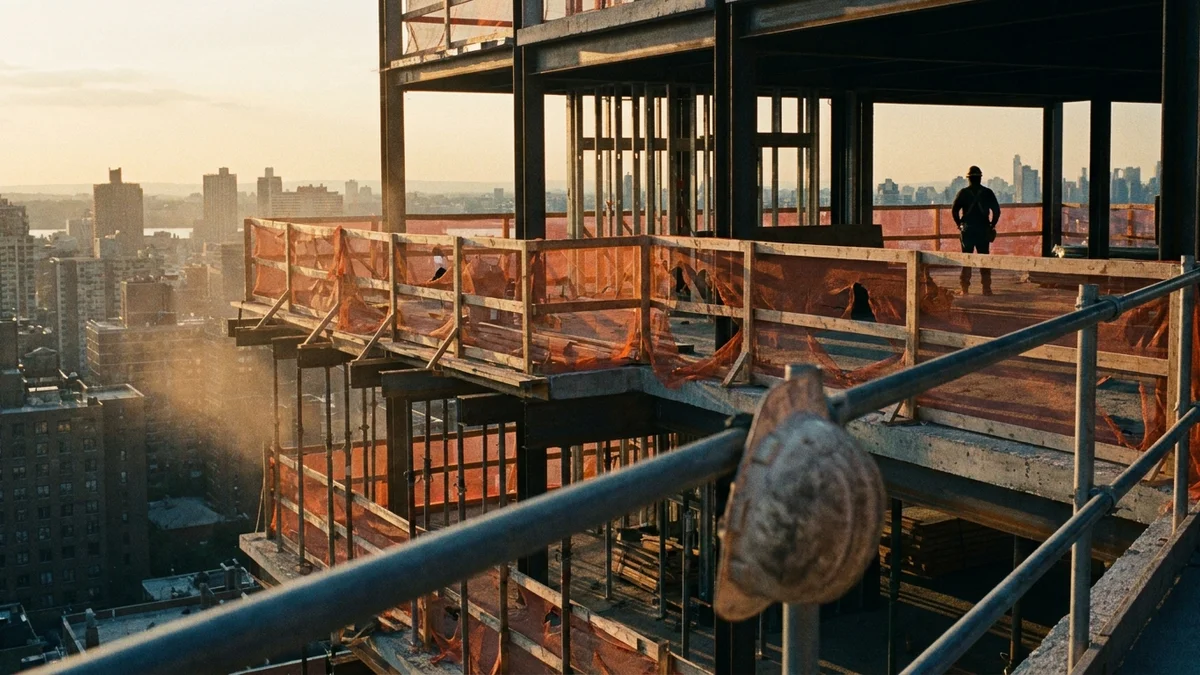
In 73% of the OSHA-investigated New York construction deaths in 2023, employers had OSHA violations tied to the fatal incident. That’s a headline number from NYCOSH’s 2025 Deadly Skyline report, drawn from OSHA’s 44 fatality investigations that year.
NYC carried 30 of those deaths, the highest single-year toll in over a decade. The same year, NYC’s Comptroller crossed $15 million in recovered back wages from contractors who shorted workers on public projects. The two enforcement files describe a single business model.
Methodology
The fatality counts and overlap percentages come from NYCOSH’s 2025 Deadly Skyline report, an annual compilation of New York construction worker deaths drawn from OSHA fatality investigations, DOB stop-work orders, NY State Department of Labor records, and medical examiner reports for calendar year 2023.
The 73% figure measures the share of OSHA-investigated fatalities where the employer was cited for OSHA violations connected to the fatal incident, calculated against OSHA’s 44 fatal-incident investigations for 2023. The 77% non-union share is calculated against the same 44 investigations.
NYC’s fatality count is reported at 30 deaths, against a construction workforce of roughly 257,000 (a count the report’s per-worker rate implies rather than states), yielding a rate of 11.6 per 100,000 workers.
The Comptroller’s recovered-back-wages totals are pulled from the NYC Comptroller Bureau of Labor Law press releases tracking enforcement from January 2022 forward, and from the September 3, 2025 Employer Violations Dashboard update. Named contractors come from the Comptroller’s Wall of Shame and DOB OATH adjudicated cases.
The Body Count and the Wage File Describe the Same Economy
NYCOSH’s 2025 Deadly Skyline tracked 74 construction worker deaths in New York State in 2023. That was a 48% jump from 50 deaths in 2022. New York City carried 30 of them, the highest single-year city total in over a decade.
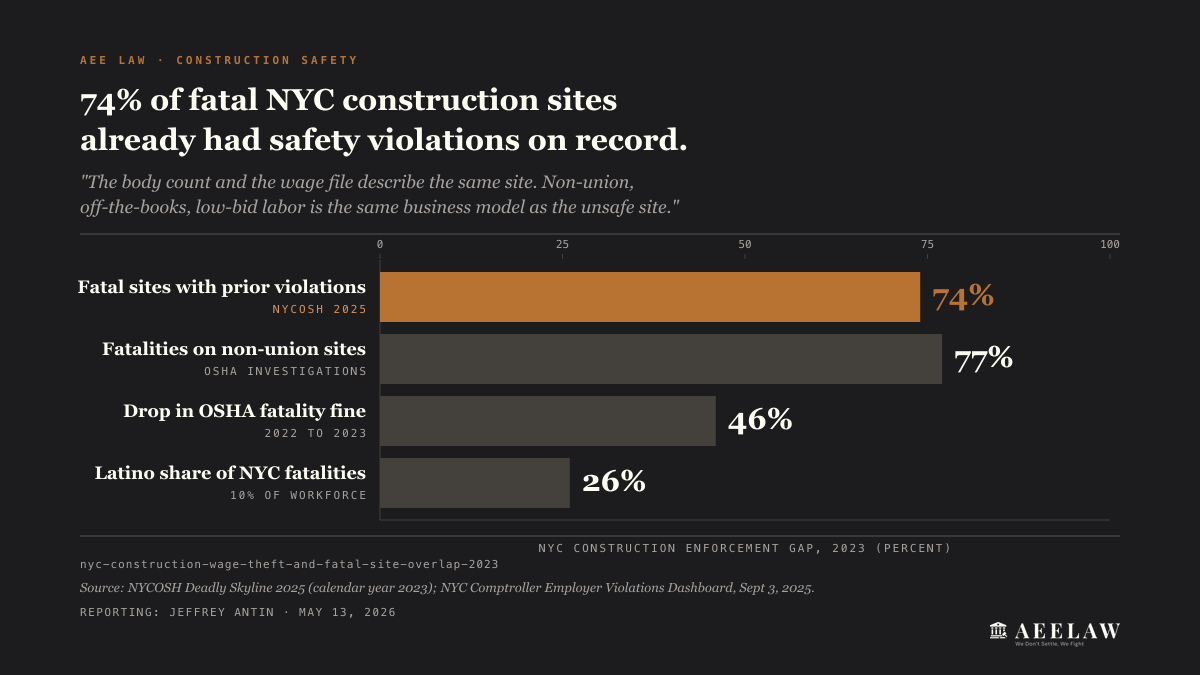
The report’s most cited number is the safety record on those sites. In 73% of the 44 fatalities OSHA investigated, the employer was cited for OSHA violations connected to the fatal incident.
Falls remained the leading cause. The OSHA average fine on a fatal construction case fell from $59,075 in 2022 to $32,123 in 2023, a 45.6% drop.
The NYC Department of Buildings headcount plan for fiscal year 2025 ran 119 positions below 2024, and the agency’s January 2025 vacancy rate was 13.3% even as construction project counts climbed.
Two other findings from the same report are worth holding in mind:
- 77% of the fatalities OSHA investigated were on non-union sites.
- Latino workers were 10% of the construction workforce but 26% of the fatalities.
Both numbers point at the same labor market. Non-union, immigrant, often off-the-books labor. The kind of labor that gets paid in cash, gets misclassified as 1099, or gets paid below the prevailing wage on a public project.
The NYC Comptroller’s enforcement file describes the same labor market from a different angle. Since January 2022, the office’s Bureau of Labor Law has crossed $15 million in recovered back wages and supplemental benefits. The settlements name contractors working on the same kinds of sites NYCOSH counts deaths on.
NY Labor Law § 220 and NY Labor Law § 230 set prevailing wage on public works. NY Labor Law § 198 creates a private right of action for wage theft. Labor Law § 240(1) and Labor Law § 241(6) govern the safety side. Same project, same workers, different bureau handling the file.
What the Wall of Shame Actually Names
The Comptroller’s Employer Violations Dashboard launched in September 2024 and added a “Wall of Shame” tier in September 2025. The Wall lists contractors with the most egregious citations across ten categories. Two are construction-vertical names worth pulling apart.
Montis Construction LLC was debarred from bidding on NYC contracts for five years after the Comptroller’s office found the firm had paid workers $15 per hour while certifying $25.38 per hour on payroll records for the Zerega Bus Depot Central Maintenance Facility in the Bronx, a New York City Transit Authority funded project.
Montis paid over $69,000 in backpay and civil penalties. The carpentry-work scope and the falsified payroll certifications are textbook prevailing wage fraud.
NY Developers & Management accumulated 32 OATH-adjudicated construction safety violations across Brooklyn, the Bronx, Manhattan, and Queens.
Two were “Aggravated II” penalties, the most severe tier in the NYC Building Code Chapter 33 schedule, after DOB investigations of worker injuries at Brooklyn job sites in 2023 and 2024 found the firm had failed to provide required site safety orientations and failed to institute safety measures. The total fine load was over $73,000.
Look at those two firms together. One is a wage case. One is a safety case. Both are NYC construction. Both are repeat-violator profiles. The Wall of Shame doesn’t yet present them as overlapping data, but the firm profile, the project type, and the worker demographics line up.
ICP Construction is the cleanest illustration of the wage thread alone. The NYC Comptroller’s office settled an $855,328.42 prevailing wage case against ICP Construction in 2025. The 22 underpaid workers had renovated NYPD precincts citywide, including 1 Police Plaza, between October 2018 and November 2020. The same payroll-certification dynamic Montis ran on the Zerega site.
The Statutory Picture
Two statutes do most of the work on the safety side. NY Labor Law § 240(1), the Scaffold Law, imposes absolute liability on owners and general contractors for gravity-related construction injuries: falls from height, falling objects, scaffold or ladder failures.
Comparative negligence does not apply. Once the safety device failed, the GC and owner are liable. NY Labor Law § 241(6) covers other Industrial Code violations and is the broader catch-all on excavation, demolition, and general site safety. The injured worker can pursue both alongside a workers’ comp claim against the direct employer.
Two statutes do the work on the wage side. NY Labor Law § 220 and NY Labor Law § 230 set prevailing wage and supplemental benefits on public works projects.
NY Labor Law § 198 creates the private right of action for wage theft, with liquidated damages and attorney’s fees. Under Labor Law § 198-a, failing to pay wages is a misdemeanor for a first offense and a felony for a repeat offense within six years.
A worker hurt on a non-union NYC job site where the sub paid in cash, didn’t certify hours correctly, and skipped fall protection has three claims sitting on top of each other:
- The 240 or 241(6) claim against the owner and GC for the injury. Absolute liability if 240 applies.
- The wage claim against the direct employer for unpaid hours, overtime, or below-prevailing wage.
- The workers’ compensation claim against the direct employer for medical and lost wages.
These are separate proceedings in separate forums. They do not cancel each other out. Misclassification as a 1099 is not a defense to a Labor Law 240 claim. The test for “employee” under the comp statute and “person employed” under 240 are different.
What This Means for Injured NYC Construction Workers
Three things the data above changes for somebody hurt on a NYC construction site.
The off-the-books status doesn’t end the case. A worker paid in cash, misclassified as 1099, or working for a sub that’s not on the certified payroll is still covered by Labor Law 240 and 241(6) when those statutes’ elements are met.
The right defendants are the owner and general contractor, not the cash-paying sub. Absolute liability on the GC is the legal mechanism that gets compensation to a worker the sub would rather erase from the record.
The same sub that hurt the worker is often the same sub that stole the wages. When a firm cuts corners on prevailing wage certification, the firm is usually cutting corners on safety orientation, fall protection, and PPE on the same job site.
The Comptroller’s wage file and the OSHA inspection file describe overlapping firm profiles. A worker pursuing a Labor Law 240 case should preserve every payroll stub, every text message about hours, every cash transaction record. Those documents are evidence in both the safety case and the parallel wage claim.
Public-works projects have a paper trail. Prevailing wage projects file certified payrolls with the city or state. When a worker can document that the certified payroll shows $25.38 per hour and the actual paycheck says $15, the wage case is straightforward.
The certified-payroll fraud is also a credibility point in the 240 case. A GC who tolerated fraudulent payroll certifications on the safety paperwork didn’t tolerate the violation in a vacuum.
What’s Coming
Three threads sit downstream of the 2025 enforcement window.
The Comptroller’s Wall of Shame is on a public dashboard now. That changes the bidding landscape for the worst NYC construction firms. Debarment plus reputational visibility is the pressure point the office has against repeat violators that fines alone don’t reach.
OSHA’s average fatality fine fell almost in half between 2022 and 2023. The federal enforcement signal on construction deaths weakened in the same window that NYC’s fatality count hit a 10-year high.
The gap between federal civil penalties and city-level reputational visibility will keep widening if the dashboard adds new contractors at the pace it has.
The next granular data move on this beat is geocoding. Joining the Comptroller’s contractor wage-theft addresses to DOB ECB violation addresses to the OSHA establishment search would surface the actual address-level overlaps the public summaries describe in aggregate. The data is public. The harvest is the lift.
Cheap labor and unsafe sites are the same job site.