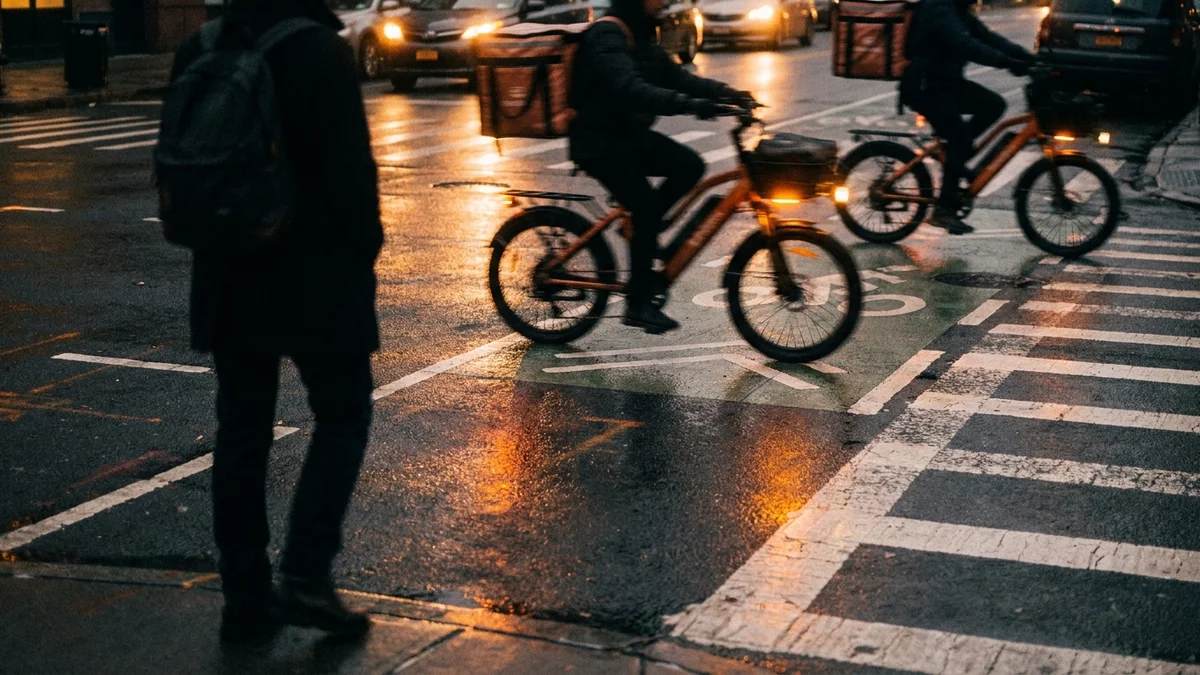
Between 2010 and 2014, left-turning vehicles killed 108 pedestrians and cyclists in New York City. That is roughly 13% of the 859 total pedestrian and cyclist fatalities during that period, from a single turning movement at intersections.
The problem is geometry. A left turn crosses oncoming traffic and sweeps through the crosswalk at a wider, faster arc than a right turn. The driver’s attention is split between oncoming vehicles, the turn itself, and pedestrians who may be halfway across the street. Pedestrians enter the crosswalk expecting to be seen. Many are not.
NYC DOT published a dedicated Left Turn Pedestrian and Bicyclist Crash Study documenting this pattern. The findings triggered one of the largest intersection safety programs in any American city. We looked at the crash counts since, and whether the program is working.
77% of Pedestrian Injuries Happen at Intersections
The broader context matters. Approximately 77% of pedestrian injuries and 59% of pedestrian fatalities in NYC occur at intersections. In the first nine months of 2024, 88% of the 88 pedestrians killed were at intersections with no daylighting protection. Daylighting means removing parking near crosswalks so drivers can see pedestrians.
Transportation Alternatives documented in late 2024 that traffic crashes killed 193 people and seriously injured 2,338 more in the first nine months of 2024, more fatalities than eight of the previous ten years. In that nine-month window, 645 pedestrians were seriously injured, a 13% increase over the same period in 2023.
Left turns are not the only intersection killer, but they are the most mechanically fixable. The geometry of the turn itself can be changed with physical infrastructure. NYC DOT has been doing exactly that since 2016.
The Turn Calming Program: 1,236 Intersections
NYC DOT launched the turn calming program in 2016. The concept: use physical barriers to force turning vehicles into slower, tighter arcs that give drivers more time to see pedestrians and give pedestrians more time to get out of the way.
Two primary treatments exist.
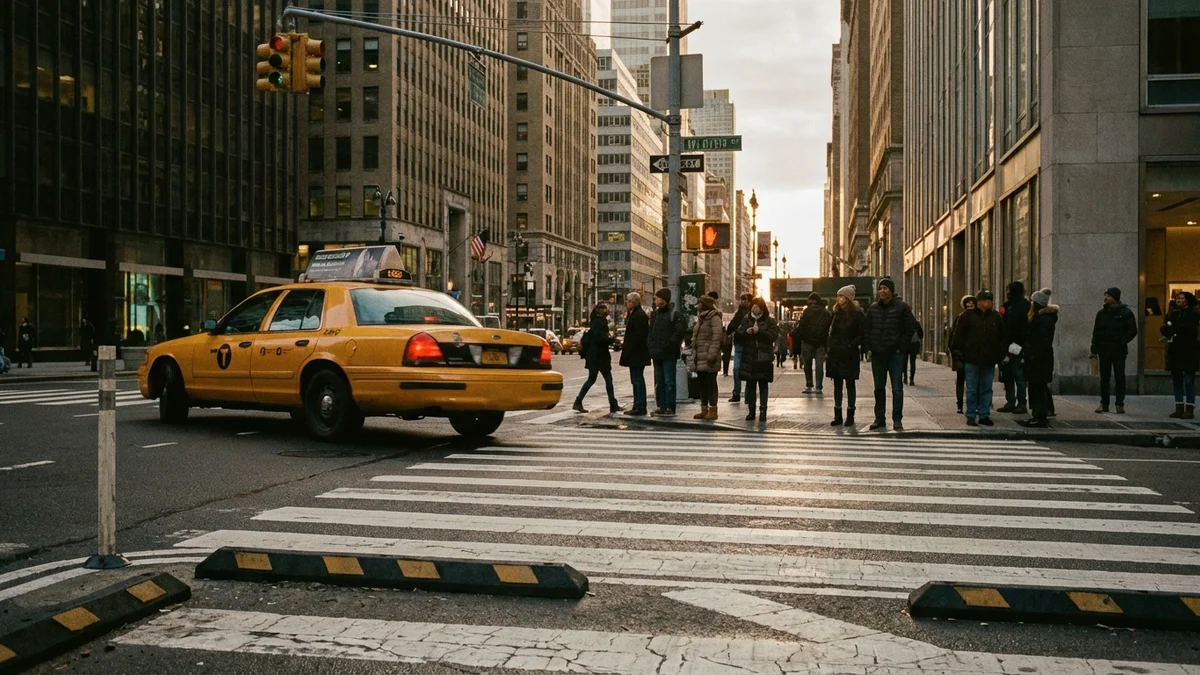
Basic hardened centerlines (802 locations since 2016): Five pieces of rubber curb and bollards or rubber speed bumps installed on the centerline, extending up to six feet into the intersection. These prevent drivers from cutting the corner on a left turn.
Complete hardened centerlines (147 installations since 2016): Rubber curbs, bollards, “No Parking” markings, slow-turn wedge markings, and flexible plastic posts for one-way to two-way configurations. These cover more of the intersection geometry.
By December 31, 2025, the turn calming program had treated 1,236 intersections citywide.
What the Data Shows
The measured results at treated intersections:
| Metric | Change |
|---|---|
| Average left-turn speed | Down 52.6% |
| Crossing the double yellow line on left turns (treatment to the stop bar) | Down 78.9% |
| Average right-turn speed | Down 34.1% |
| Pedestrian severe injuries from vehicle crashes | Down 33% |
At intersections where the treatment extends to the crosswalk, drivers crossing the double yellow line during left turns dropped to zero: a 100% reduction.
These are not modeled projections. This is before-and-after data from treated intersections compared to their pre-treatment baselines.
Leading Pedestrian Intervals: 56% Fewer Left-Turn Deaths
A Leading Pedestrian Interval gives pedestrians a head start, typically 7 to 12 seconds, to enter the crosswalk before turning vehicles get a green light. The pedestrian is already visible in the crosswalk when the driver begins the turn.
NYC installed 13 LPIs in 2013, 55 in 2014, and 417 in 2015. The program has continued expanding since.
The strongest effectiveness data comes from NYC DOT’s analysis of 104 intersections that received LPIs between 2003 and 2011, measured against crash data spanning 2000 to 2014. The result: a 56% decline in pedestrian and cyclist fatalities and severe injuries caused by left turns.
Split LPIs, which provide a longer 12-second head start, have been piloted at 28 intersections. At Lafayette Street and Kenmare Street in SoHo, the split LPI gives pedestrians the full 12-second head start before any vehicle movement begins.
Left-Turn-Only Signals: 33% Fewer Injuries
The most restrictive intervention separates turning drivers from crossing pedestrians. Left-turn-only phasing means drivers can only turn left when they have a dedicated green arrow, and pedestrians have a red signal during that phase.
NYC DOT’s before-and-after crash analysis at 478 intersections, using three years of pre- and post-data:
| Intervention | Left-Turn Injury Reduction |
|---|---|
| Left-turn-only signals | 33% drop in left-turn pedestrian/cyclist injuries |
| Left-turn restrictions | 41% drop in left-turn pedestrian/cyclist injuries |
| Left-turn bays | 15% drop in left-turn pedestrian/cyclist injuries |
When you physically separate cars turning left from the pedestrian phase, the injuries fall. The trade-off is signal time, which is why the city reserves this treatment for its highest-crash intersections.
Where the Gaps Remain
As of 2024, 92% of pedestrians killed at intersections were at locations with no physical daylighting features. The turn calming program has treated 1,236 intersections, but NYC has over 10,000 signalized intersections.
Serious injury data from Transportation Alternatives shows 116 intersections with 5 or more killed-or-seriously-injured incidents since 2022. Nearly 3 million NYC residents live within walking distance of these high-KSI intersections.
Borough-level injury trends from 2024 show the problem is not evenly distributed:
| Borough | Serious Injury Increase (2023 to 2024) |
|---|---|
| Queens | 21% |
| Brooklyn | 20% |
| Manhattan | 16% |
| Bronx | 10% |
Queens and Brooklyn, which have the widest arterial roads and the most complex multi-lane intersections, are seeing the largest surges in serious pedestrian injuries.
The Legal Framework
Under Vehicle and Traffic Law § 1141, a driver making a left turn must yield the right of way to oncoming vehicles close enough to be a hazard. Under Vehicle and Traffic Law § 1151, that same driver must yield to a pedestrian crossing within the crosswalk.
Failure to yield is a traffic violation and constitutes negligence per se in a personal injury action.
When a pedestrian is struck by a left-turning vehicle in a crosswalk with a walk signal, the driver bears presumptive fault. The pedestrian does not need to prove the driver was distracted or speeding. The failure to yield is the negligence.
In cases where the intersection had a documented crash history and the city had not implemented turn calming or signal changes, additional claims against the City of New York may be viable. Prior notice is a required element: the city must have known about the dangerous condition.
NYC DOT’s own crash data, which identifies high-KSI intersections, can serve as evidence of that knowledge.
2025: Progress, but Not Enough
NYC DOT’s January 2026 year-end report documented NYC’s lowest overall traffic death count on record in 2025: 205 total fatalities, a 19% decline from 253 in 2024. Pedestrian fatalities fell from 122 to 111, a 9% drop. These numbers reflect the cumulative impact of turn calming, LPIs, protected bike lanes, and speed camera expansion.
But 111 pedestrians still died. Twenty-three people a day were still injured. The interventions that work are proven. The question is speed of deployment. At the current rate, it will take years to treat the remaining high-KSI intersections. Every untreated intersection is a known risk with a documented fix.