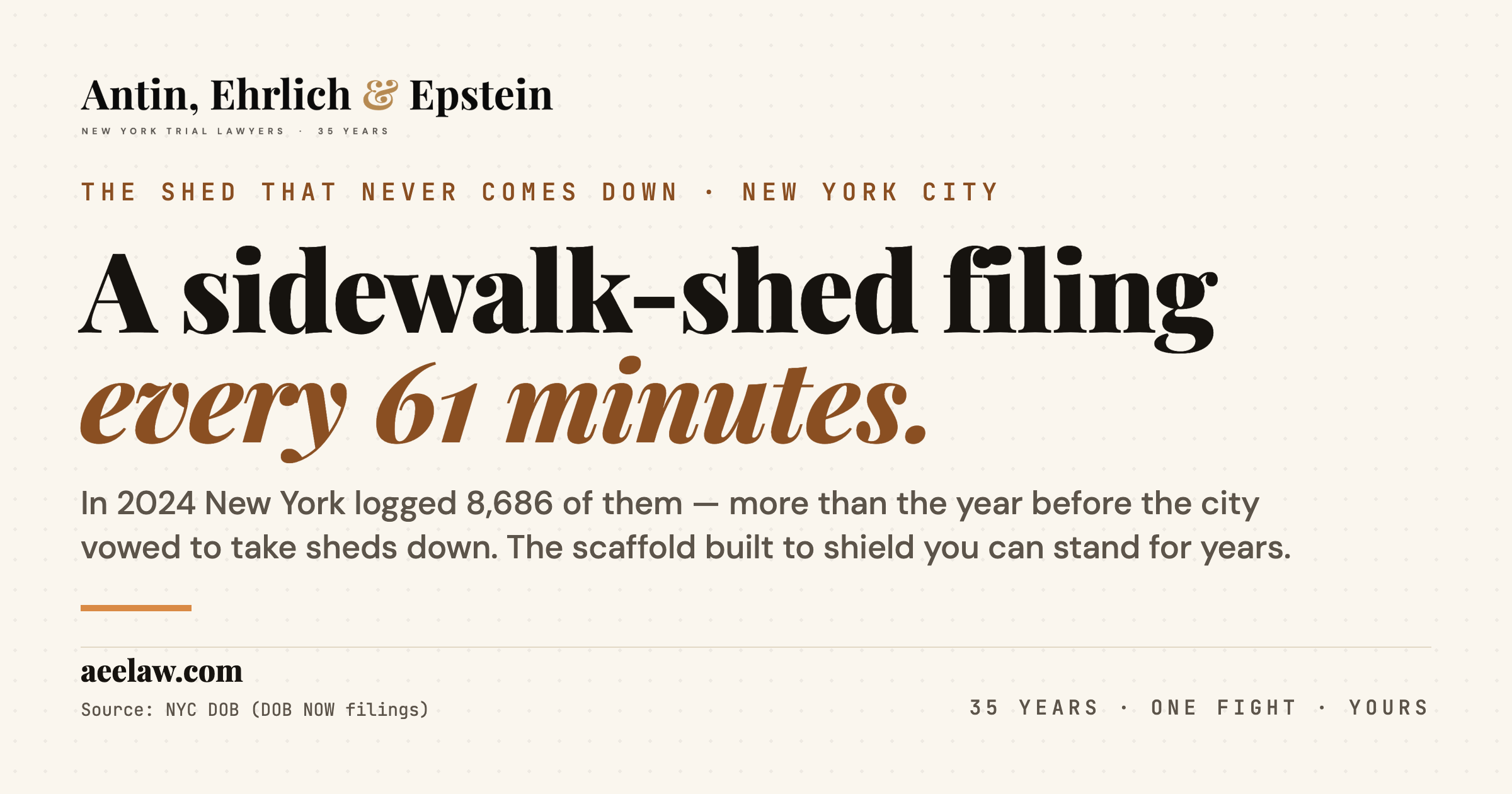
New York City logged 8,686 sidewalk-shed filings in 2024, roughly one every 61 minutes, around the clock.
That is not a backlog the city is clearing. It is a backlog the city is feeding. The year before, in 2023, New York launched a high-profile push to take its sidewalk sheds down. The year after, the filings went up.
Methodology
We pulled every DOB NOW Build job filing flagged as sidewalk-shed work from NYC Open Data, a set of 67,408 filings from August 2016 through June 16, 2026, and computed annual counts, the split across boroughs and neighborhoods, and the most frequent filers by owner business name. A filing is a permit record, not a unique standing shed, because a single shed is re-filed each time its permit renews, so these numbers track shed activity rather than a live count of sheds on the street.
The legacy city permit dataset stopped updating in 2020, so the current records live in DOB NOW. Figures on sheds removed, total miles covered, and the longest-standing shed come from the Mayor’s Office and the Department of Buildings, and we attribute them as city statements rather than our own measurement.
The shed count is rising, not falling
New York logged 8,686 sidewalk-shed filings in 2024, up from 8,298 in 2023, the year the city launched its Get Sheds Down initiative in July. Filings have held above 8,000 a year every year since 2021. For a program built on the promise of clearing the streets, the permit record runs the other way.
The city points to real removals. It says it has taken down more than 15,000 sheds and that it is rewriting the rules so fewer go up in the first place. Both are true at once: the city removes old sheds while owners file for new ones at nearly the same pace. The net result is a streetscape that stays covered. By the city’s own count, sheds still stretch across roughly 380 miles of sidewalk.
“New York adds sheds faster than it takes them down.”
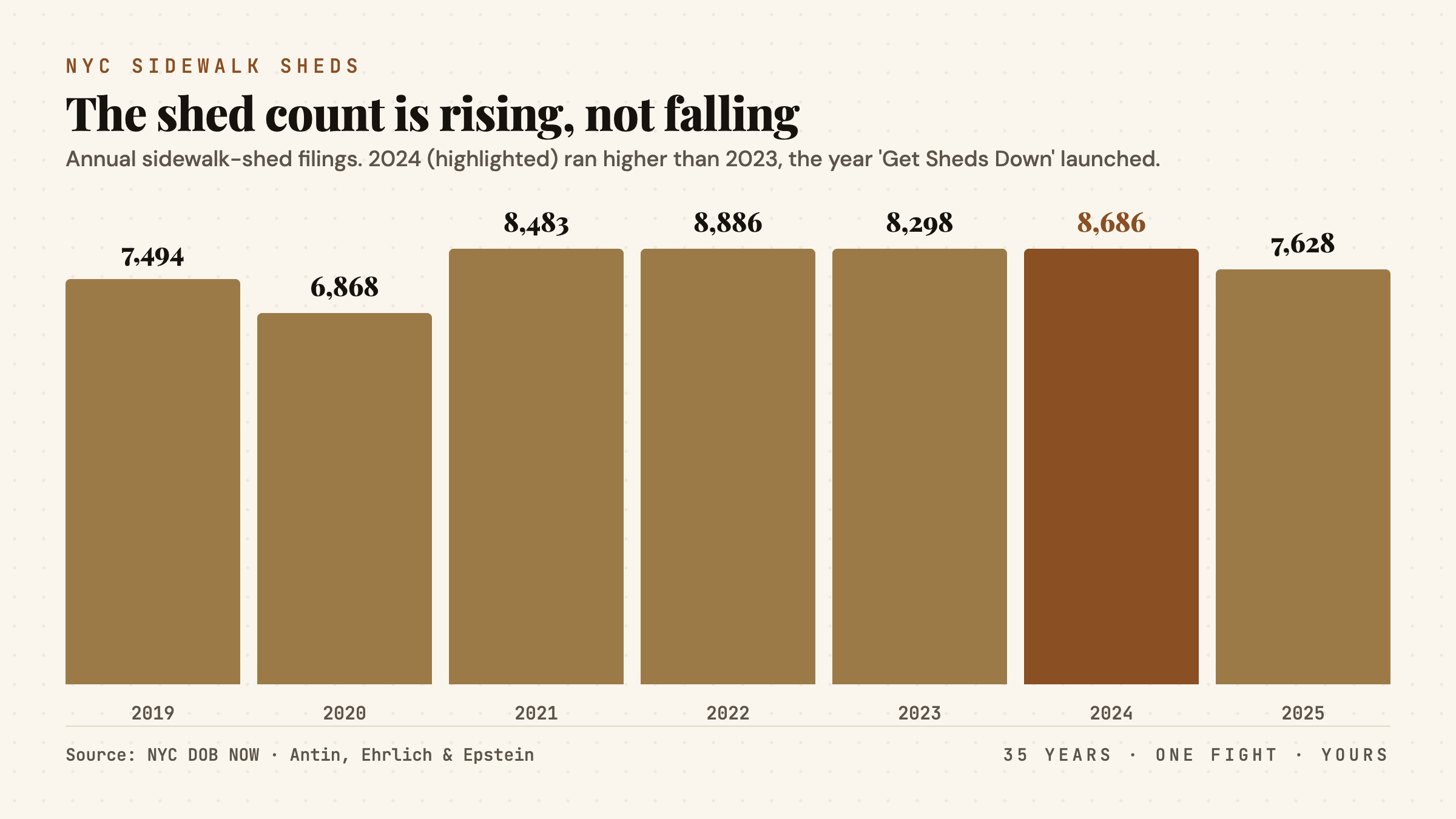
Annual NYC sidewalk-shed filings, 2017 to 2025, from NYC Open Data DOB NOW Build records.
The sheds cluster where the most people walk
Manhattan accounts for 29,545 of the 67,408 shed filings since 2016, close to half the citywide total. Brooklyn follows with 19,187, then the Bronx with 9,540 and Queens with 8,618. Staten Island, with the fewest pedestrians on dense commercial blocks, files the fewest by a wide margin.
Drill into neighborhoods and the pattern sharpens. The Upper East Side and Carnegie Hill lead the city with 2,467 filings, followed by Midtown and Times Square at 2,287 and the Upper West Side at 1,879. These are the blocks with the heaviest foot traffic in the country. The shed that is supposed to shield a person on a crowded Midtown sidewalk is the same structure that funnels that person into a dark, narrow corridor for months or years at a time.
“The sheds pile up exactly where the crowds do.”
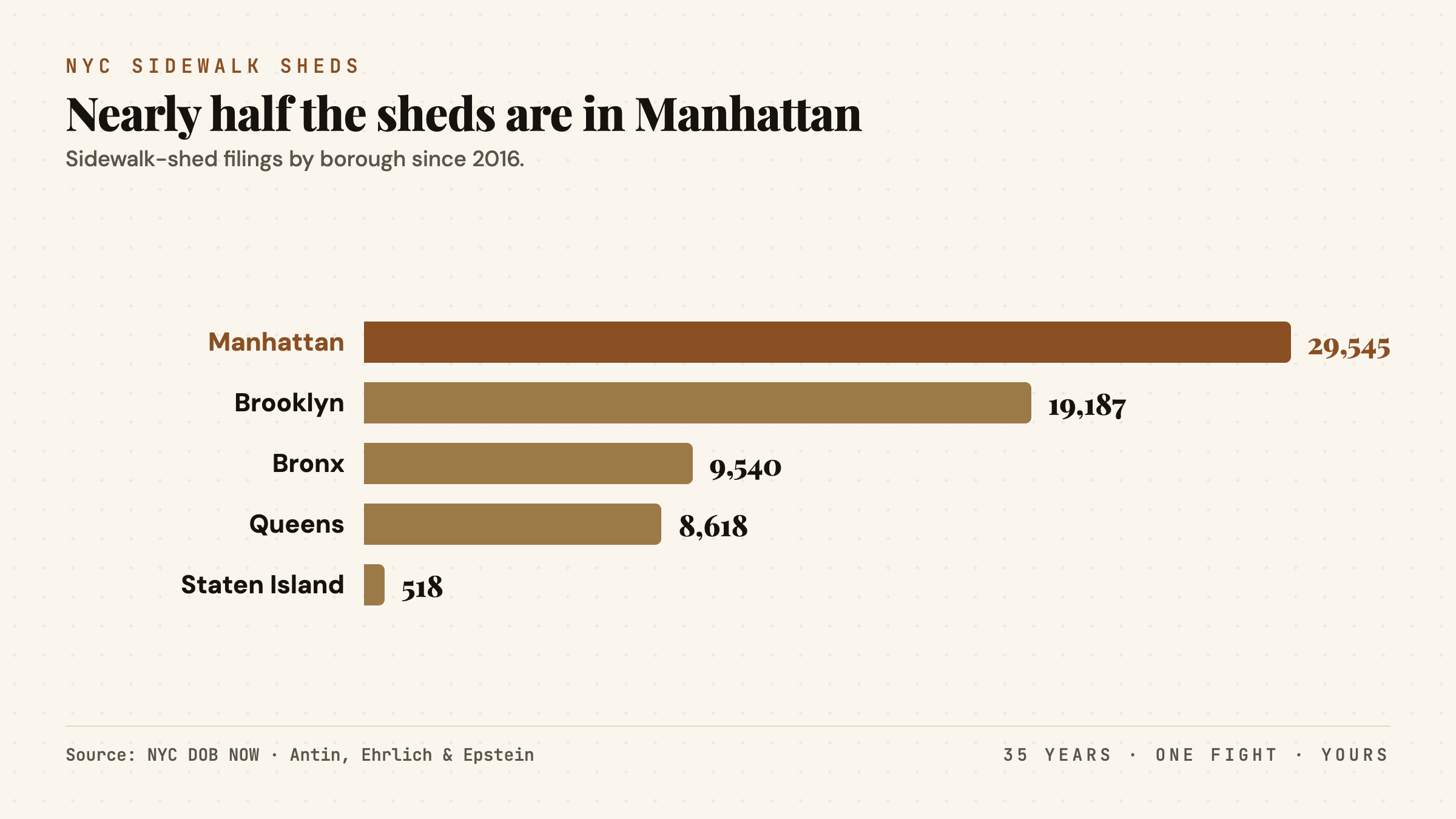
NYC sidewalk-shed filings by borough since 2016, from NYC Open Data DOB NOW Build records.
The biggest shed-keepers include the city itself
The single largest identifiable filer in the data is the New York City Housing Authority, which appears on 2,912 sidewalk-shed filings, second only to a generic “PR” owner code. The city’s own landlord is one of the most prolific shed-keepers in New York. In March 2026 the city committed 650 million dollars to repair NYCHA facades and pull sheds at 40 developments, an acknowledgment that public buildings had let sheds stand for years.
That delay is the core of the problem for the people underneath. A sidewalk shed goes up to protect the public from falling facade material while repairs happen. When the repairs stall and the shed stays, it stops being protection. Decks accumulate debris and standing water. Lighting fails. Posts and base plates narrow the walkway and become trip hazards. New Yorkers have understood sheds as crime corridors for as long as the sheds have existed.
New York courts have sorted out who pays when a sidewalk structure injures a passerby for decades. Appellate Division decisions from Kuzyns v. City of New York in 1993 through McKenzie v. Columbus Centre in 2007 and Glispy v. Riverbay Corp. in 2014 trace a consistent line: the owner and the contractor that erect and maintain a shed owe a duty of care to the people who walk under it. The Scaffold Law, Labor Law 240 and 241, protects the workers on the facade job. The pedestrian’s claim is a common-law negligence claim against whoever controlled the shed.
“A shed up for years is a hazard, not a shield.”
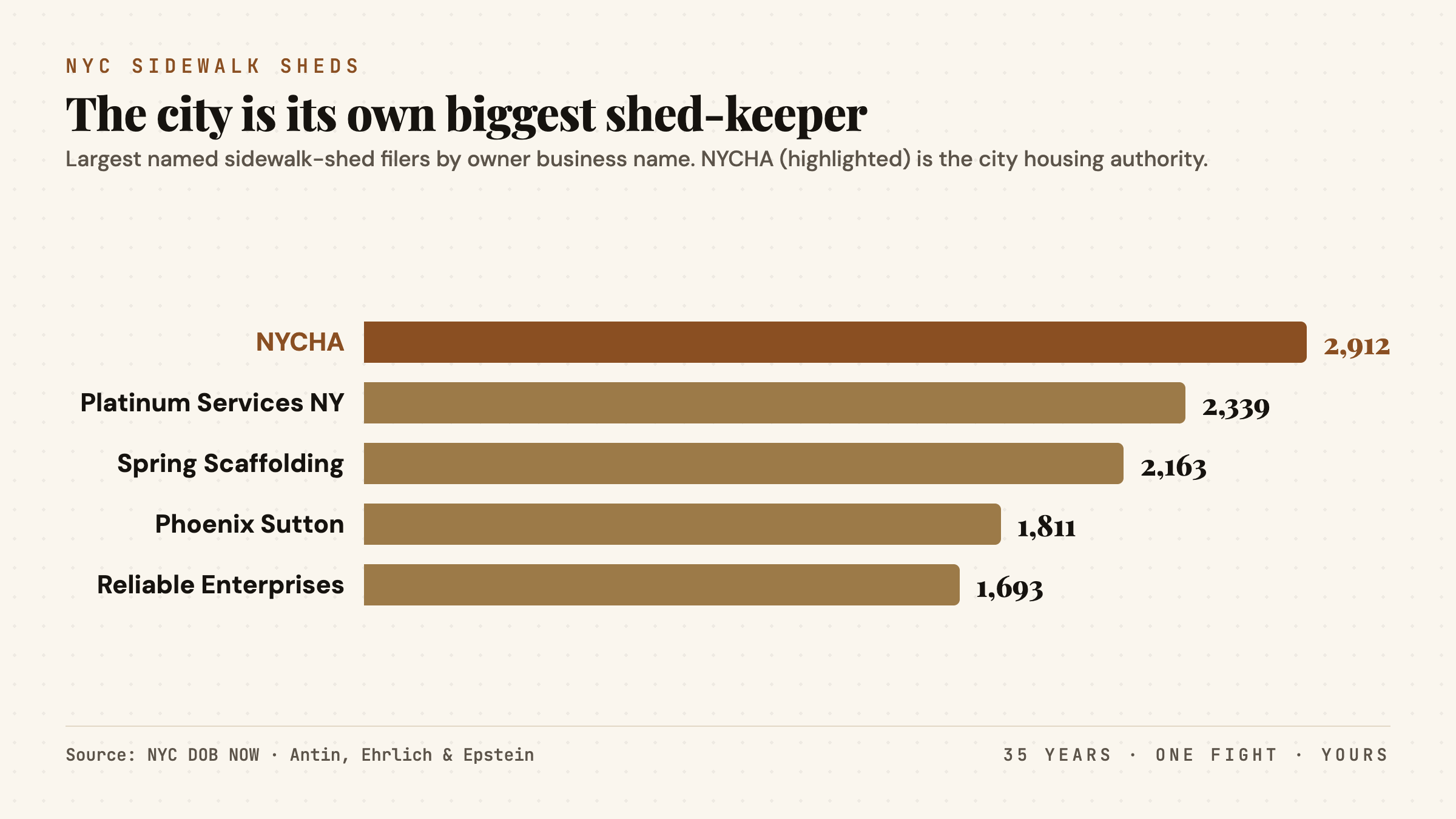
Largest NYC sidewalk-shed filers by owner business name, from NYC Open Data DOB NOW Build records.
What this means for New Yorkers
If you were hurt under a sidewalk shed, the structure was somebody’s responsibility. A person struck by debris that fell through or off a shed deck, hurt when a shed or its scaffold gave way, or injured tripping on an unlit base plate has a claim against the owner of the building and the company that put up and maintained the shed. The permit record names those parties. The filing data we pulled shows who held the shed and how long it had been standing, and a shed that has stood far past its useful life is a shed whose maintenance has usually lapsed.
The legal frame matters here. Workers repairing the facade above are covered by New York’s Labor Law 240 and 241, which hold owners and contractors strictly liable for certain elevation-related and construction hazards. A pedestrian on the sidewalk is not a worker, so that pedestrian’s case runs on common-law negligence and the city’s own shed-maintenance and lighting requirements. The questions are who controlled the shed, what condition it was in, and whether the responsible parties knew or should have known about the defect. The longer a shed has stood, the easier those questions usually are to answer.
New York keeps promising to take its sheds down. Until the permit data turns, the obligation runs the other way: every owner who leaves a shed up owes the people walking under it a structure that is lit, maintained, and safe.
Protection that never comes down stops being protection.
Authored by Jeffrey S. Antin, Managing Partner at Antin, Ehrlich & Epstein, LLP. Last updated June 17, 2026.