

NYC’s Department of Health and Mental Hygiene logged 34,033 reportable dog bites between 2015 and 2024, with 4,041 in 2024 alone. That single year was the highest annual count of the decade and a 58% jump over the 2020 pandemic-year low of 2,551. The reporting baseline didn’t change. The bite count did.
Methodology
The bite counts here come from the NYC Department of Health and Mental Hygiene Dog Bite Data feed on NYC Open Data, accessed May 2026, covering calendar years 2015 through 2024. N = 34,033 records. Each record carries date of bite, borough, ZIP code, plus owner-reported breed, gender, age, and spay or neuter status where available.
Sample frame: all bites reported to DOHMH under NYC Health Code Article 11, which requires every animal bite involving a human to be reported within 24 hours. Records flagged “Other” borough (1,482) represent bites reported on behalf of NYC residents bitten outside the five boroughs or with incomplete location data, and we hold those out of the borough breakdown. Breed identification is owner-reported at the time of the bite report, which means “UNKNOWN” appears on 6,153 records and Pit Bull descriptors split across multiple labels (Pit Bull, American Pit Bull Terrier/Pit Bull, American Pit Bull Mix).
NYC Bite Reports Hit a Decade High in 2024
Bite reports rose every year from 2020 forward. 2020 logged 2,551, the lowest year of the decade. 2021 climbed to 2,921. 2022 hit 3,464. 2023 reached 3,865. 2024 closed at 4,041, the highest annual count on record. Across the full 2015 to 2024 window, NYC averaged 3,403 reportable bites per year.
The 2024 number isn’t a quirk of the calendar. Three structural reasons line up with the climb. Pandemic dog adoptions surged in 2020 and 2021, bringing inexperienced households into ownership during a window when training classes and veterinary socialization visits ran on remote schedules. Off-leash enforcement in NYC parks has remained a complaint volume topic at every Community Board meeting tracked through 2024. And NYC Health Code Article 161 dog-licensing compliance runs low citywide, with most dogs unlicensed, which means the city has limited line-of-sight to which animals it actually has.
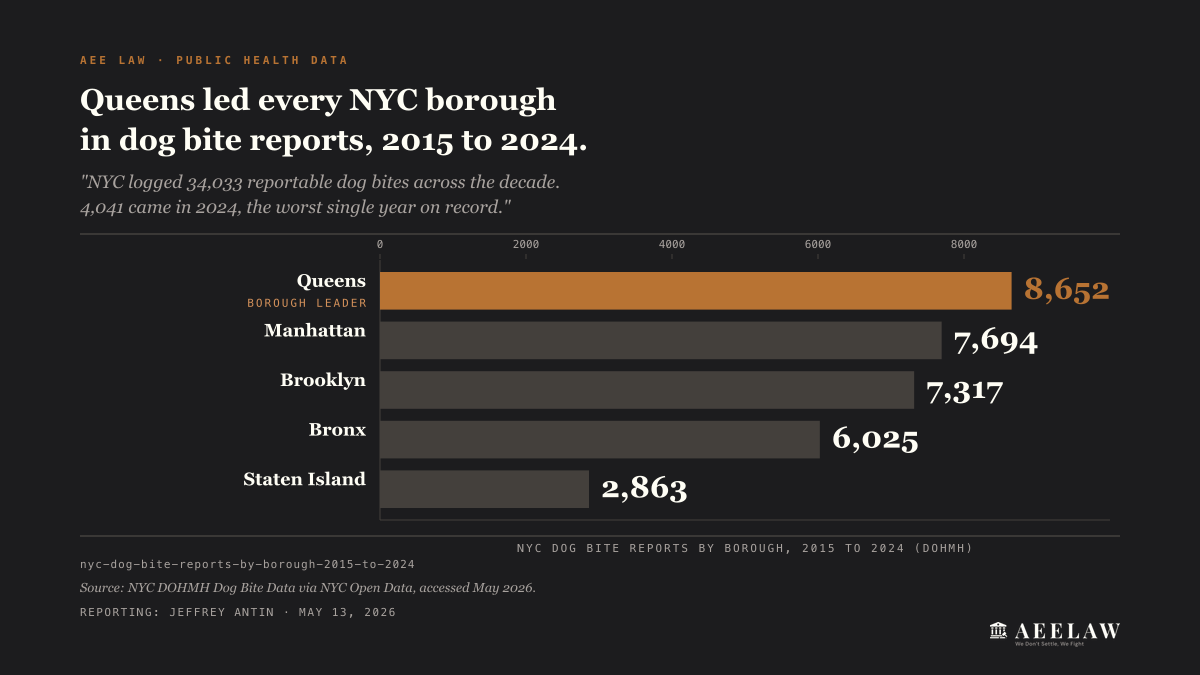
Queens led every borough across the full decade at 8,652 reported bites. Manhattan followed at 7,694, Brooklyn at 7,317, the Bronx at 6,025, and Staten Island at 2,863. The borough order isn’t a population leaderboard. Manhattan ranks second in bites despite holding fewer residents than Brooklyn or Queens because population density, sidewalk congestion, and tourist exposure all concentrate dog-to-stranger contact per square mile.
ZIP 10029 in East Harlem Is the Top Single Postal Zone
The single-ZIP leader across the decade is 10029, the East Harlem corridor running from East 96th to East 124th between Fifth and the East River, at 521 reported bites. Twelve more ZIPs cross the 250-bite threshold across the decade: 11208 in East New York (367), 10128 on the Upper East Side (361), 10065 on the Upper East Side (329), 11368 in Corona (315), 10314 in Mid-Island Staten Island (306), 11377 in Woodside (281), 10312 in South Shore Staten Island (257), 11207 in East New York and Brownsville (256), 10467 in Norwood in the Bronx (252), 10456 in Morrisania in the Bronx (250), 11234 in Bergen Beach and Mill Basin in Brooklyn (250), and 11373 in Elmhurst in Queens (250).
The high-density ZIPs aren’t all the same shape. East Harlem (10029) and the Upper East Side (10128, 10065) sit at the top of Manhattan’s density curve and the bite numbers track that density. East New York (11208, 11207) and Corona (11368) are denser-than-average outer-borough ZIPs with high public housing concentration. The Staten Island entries (10314, 10312) cover lower-density single-family zones where off-leash backyard incidents and visitor bites both contribute. No single explanatory variable carries every leader ZIP.
Those 13 ZIPs at the 250-bite threshold together account for 3,995 reports, or 11.7% of the citywide total. The bite distribution doesn’t pinch into a few postal zones. It spreads across most of the five boroughs, which means the prevention pressure isn’t a hot-spot fix.
Pit Bull Sits at the Top of the Breed Column
Breed is owner-reported at the bite-report stage and isn’t always cleanly tagged. Across the 34,033 records, 6,153 list “UNKNOWN” breed and another roughly 1,900 split across “MIXED,” “MIXED BREED,” and “Mixed/Other.” The top named breeds with cleaner identification: Pit Bull at 5,853, Shih Tzu at 949, German Shepherd at 940, Chihuahua at 869, Yorkshire Terrier at 654, Siberian Husky at 507, Rottweiler at 494, and Maltese at 475. When the three Pit Bull label variants are merged (Pit Bull, American Pit Bull Terrier/Pit Bull, American Pit Bull Mix), the combined count reaches 7,048, the highest breed concentration in the file by a factor of seven.
Owner-reported breed data has well-documented identification limits. A 2015 American Veterinary Society of Animal Behavior position statement and a series of veterinary surveys have shown that visual identification of mixed-breed dogs by owners disagrees with DNA testing more than half the time, especially for dogs labeled “Pit Bull.” The bite count for that label tracks both genuine Pit Bull bites and bites by stocky-build mixes assigned to that bucket. That said, the gap between the top label and every other named breed is large enough that mislabeling doesn’t erase the trend.
NYC has no breed-specific legislation. NY State expressly preempted breed bans in 1996 under NY Agriculture and Markets Law § 107(5), which forbids local laws from regulating dogs in a manner that is breed-specific. The result is that the bite report data identifies a breed pattern that the law refuses to treat as legally relevant.
The Three Paths That Decide a NYC Bite Case
New York’s dog bite framework now runs on three tracks. First, NY Agriculture and Markets Law § 123 creates a strict-liability mechanism. Once a dog is judicially adjudicated dangerous in the dangerous-dog proceeding that § 123(2) sets out, the owner becomes strictly liable for the bitten person’s medical and veterinary costs. That adjudication can be triggered after the bite by the person bitten, the dog control officer, or a peace officer petitioning a court of competent jurisdiction.
Second, every other element of damages, including pain and suffering, lost wages, future medical care, and emotional distress, runs on the common-law rule the New York Court of Appeals set in Collier v. Zambito, 1 N.Y.3d 444 (2004) and Bard v. Jahnke, 6 N.Y.3d 592 (2006). Under that rule, the bite plaintiff proves the owner knew or should have known the dog had vicious propensities. Knowledge can come from prior bites, growling at strangers, lunging on a leash, biting other animals, or being kept as a guard dog. Before 2025, a victim who couldn’t prove that knowledge had no claim at all, even when the injury was severe.
That changed on April 17, 2025. In Flanders v. Goodfellow, 44 N.Y.3d 57 (2025), the New York Court of Appeals overruled Bard v. Jahnke to the extent it barred a common-law negligence claim against the owner of a domestic animal. A bite victim now has a choice. They can still pursue strict liability when the owner knew or should have known the dog was dangerous. Or they can sue in ordinary negligence, proving the owner failed to use reasonable care to prevent a foreseeable bite. The earlier rule from Doerr v. Goldsmith, 25 N.Y.3d 1114 (2015), which blocked negligence claims for non-vicious behavior, no longer controls after Flanders.
That hybrid framework changes how a bite case gets built. The medical record alone, without proof of the dog’s prior history, isn’t enough to recover the full damages. Skilled bite-case investigation pulls 311 complaint records, NYC DOHMH dangerous dog complaint files, prior bite reports against the same animal, and neighbor witness statements about the dog’s earlier behavior. NYC’s 311 system carries an “Animal in a Park” and “Animal Abuse” complaint stream that often turns up the priors that the formal bite record doesn’t capture.
What This Means for People Bitten in NYC
If you were bitten by a dog in NYC, three points the data above changes the calculus on.
The bite is supposed to be reported. NYC Health Code Article 11 requires the bite to be reported to DOHMH within 24 hours, typically by the treating physician or ER. That report creates the official record that anchors any later civil claim and triggers the rabies-exposure protocol. If the bite wasn’t reported, the bitten person or someone on their behalf can report it directly to 311 or DOHMH after the fact.
A dangerous-dog adjudication is a separate proceeding from a civil claim. Filing a § 123 dangerous-dog complaint in the local court starts the process. A successful adjudication triggers § 123’s strict-liability rule for medical and veterinary costs, which is the floor of any later civil recovery. The civil case for pain, suffering, and lost wages runs separately, on the vicious-propensity rule or, since Flanders, on ordinary negligence.
Homeowner and renter insurance is the practical funding source. Most NYC dog bite recoveries don’t come from the dog owner’s personal assets. They come from a homeowner, condo, co-op, or renter insurance policy that names the owner. Some policies exclude specified breeds. Some exclude all dogs. Reading the declarations page early in the case identifies whether coverage exists. Where coverage exists, the policy limits frequently cap the recovery before damages would otherwise hit higher.
NYC’s bite report file is large, growing, and uneven across the five boroughs. The legal framework asks more from the bite plaintiff than a pure strict-liability state would. Both can be true at once.
One bite, three paths to recovery.