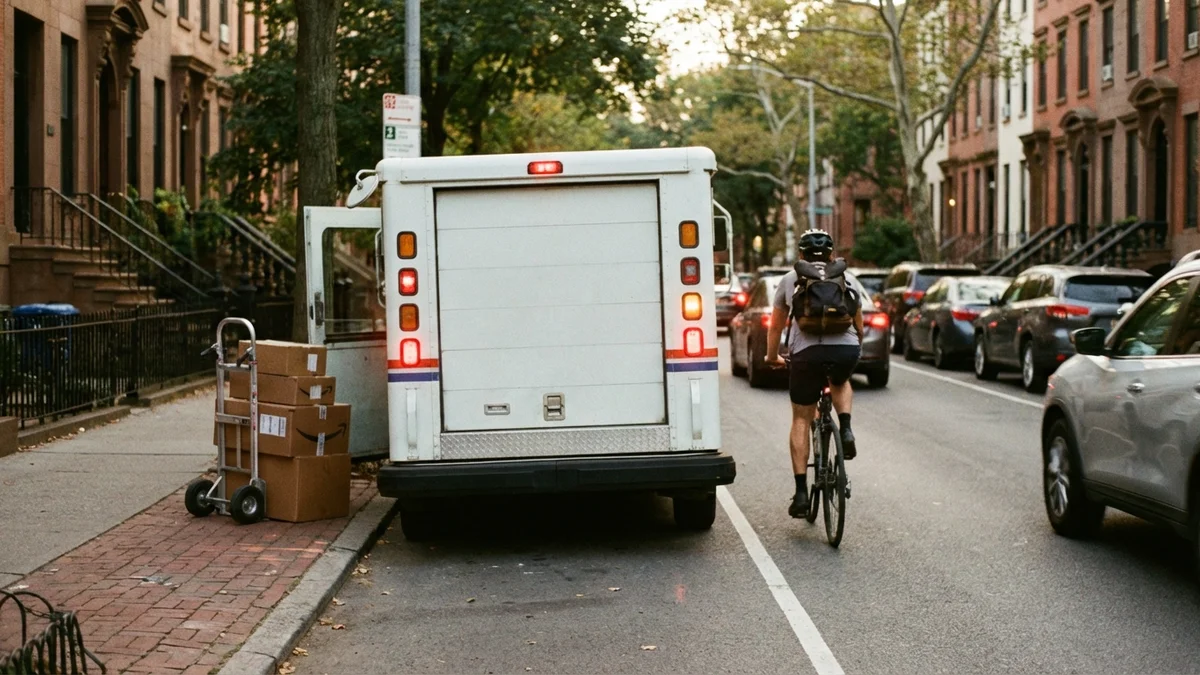
New York City receives approximately 2.5 million package deliveries every day. Before the pandemic, that number was 1.8 million. The growth is driven overwhelmingly by Amazon, which now ships more packages annually than UPS: 6.3 billion in 2024, up from 2 billion in 2019.
Amazon operates 42 facilities in New York City totaling 4.8 million square feet, employs approximately 20,000 workers, and pushes roughly 500,000 packages per day through the city’s streets via a network of contracted drivers.
Crash data reflects that volume. In November 2025, the NYC Comptroller’s report, “Fast Shipping. Slow Justice”, found that truck-related crashes increased 146% and truck-injury crashes increased 137% in areas near last-mile delivery facilities. Seventy-eight percent of neighborhoods near these facilities saw increased injury-causing crashes.
We pulled the crash records and the contractor structure to work out who is actually on the hook when an Amazon delivery van hits someone in New York City.
The DSP Model: Amazon’s Liability Shield
Amazon does not employ the drivers who deliver its packages. Instead, it contracts with Delivery Service Partners (DSPs), small companies that hire and manage drivers, purchase or lease Amazon-branded vans, and carry their own commercial insurance.
This is by design. The DSP structure creates a legal barrier between Amazon and the driver who causes an accident. When an Amazon van hits a pedestrian, the initial liable party is the DSP company, not Amazon.
But the degree of control Amazon exerts over DSP operations complicates this arrangement:
- Amazon dictates delivery routes and stop sequences
- Amazon sets package-per-hour performance targets
- Amazon specifies the vehicles DSPs must use
- Amazon monitors drivers through in-van cameras (Netradyne Driveri system)
- Amazon can and does terminate DSP contracts for underperformance
- Amazon controls the branding on every vehicle
Courts look at this level of control when deciding whether Amazon is liable despite the contractor label. Under New York law, the key question: does the hiring entity control the “manner, means, and method” of the work? Amazon’s control over DSP drivers is extensive and well-documented.
What the Federal Data Shows
A CBS News investigation using Federal Motor Carrier Safety Administration (FMCSA) records found that Amazon’s contracted carriers had unsafe driving violation rates at least 89% higher than non-Amazon carriers in every month over a six-year period.
Over a two-year window, at least 57 people died in crashes involving Amazon’s federally regulated carriers.
A separate U.S. Senate HELP Committee investigation (2024) found that during Prime Day 2019, Amazon’s total injury rate hit nearly 45 per 100 workers, based on Amazon’s own internal data. Senate investigators also found that Amazon manipulates OSHA injury reporting data.
The NYC Comptroller’s report puts the DSP driver injury rate at 9.2 per 100 workers for 2023-2024, compared to a national private-sector average of 2.4. Nearly four times the industry norm.
NYC Delivery Crash Data
The Comptroller’s “Fast Shipping. Slow Justice” report analyzed crash data around NYC’s last-mile delivery facilities and found:
- 146% increase in truck-related crashes near delivery facilities
- 137% increase in truck-injury crashes near delivery facilities
- 78% of areas near facilities saw increased injury-causing crashes
- Daily NYC deliveries grew from 1.8 million (pre-pandemic) to 2.5 million (2024)
One critical gap: the report does not break out Amazon-specific crash data. Police reports record the DSP company name, not Amazon.
Amazon’s name rarely appears in crash databases even when the vehicle is Amazon-branded and the driver is delivering Amazon packages on an Amazon-dictated route. That is a feature of the contractor model, not a bug.
Notable NYC Incidents
June 2023, Gramercy Park
Malcolm Livesey, 18, was killed while cycling at First Avenue and 17th Street when struck by an all-electric Amazon delivery truck. The truck had no license plates.
Staten Island, Gulf Avenue
Leony Salcedo-Chevalier, who worked for a third-party contractor at an Amazon facility, was killed when struck by a reversing truck on the site.
Queens (Espinal case)
A judge found Amazon 100% responsible for rear-ending a parked car, rejecting the DSP liability shield.
Courts Are Piercing the DSP Shield
Amazon’s contractor structure is increasingly failing to hold up in court:
New York’s Employment Presumption
Under New York’s Commercial Goods Transportation Industry Fair Play Act, a commercial-goods delivery driver is presumed to be an employee rather than an independent contractor. To rebut that presumption, the contractor must satisfy a strict ABC test or an 11-criteria separate-business-entity test.
This is a wage-and-classification statute, not a crash-liability rule, but the same evidence of control, Amazon’s dictation of routes, schedules, vehicles, and performance targets, also drives the negligent-hiring, negligent-entrustment, and retained-control theories that reach Amazon directly in an injury case.
The Volume Problem
Package volume has more than tripled since 2019. More packages means more vans on NYC streets, running under time pressure, in a city with narrow lanes, double-parked cars, bike lanes, and 8.3 million pedestrians.
Scale of the operation:
- 6.3 billion packages shipped nationally in 2024 (up from 2 billion in 2019)
- 42 facilities in NYC (warehouses, delivery stations, sorting centers)
- 500,000 packages per day through NYC
- ~20,000 workers across NYC facilities
For comparison, UPS shipped fewer packages nationally than Amazon in 2024. FedEx shipped even fewer. Amazon is now the largest delivery operation in the United States, and its growth in NYC is concentrated in the same neighborhoods where crash rates are spiking.
What This Means for Injury Claims
These claims are more complex than a standard car accident case. Several layers to navigate:
Identifying the Real Defendant
The police report lists the DSP company. The vehicle has Amazon branding. The driver delivers Amazon packages on an Amazon route. Sorting out liability requires investigating the DSP contract, Amazon’s control, and the crash itself.
Preserving Evidence
Delivery vans have Netradyne Driveri cameras that record both exterior and interior footage. Amazon controls this footage. A litigation hold letter to both the DSP and Amazon should go out immediately after an accident.
Multiple Insurance Layers
DSPs carry their own commercial auto insurance, but Amazon also maintains excess liability policies. The available insurance coverage in an Amazon delivery accident can be substantially higher than a standard vehicle accident.
Time Pressure as a Cause
Amazon’s package-per-hour targets create documented pressure on drivers. If time pressure contributed to the accident, Amazon’s performance metrics become relevant evidence of negligence.
New York’s Commercial Vehicle Regulations
Amazon delivery vans operating in NYC must comply with city commercial vehicle rules, including designated truck routes, loading zone requirements, and speed restrictions. Violations of these regulations at the time of an accident strengthen negligence claims.