NYC’s Department of Housing Preservation and Development issued 111,509 lead-paint and lead-related housing violations between January 2018 and March 2023. That’s the count from the City Council’s Lead Data Dashboard, the public-records aggregation of every Class C lead hazard HPD has cited under Local Law 1 of 2004. The monthly violation count climbed from 1,181 in January 2018 to 2,838 in March 2023, a 140% increase across five years.
Methodology
The HPD violation totals here come from the NYC Council Lead Data Dashboard, the City Council’s public-records aggregation of HPD’s Housing Maintenance Code violations classified as lead-paint or lead-related hazards. The dashboard covers January 2018 through March 2023. Sample frame: every HPD-issued Class C (immediately hazardous) lead violation tagged to a Building Identification Number citywide.
The borough-rate figure of 73 violations per 1,000 residential units reflects the Bronx aggregate across the same window. Housing-court litigation counts cover January 2006 through March 2023, scoped to lead-paint-related HP actions filed in NYC Housing Court.
The Bronx Carries the Lead-Paint Map
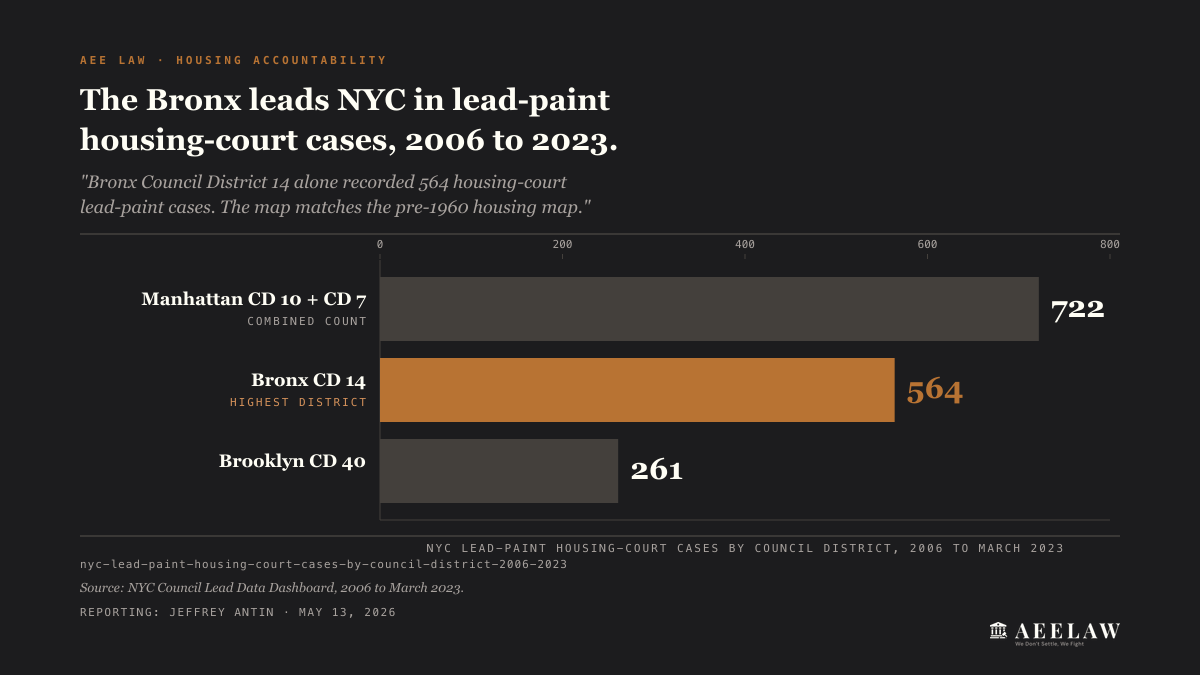
The Bronx leads every borough in lead-paint enforcement metrics. The NYC Council Lead Data Dashboard reports 73 lead-related housing violations per 1,000 residential units in the Bronx, the highest rate citywide. Council District 14, which covers parts of Fordham, Bedford Park, and University Heights, recorded 564 housing-court lead-paint cases between 2006 and March 2023. That’s the highest single-district count in the city.
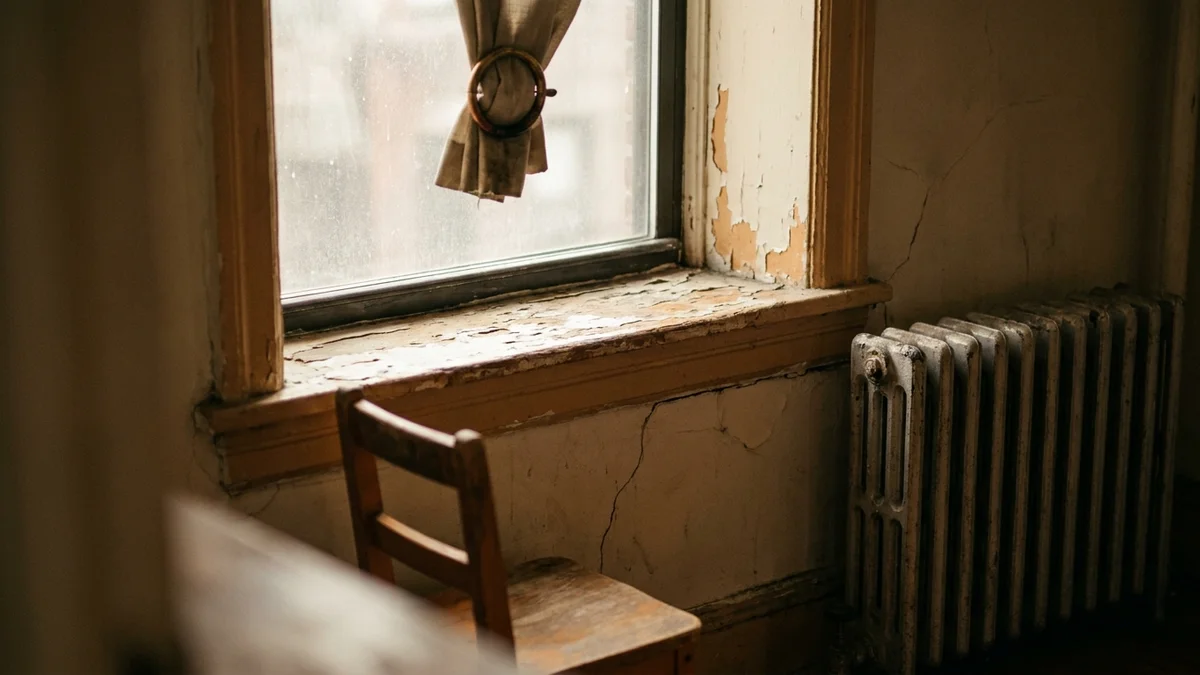
The Bronx leads because its housing stock leads. Roughly two-thirds of Bronx residential units predate 1960, and Local Law 1 of 2004 establishes a presumption of lead-based paint in any NYC dwelling built before 1960. That presumption shifts the burden onto the owner. If the unit has a child under six, the owner must annually inspect, must remediate any peeling or deteriorated paint within 21 days of notice, and must use EPA-certified abatement workers. Failure to comply is not a paperwork problem. It triggers a Class C immediately hazardous HPD violation, carries city civil penalties of up to $1,500 per violation, and becomes powerful evidence of the landlord’s notice and breach if a child is later diagnosed with elevated blood lead.
The map looks identical to the Section 1983 map and the construction-fatality map and the asthma-hospitalization map. The same housing stock, the same families, the same enforcement gap. Lead-paint violations aren’t an outlier dataset. They’re another readout of the same underlying problem.
Monthly Violations Climbed 140% in Five Years
In January 2018, HPD issued 1,181 lead-paint violations citywide. In March 2023, the count was 2,838. The growth wasn’t linear. It accelerated after Local Law 66 of 2019 strengthened inspection requirements and lowered the actionable lead-dust threshold. The violation curve is a function of enforcement intensity layered over a steady underlying hazard inventory.
The cumulative count across the five-year window: 111,509 lead-paint and lead-related housing violations. Each one represents a documented hazard in a specific apartment with a specific address tied to a specific landlord. None of that data is hypothetical. HPD recorded every one of those violations, served notice on every owner, and tracks compliance through its own enforcement portal.
What the violation count doesn’t capture: the apartments HPD never inspected. Local Law 1 inspection is complaint-driven. If a tenant doesn’t call 311, doesn’t know the building was built before 1960, doesn’t know there’s a child under six in the apartment next door, the hazard sits. The 111,509 number is the floor, not the ceiling.
The Court Docket Names the Landlords
Between 2006 and March 2023, 3,714 NYC building owners appeared in housing-court lead-paint cases. The Council’s dashboard tracks these by Council District. Bronx Council District 14 led at 564 cases. Manhattan Council Districts 10 and 7 combined for 722 cases. Brooklyn’s Council District 40 recorded 261.
The peak year was 2008, when 975 lead-paint housing-court cases were filed citywide. The count fell to 29 by March 2023. The decline reflects the rise of administrative enforcement (HPD violations issued without filing in court) rather than fewer hazards. HPD moved most of its lead-paint enforcement out of court and into its own administrative pipeline, which closes faster but generates less public docketing.
For people injured by lead exposure, the court docket is still the venue. A claim against a NYC landlord for lead-paint poisoning in a child runs under three statutes braided together: NYC Administrative Code Section 27-2056 (the Local Law 1 of 2004 framework), New York State Public Health Law Article 13 Title 10 (Lead Poisoning Prevention and Control), and common-law premises liability. Local Law 1 establishes the duty. Public Health Law sets the state-level reporting trigger when a child’s blood lead reaches 3.5 micrograms per deciliter, the CDC reference value adopted in October 2021. Premises liability supplies the damages framework.
A properly proved lead-paint injury case runs on common-law negligence and premises liability, not on Local Law 1’s penalty scheme, which only funds city fines. The recovery stacks economic damages (medical, future special education, future lost earning capacity) and non-economic damages (pain, suffering, cognitive impairment). The HPD violation history is what proves the landlord’s notice and breach. Landlords settle these cases when the file shows the violation history was already on record.
What the Children Are Carrying
The CDC’s blood lead reference value is 3.5 micrograms per deciliter. That’s not a safety threshold. The CDC’s own guidance states there is no known safe blood lead level in children, and even levels below the reference value can affect brain development, learning, and behavior.
NYC DOHMH reports that blood-lead testing of young children has climbed sharply over the past decade under City Council oversight. The testing gap narrowed. The hazard-remediation gap has not.
When a child’s blood test crosses the reference value, the public-health response is well-defined: NYC DOHMH refers the case to HPD for an environmental inspection of the home. If lead paint is found, the owner must remediate. If the owner doesn’t, HPD escalates to a Class C violation and, in some cases, emergency repair. The legal-liability response is also well-defined, but slower. The civil-damages clock starts when the child is harmed.
For a NYC family whose child’s blood test comes back elevated, the next 90 days are the highest-stakes window in the entire claim. HPD inspection records, DOHMH home-environment reports, and the landlord’s prior violation history all become discoverable. Filing within that window preserves the evidence chain that links the apartment’s lead-paint condition to the child’s exposure.
What This Means for NYC Families
If your child is diagnosed with an elevated blood lead level in NYC, three points the data above changes:
The landlord’s prior-violation record is public. HPD violation history, housing-court filings, and NYC Open Data lead-hazard registries are all retrievable by address. A landlord with prior open lead violations on the building has on-record notice of the hazard. That notice element drives the negligence analysis.
The violation record carries legal weight. NYC Administrative Code Section 27-2056 imposes affirmative inspection and remediation duties on the landlord, and an open Class C violation is documented proof the landlord knew and failed to act. That notice element drives the damages a child can recover under common-law negligence.
The two statutory tracks are parallel, not alternative. A claim runs simultaneously under Local Law 1 (the city framework) and NY Public Health Law Article 13 Title 10 (the state framework) plus common-law premises liability. The three tracks read evidence the same way: did the landlord know, did the landlord fix it, and did a child get harmed.
Lead poisoning isn’t an accident. It’s an open violation that didn’t get closed.